Showing posts with label reformed. Show all posts
Saturday, July 9, 2011
C. J. Mahaney stepping down
I've posted twice before regarding SGM Sovereign Grace Ministries which was a look at structural problems in their discipline process and Sovereign Grace Ministries' use of demotivational methods which was a particular abusive technique they made heavy use of which was a distinctive. The leader of SGM C. J. Mahaney is stepping down. Note on his blog, note from the board, leaked documents regarding the dispute. C.J. heads up Together for the Gospel, and is bringing in his friends from that organization to guide him during his stepping down.
I'd like to congratulate the people at the various SGM blogs: SGM Survivors, SGM Refuge, Spiritual Tyranny, Wartburg Watch, SGM Uncensored . Mahaney has been a major leader in the whole New Calvinism movement. So far the issues being discussed are internal problems regarding Mahaney creating problems with other pastors, rather than the more widespread longstanding pattern of abuse of membership. Its the authoritarian culture that's the problem, Mahaney, as dictators go is not unusually bad. Part of being a dictator is terrorizing or at least intimidating those around you, that's the job. If you don't like the behavior don't create authoritarian structures that necessitate it.
So the doctrinal and structural problems remain. But what has changed is the problems are being widely talked about on the web. When Joshua Harris rereleased Boy meets Girl the fact that 2 of the couples in his previous edition were getting divorced was public knowledge. Stories about church facilitated sexual abuses have leaked. Stories about embezzlement have leaked. Stories about wrongful terminations, ruined marriages, and how miserable so many women are in SGM have leaked. SGM is not able to act in secrecy anymore and the blogs above, and several others that were active over the last few years are responsible.
I don't have much to say other than this was an important step in people banding together to try and prevent the sorts of rampant abuses in authoritarian churches. And the offer I made to Josh Harris 3 years ago remains open. If SGM wants to start trying to build structures to stop abuses rather than to facilitate them I'd love to engage in constructive conversation.
____
Post Script (Feb 2, 2012)
It appears that way these allegations were handled was to create a biased board that investigated it and exonerate C.J. Mahaney. The results are still not published, but the underlying facts to present Mahaney as having threatened someone to keep them silent years ago. I'm not sure what is going to ever get published but I'll update here as more information becomes available:
____
See also:
I'd like to congratulate the people at the various SGM blogs: SGM Survivors, SGM Refuge, Spiritual Tyranny, Wartburg Watch, SGM Uncensored . Mahaney has been a major leader in the whole New Calvinism movement. So far the issues being discussed are internal problems regarding Mahaney creating problems with other pastors, rather than the more widespread longstanding pattern of abuse of membership. Its the authoritarian culture that's the problem, Mahaney, as dictators go is not unusually bad. Part of being a dictator is terrorizing or at least intimidating those around you, that's the job. If you don't like the behavior don't create authoritarian structures that necessitate it.
So the doctrinal and structural problems remain. But what has changed is the problems are being widely talked about on the web. When Joshua Harris rereleased Boy meets Girl the fact that 2 of the couples in his previous edition were getting divorced was public knowledge. Stories about church facilitated sexual abuses have leaked. Stories about embezzlement have leaked. Stories about wrongful terminations, ruined marriages, and how miserable so many women are in SGM have leaked. SGM is not able to act in secrecy anymore and the blogs above, and several others that were active over the last few years are responsible.
I don't have much to say other than this was an important step in people banding together to try and prevent the sorts of rampant abuses in authoritarian churches. And the offer I made to Josh Harris 3 years ago remains open. If SGM wants to start trying to build structures to stop abuses rather than to facilitate them I'd love to engage in constructive conversation.
____
Post Script (Feb 2, 2012)
It appears that way these allegations were handled was to create a biased board that investigated it and exonerate C.J. Mahaney. The results are still not published, but the underlying facts to present Mahaney as having threatened someone to keep them silent years ago. I'm not sure what is going to ever get published but I'll update here as more information becomes available:
____
See also:
Labels:
evangelical,
feminism,
fundamentalism,
minister,
news,
reformed,
Sovereign Grace
Friday, July 17, 2009
4 marks of a hellbound man
So I'm checking out some of latest sermon by John MacArthur and he has one called 4 marks of a hellbound man. In it he lists the 4 characteristics that he believes lead to damnation:- Self righteous
- Worldliness
- Unbelieving
- Willfully ignorance
Tell me that Mr. "Truth War", "Lordship salvation", "Charismatic Chaos"... didn't just preach a sermon against self righteousness and willful ignorance. John, please turn your bible to Matthew 24... "Woe to you, hypocrites"...
See Also:
Monday, July 13, 2009
Voice Translation
The Voice translation is a new translation by Chris Seay and co. The group's goal in the project was to produce a “holistic,” “beautiful,” “sensitive” and “balanced” New Testament that present-day readers could identify with. In short their goal was to produce a modern liturgical version, designed to be read out-loud or at the chapter level. To be excellent for quick reading or public reading the bible needs to avoid complex vocal constructions, which generally means short sentences or clauses and connection of ideas. Also obviously contemporary language. Such a bible would not designed for line by line study.In addition to the use of modern language and aggressive punctuation; the way The Voice translation creates a verbal flow is by using a a play-like format with italicized in-text explanations. There is also occasional commentary to pull the structure together dramatically. Each book in the New Testament is preceded by a brief introduction explaining its background and significance. You can see this in the free online version of the Voice's John.
What is interesting about this new translation is that “writers rather than the scholars were tasked with producing the first draft.” Then, scholars, “working from the Greek or Hebrew, adjusted the translation to capture the nuances of the original.” That is typically a bible is written by translators and then edited. This bible was written and then translational issues were corrected. The puts the focus is on flow not on detailed accuracy. I think the accuracy is fine I recommend this bible for its intended uses. In particular:
- This is a great choice for a first read of the bible. The text notes assume unfamiliarity which is rare in most study bibles. It reads as almost as easily as The Message and keeps the focus on the text itself unlike any study bibles.
- This is one of the very few bibles I know that work well for informal out-loud reading. There are huge differences between what is retained vocally vs. visually. For preaching through a large section of a chapter or any other reading outloud.
- This out-loud readability makes it a good choice for an informal liturgy.
So I fully concur with Thomas Nelson's press release:
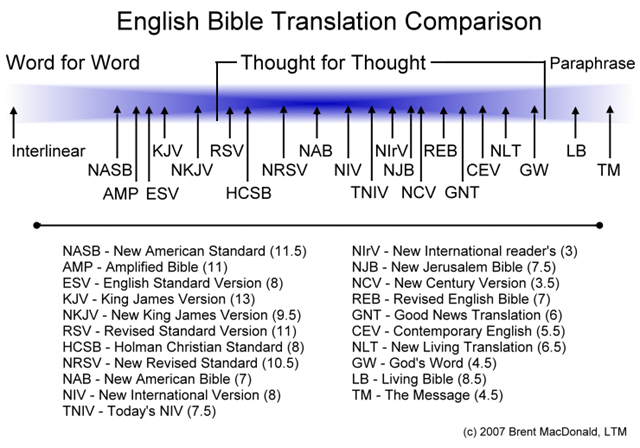
This focus on flow and readability however does come at a cost. Since, there aren't many reviews of the The Voice I hope my regular readers will forgive me if I'm a I'll be a bit more pedantic than normal and assume some readers not familiar with translation philosophies might be reading this review. In translation the closer you stay to the text the more accurately you capture the original structure but the less you can accurately capture the meaning. As you move away from the original structure you are able to better capture meaning. As you move even further away from the original structure you in effect rephrase the ideas of the text in your own language. It ceases to be translation and instead becomes a paraphrase. The graphic below shows the major translations as they move from the most literal, interlinears which preserve Greek word order to formal translations which preserve the positions of phrases with a sentence, to dynamic which preserver the order sentences to paraphrase which preserve the order of ideas.And we have a significant change in the liturgy of many churches that excludes that appointed time allotted for the specific reading aloud of the Sacred Text (sometimes in concert with a Lexionary and sometimes just as a focus where the whole congregation stands for the reading of the Word). Both of these changes have been made at the sacrifice of the oral experience of the Bible....The Nelson team created The Voice translation with this perspective in mind. Specifically, the screen-play format, the linguistic and historical information included in italics, and the contextualization that is present in the commentary makes The Voice ideal for public reading and understanding. (Thomas Nelson press release)
I personally put translation into 9 groups with the voice in the 8th group (loose dynamic):
- Hebrew/Greek, Diglot or Hebrew/Greek Reader (NA27, Majority /Byzantine Text, Textus Receptus, MT-Heb)
- Interlinear translation (Brown & Comfort, Marshall, McReynolds, Concordant interlinear)
- Highly literal (AMP, NASB, YLT, Mounce, Concordant)
- Formal (ESV, KJV, ASV, NKJV, NRSV, RSV)
- Balanced (TNIV, NET, NIV, HCSB, Price)
- Tight Dynamic (REB, NAB)
- Dynamic (NEB, NJB, CEV, NLTse, Gaus)
- Loose dynamic (NLT1ed, GNB, Voice)
- Paraphase (MSG, TLB, TAB, JBP)
While I think the formatting works very well in all aspects except one. The Voice footnotes aren't numbered in the text, instead a generic asterisk is used and the verse referred to in the note. You can see an example of this in the John chapter on page 161 (John 1:23-8). I think this format is difficult, it can be unclear which phrase the note is applying to. But even in the best case this requires looking backwards through the text for the verse number, looking down to find the associated note and then on a few pages having to looking up to find the chapter number. Given the demographics of The Voice I'd assume most people are comfortable with standard footnoting conventions, this seems like a mistake. Footnotes are used for translation commentary, glossary and cross reference so they aren't rare though not overwhelming either.
In terms of the internet, this is an emerging church product so basically conservative reformed Christians bash it. No one has really written a decent reply so, I guess I will. The most detailed and accurate review is a hostile one by Chris Rosebrough of Extreme Theology (review part1 part2). He's an ESV guy so not unexpectedly he hates the theology of the The Voice. A good example (using one from the free sample in case you want to check context) is John 1:13:
- Brown & Comfort (literal): The ones not of bloods nor of [the] will of flesh nor of [the] will of a husband but of God were born.
- ESV (formal): who were born, not of blood, nor the of the will of the flesh, nor of the will of man, but of God.
- NET (mediating): children not born by human parents or by human desire or a husband’s decision, but by God.
- NLT (dynamic): They were reborn -- not of a physical birth resulting from human passion or plan, but a birth that comes from God.
- Voice (12-13)(loose dynamic): He bestows this birthright not by human power or initiative but by God's will. Because we are born of this world, we can only be reborn to God by accepting his call.
If I were translating I personally would mix dynamic and formal here. I wouldn't want to lose John's clausal structure but I think the "bloods" to "blood" translation is far too literal, and men rather than husband is just plain wrong. The reference to bloods here is critical, but it relies on the Greek idiom that the fetus grows on blood which is not an American English idiom. You could translate it keeping blood with a technical term, something like "not from fetoplacental circulation" but that shifts the tone too much. The key is to retain the spirit vs. flesh theme from John while changing idioms i.e. being dynamic to be made more explicit. Anne Nyland's The Source Bible does a great job for this verse "children not born from a woman nor from the purposes of the natural realm nor from the purposes of a man, but born from God". Suzanne McCarthy goes similarly with:
children not born from the womb of a mothernor from the will of the natural bodynor from the will of a father,but born from God.
Incidentally I use the ESV here for the formal because Mr. Rosebrough does. The NRSV is similar, "who were born, not of blood or of the will of the flesh of man, but of God." I think it is interesting he picks this verse to defend formal because in my opinion it show the relative merits of both. The ESV's use of "man" over husband here, especially because they use man for so many other Greek words, and then being literal with blood desexualizes and thus loses the connection between the man and the birth. I also don't like the tense changes, the ESV is far too free with tenses for a formal translation. The NET and the NLT IMHO do a much better job in capturing the key connection lost by the ESV. On the other hand the NET/NLT is completely artless, this is a poem loaded with the height of imagery in Christianity and while they capture the meaning better their text is flat.
So what about The Voice? You get the gospel message without any of John's flavor. Those who accept the divine voice of God are reborn as children of God not children of flesh. Mr. Rosebrough in his critique blows a gasket because this is the Arminian gospel and not the Calvinist gospel. The ESV drops the sexual metaphor to emphasize unconditional election and irresistible grace, "not by the will of man", The Voice drops it to emphasize decision theology. From my perspective, both are equally bad. Flesh vs. spirit is one of the five main themes of John, I don't want either Arminius or Calvin to pollute John. But I think this sort of simplification is acceptable in The Voice, this sort of theological commentary in the text is much worse in a bible whose stock and trade is its "essentially literal accuracy" than in a bible whose stock and trade is "first time readers will get it, and it sounds good when read out-loud". By the time someone is ready to discuss limited vs. unlimited atonement I hope that they wouldn't use The Voice, and I believe Chris Seay would agree with me. So with Rosebrough (and again I picked his review because he did the best job in a hostile critique) by seeing what this looks like from the other side might appreciate "turnabout is fair play" and perhaps appreciate why the English Standard Version raises such strong objections.
In short while I've read the hostile reviews, I don't think they address the core function of The Voice. Blow through at normal reading speed John 1:1-14 out-loud with a reader unfamiliar with the them from the ESV and see what someone is actually retains. Or if you want an actually accurate translation the same thing would happen with the NRSV. Then try it with The Voice, I think they would get a lot. This bible is designed for verbal retention from unfamiliar readers, the critiques aren't analyzing assuming the intent it was designed for.
Pieces of The Voice are available separately:
- The Voice, amazon link to main book
- The Voice of Romans: The Gospel According to Paul by Chris Seay
- The Voice of Hebrews: The Mystery of Melchizedek Greg Garrett
- The Voice of Mark: Let Them Listen Greg Garrett
- The Voice of Luke: Not Even Sandals by Brian D. McLaren
- The Last Eyewitness: The Final Week (John 13-21) Chris Seay et al, illustrated
- The Voice Revealed: The True Story of the Last Eyewitness by Chris Seay
- The Voice of Acts: The Dust Off Their Feet: Lessons from the First Church by Chris Seay
- The Voice from on High: God Announces His Son as Israel's Liberating King by Lauren Winner
- Son of the Most High: The Christmas Story Retold in the Voice
As a closing note Thomas Nelson also published The Truth War which is essentially an anti-Emerging church hate piece by MacArthur, as well as the MacArthur Study Bible. I'll give them a lot of credit for being open minded, but I wouldn't want to be around when they have author's Christmas party.
See Also:
- Apologetics Index on the Voice, hostile
- Subversive Influence, friendly review and recommendation as a replacement for The Message.
- The voice of unreason hostile review.
- IndyWatchmen, a "I haven't read it but it is going to suck" warning before it came out.
Friday, July 10, 2009
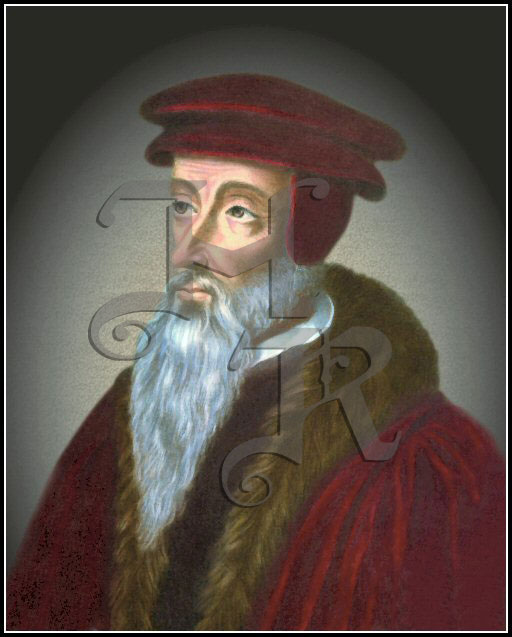
Calvin's 500th birthday
Well I wasn't ready for a big post on Calvinism today. I probably should have been. Calvin is going to have a very good 500th birthday. 20 years ago Arminianism was still the rage and Calvinism quite out of fashion, the fashion has completely shifted. As we have approached the 500th Calvin and TULIP have made a come back. Individually I've never been able to get over the basic problem that I can't believe myself to be morally responsible for anything I have no control over. So: If I am born in a state of Total depravity my rejection of God is not an immoral act. If election is Unconditional then God is the one doing the choosing not man. The morality of choosing or not choosing sits entirely with him not the creation. If atonement is Limited then by preselection then the actual sacrifice is of no meaning to those outside the circle of the eternally elected. It has nothing to do with me anymore than Polish law. If grace is Irresistible then even those saved have no merit. Finally with Perseverance of the saints we remove any merit to the saved for even keeping with the program.
The whole system turns salvation into a lottery. Whether you are saved or not becomes as moral an issue as whether you have brown or blue eyes: something you had no control over, predetermined at birth that you can't change or alter. I don't and shouldn't consider brown or blue eyes a moral issue. While there is fairly good biblical support for these doctrines the net effect of going to this extreme is to rob God's redemption of any sort of morality at all. From a human perspective you are either damned or saved completely at random, like winning at craps. The answer to faith vs. lordship in this system turns out to be neither.
Calvin himself built a nightmare police state (see Calvin the totalitarian) that collapsed because of his petty jealousy, intolerance and inability to address the human condition as it really exists and not as he theorized it should exist (see Anne Le Fert (Questionable Excommunication part 2)).
His current followers have created the most dishonest translation of the bible in a generation to back their views. I've celebrating 21 years on the internet, and when I compare the religious dialogue today to what existed on places like soc.religion.bible, or talk.misc.christian 21 years ago there is no question that a culture of intolerance exists today that did not exist then. Virtually every bible blogger has been banned from one board or another, there is a casual culture of "I don't like that view so I won't allow it to be expressed" that the moderators 2 decades ago (equivalent of blog owners) would have seen as outright anti-American. In society at large the new Calvinism hasn't had a chance to have much impact. But the traditional arminian baptists were firmly in the camp of Roger Williams (founder of Rhode Island) and believed that religion in America (at the time the colonies) should be always consensual. Today ideas like Christian reconstructionism, which argue that the state should enforce religious codes get their legitimacy among Protestants from Calvinism (though the Catholic Church suffers from a similar confusion). The fact that I'm having to write posts like Why not to keep going on with discipline after a member leaves is a direct reflection of a general rejection of Williams core idea that religion is something freely entered into between a person and their god. The very defense that Machen presented at his trial involved Christian liberty from Church taxes (see Excommunication of Gresham Machen for details) and would be rejected by the very churches he has founded today.
The mechanism by which this casual intolerance has spread is the the idea and ideology of presuppositional apologetics, and this has led to this breakdown in communication that existed 2 decades ago. While presuppositional apologetics are fully consistent with TULIP, they create a situation in which one of the parties believes the other is simply not worth discoursing with. The "unelected" are in an permanent irreparable state of delusion. Refutations of Reformed popular ideas don't need to be considered because they are true by presupposition. Counter arguments are satanic, because they contradict these presuppositions. Counter evidence is dismissed because it challenges the sufficiency of scripture. And on and on and on. Under this model dialogue becomes impossible.
It is from the reformed camp that the Patriarchy and complementarian movements are arising, creating a biblical mandate for the causal sexism of the 19th century (see defense against patriarchy part 6).
So on his 500th birthday I'd like to congratulate Calvin on making fashionable once again the absolutely worst aspects of European religion. There is no question that Calvin is one of the great theologians and biblical thinkers of all time. It is unfortunate that his short comings and not his strengths are what we are today confronted with.
Wednesday, July 1, 2009
A defense of Driscoll to the left
This is an unusual post for me. Normally this blog attacks Patriarchy and Complementarianism. My opinion hasn't shifted on that. This blog has ended up being very critical of Conservative Reformed Christianity, and my opinion on that has shifted in the last 2 years in a very negative direction. When I started I thought the problems were much less frequent and much less deep than I do today. So why write a defense of Mark Driscoll? Well because a great many of the problems in conservative reformed Christianity are countered by Driscoll. He separates off the bible from a whole range of political and social conservative positions and presents a new vision for what evangelical Christianity could look like. In other words he achieves the goal of the emerging church movement even though he no longer associates himself with it. It is the missional core which I think puts him in a totally different category than the Josh Harris, John MacArthur, R.C. Sproul.... clan.
Quite simply the core idea of the neo-evangelical movement founded by Harold Ockenga was to separate Christian theology from Christian culture as a matter of working principle. A good example which is less controversial today was Moody's belief that there was no need to change the dietary habits of Eastern European converts, "The great commission is not a command to convert the world to Anglo-Saxonism". If one considers neo-evangelicalism to be a legitimate endeavor, that is disagrees with fundamentalism and liberalism that such a separation is impossible then it is hard to see what Driscoll is doing as being inconsistent with the absolute core goal of the neo-evangelical movement.
Without directly implicating MacArthur, Driscoll distinguishes between missionaries who study culture and fundamentalists who try to avoid culture."Fundamentalism is really losing the war, and I think it is in part responsible for the rise of what we know as the more liberal end of the emerging church," Driscoll says. "Because a lot of what is fueling the left end of the emerging church is fatigue with hardcore fundamentalism that throws rocks at culture. But culture is the house that people live in, and it just seems really mean to keep throwing rocks at somebody's house." (Christianity today article on Driscoll)
Driscoll built his ministry on 4 points.
- The Church is primarily middle aged and female. In particular men 22-25 are the least likely to go to church. This is very bad.
- Thus the church needs an outreach to young men.
- However, the reason young men are not attracted to the church is a systematic problem with the way church is usually conducted. So churches that want to break from this mold need to "do church" with a very different flavor.
- In particular what is needed is a to build churches that are theologically orthodox but culturally young and masculine.
One can watch the video the Church needs dudes to hear Driscoll reconstruct this argument in his own words. And if you look at the Acts29 churches I think his objective has been achieved. The core defense of Driscoll from within a neo-evangelical framework is whether people agree with these 4 points or not.
The first question is, is it bad that church is primarily female? Do we need an outreach to young men, and is acceptable to change the character of churches so that they become young men friendly; that is "affirming" of their gender and their identity?
I'd assume most neo-evangelicals would answer this question that yes it is bad. Christianity seeks converts of both sexes and if churches are some way systematically failing to reach you men that should be addressed. Driscoll himself makes an interesting argument that not only is it bad from an evangelical standpoint but leads to lack of aggression and creativity.
As he puts it "the church is run by nice soft 'chickified' church boys". Church attire in his opinion is very effeminate for example men's clothing in pastels. In his opinion the decor in most churches is effeminate and the music is emotionally charged and effeminate. This sort of environment is hostile to to aggressive young men. That is exactly the sorts of young men who are likely to be entrepreneurs. That is a marketing strategy targeted at women in their 40s will be unsuccessful with men in their 20s. So all of these aspects need to change in a church targeting young (20s) single men who are college educated and innovative (aggressive). All those aspects changed, further Driscoll developed a preaching style that he modeled on Chris Rock, a communicator who is able to effectively communicate with young men.
In terms of longer term goals, Driscoll believes that if that aggressive men are involved when young then they will marry and bring in their families so that this style of outreach is not self limiting. Moreover he sees this failure as being why evangelical Christianity is shrinking. In Driscoll's view Church planting is primarily a matter of natural talent followed by training. Most churches choose men who lack the correct natural talent and then apply an aggressive training program. The reason they do this is that most churches can't handle young entrepreneurial men. These men are the ones who are likely to question leadership, are thus seen as "trouble makers" and driven away. But in Driscoll's view, if you want innovative churches you need this sort of man.
Finally, Driscoll believes that the church environment is unbiblical. He cites David, Paul, John the Baptist, as being the sort of man he has trouble picturing "wearing sweater vests singing love songs to Jesus".
I'd also conclude by addressing the issue of Driscoll on sex. In my opinion where Driscoll has been most often attacked is for saying uncomfortable truths about male sexuality. His comments on things like middle aged weight gain, lack of oral sex or lack of frequent sex as being causes of adultery are politically incorrect and true. The question for the left wing critics is can a preacher honestly address women on the issue of male sexuality or do we need to keep pretending that sexual boredom and adultery are uncorrelated events?
See also:
- Freedom4captives A pro women's blog that contains the sort of arguments addressed in this post
- MacArthur v. Driscoll addresses the right wing criticism.
Tuesday, June 30, 2009
MacArthur v. Driscoll


I had figured this issue was going to die down but it seems that's its going into the fifth round or so. Essentially the question here is whether it is acceptable for a preacher to speak naturally on sexual topics or not. In other words can you as a Christian minister discuss sex the same way you would discuss auto repair or is hemming and hawing and being vague a requirement.
Since this charge is being led by MacArthur I think it makes sense to start by quoting him. All of the quotes come from a series of 4 sermons that MacArthur gave on Driscoll entitled "The Rape of Solomon's Song" (Part1 Part2 Part3 Part4)
[Y]ou can[not] make a biblical case for Christians to embrace worldly fads—especially when those fads are diametrically at odds with the wholesome speech, pure mind, and chaste behavior that God calls us to display. At its core, this is about ideology. No matter how culture changes, the truth never does. But the more the church accommodates the baser elements of the culture, the more she will inevitably compromise her message. We must not betray our words through our actions; we must be in the world but not of it. . . . . It's vital that you not send one message about the importance of sound doctrine and a totally different message about the importance of sound speech and irreproachable pure-mindedness.Mark Driscoll’s response to that admonition and the things he has said since have only magnified my concern.
Mark did indeed express regret a few years ago over the reputation his tongue has earned him. Yet no substantive change is observable.

The first misconception some have regarding this debate is that this is new for MacArthur based on a particular television appearance. So I'd just counter this by noting that MacArthur has been arguing this case against Driscoll for years. For example he attacked Driscoll "vulgarity" in his "Grunge Christianity" article. And I have heard claims this is personal, and I don't think it is personal. Over the years MacArthur has attacked so many different people on some many different ideological grounds with these sorts of campaigns there is no reason to believe that this is merely a cover. His followers have broadly attacked Missional Christianity as per the image to the left.
What I really see though as the base underlying cause is not vulgarity, but rather postmodernism. In The Truth War: Fighting for Certainty in an Age of Deception MacArthur also attacked Driscoll as the cursing pastor. But the big issue in this book is epistemological. Driscoll is philosophically postmodernist while completely orthodox in his theology. Driscoll argues that Christian have a responsibility to engage the last 200 years of epistemology in an effective way. MacArthur in a book on epistemology displays a shocking ignorance of the topic. That is in many ways a replay of the classic question of Galileo, "Does the bible teach what moves the heavens or how the heavens move" just applied to another sphere of human inquiry.
With that preface lets hit the 4 issues in this debate
- Legitimacy of cursing, or vulgarity.
- Legitimacy of expositional preaching on poetry.
- Legitimacy of expositional preachong on the Song of Songs in particular.
- General attack on postmodernism.
Question: What does the bible say about masturbationAnswer: Whatsoever thy hand findeth to do, do it with thy might (Ecc 9:10)
OK, were you shocked? Not did you feel like you are supposed to be shocked; were you actually shocked? My guess is no, that joke is tame. The sort of joke that anyone who understands it isn't going to be shocked by. I can't even imagine anyone being aroused by it, which is core to the definition of obscenity, so I'd immediately dismiss any claims about this joke being obscene. Now I think the reason the joke isn't repeated is because it is so borderline, far better to say "I can't repeat the obscene joke on my site...." and convict Driscoll without even a complete statement of the charges. The fact is that this joke is so far from obscene that television censors had no problem with it during daytime. If MacArthur (who preaches in Hollywood) thinks that is an obscene joke there are about 5 of the country's top comedy clubs within 10 miles of his church, where he can find out how off base he is.
Now "corse jesting" is prohibited by Eph 5:4, as is "silly talk". Even if I were to grant that MacArthur has gone a lifetime without making a course joke, I'd say he's the pot calling the kettle black when it comes to this verse given the mountain of sillyness that comes out of him. So the question is do we want to remove pastors from office for Eph 5:4 violations and if so which ones would remain standing at the end?
So having dismissed obscenity lets move on to the second charge Driscoll's interpretation of the Song of Songs. First off, Driscoll has a dedicated site on Song of Songs, Peasant princess, where you can see for yourself he does a good job doing a very standard poetical deconstruction of a love poem. Nothing particularly out of the ordinary you wouldn't hear in any high school literature class taking apart a poem with lots of metaphor and allegory. The interpretation itself is not particularly unusual either, it is standard fare that you would find in most good commentaries. Adele Reinhartz opens his analysis with “The Song of Songs is the bible’s only extensive discourse on human, erotic love.” The idea that this erotic treatment is some innovation of Driscoll's is nonsense. Driscoll presents the material well but in a very direct way.
So now lets get to the charge, we have notes on Driscoll's sermon with "objectionable" parts highlighted. Now there is no question this is on the level of a 7th grade sex ed class in a sermon only given to people over 18 while discussing a love poem. Is this over the line? Is deconstruction of a biblical poem a legitimate activity. Tim Challis as well as MacArthur answered this question in the negative. I think this point can be immediately dispatched by noting that the Book of Hebrews is an exposition of the poetry of Psalm 103. God cannot forbid what is commanded.
So then we have to turn to a more specific question if there is something unique about Song of Songs that prohibits it. And in general the answer comes back to sex. That is the MacArthur position is that a preacher can discuss politics, law, history, theology, the news, sports, movies.... from the pulpit without hemming and hawing but you can't say things like "when woman are sexually aroused blood flows to the inner and outer labia". To prove this is sexually specific would anyone object to the equally explicit, "when a person is having a heart attack they often feel stabbing or shooting pain down the arms". Was the heart attack comment obscene? I'd say no, it was good medical advice. And that is precisely my opinion about the first comment as well.
But this is a tricky point. And it gets to the very core with the debate regarding missional Christianity. Missional Christianity rejects Churchianity and the standards of Churchianity when it comes to behavior whether in dress, attitudes towards body modification, in speech, in layout of the church. It says that it is going to walk away from some aspects of Churchianity to be able to actually reach people who would otherwise not be reachable. The bible never commands this sort of bashfulness, it is rather part of the "Christian culture". Paul lived in a culture vastly more explicit and open regarding sexuality than our own and never prohibited living in the culture, rather he demanded the opposite outreach.
What Driscoll did speak openly about a sex act he did so the the same way one would speak about grocery shopping or driving. And I think this is what people are reacting to, it was not the sexual content of anything Driscoll said but rather his lack trepidation in discussing it. Driscoll is not embarrassed to speak openly and sex that I think that not the content is MacArthur really found distressing. I had a similar experience on this board when trying to have an adult discussion of Christian Domestic Discipline. What I found then as well as every time this topic comes up, was that Churchianity's insistence on in treating sex differently than driving on adult boards is to impose upon sex the very obscenity that people like MacArthur are supposedly objecting to.
And this finally brings us to MacArthur's general attack on postmodernism. For MacArthur postmodernism is a chance to relive his hero's battle (see Spurgeon and the Down-Grade Controversy), (and Fed Up by Johnson). For Driscoll it is an opportunity for the church to reform its literature and make itself relevant to a culture which is altering its opinion on core issues about the connection between mind and world. The ideological struggle between Driscoll and MacArthur, deserves its own post and further should be broadened . Driscoll himself asserts that the primary division he has with MacArthur is over the contextualization of gospel.
MacArthur is Reformed, were he Arminian we could ask for a clear number like, how many souls should be lost due to an unwillingness to be missional: five, a hundred, a thousand, ten thousand, five hundred thousand...? How many would would just be "collateral damage" and not induce a policy change and how many would make outreach worth it. Since the answer is most likely in the millions, today I think this is a worthwhile question. MacArthur cannot reach the people that the missional Christian movement meets and reaches out too. So were he and his followers successful in delegitimizing it the number who would leave or never join the faith would hopefully only be in the tens of millions over the next century. But MacArthur is reformed so essentially he can be as ineffectual as he wants in outreach, since his works have no part in people being saved. So I close with question to readers who disagree with me, what your number?
See also:
- A defense of Driscoll to the left addresses the left wing critique
- iMonk vs. centuri0n debate: Frank1, iMonk1, Frank2, iMonk2
- A discussion by Tom Ascol, Chris Poe, Phil Johnson on this topic.
- A video by John Piper about Driscoll's style
- Preaching Dirty by Phil Johnson (one of MacArthur's employees)
- Freedom 4 captives (an anti-Driscoll website) this one is to the left of Driscoll. (See post which specifically addresses the Song of Songs issues)
- A direct video response of Marc Driscoll to Phil Johnson
- An excellent summary by theological persiflage
- A similar attack by Cathy Mickels
- Relit -- books by Driscoll
Labels:
emerging church,
evangelical,
fundamentalism,
real case,
reformed
Tuesday, March 10, 2009
Open challenge on presuppositional apologietic
I don't think the presuppositional apologetic will hold up to a simple empiricist argument. Are there any advocates out there that would like to try and run one through about a dozen back and fourths to give it a shot? If so post (non anonymously please).
Sunday, July 20, 2008
Gresham Machen (Invalid Excommunication part 4)
Anyway who is a regular reader will be shocked that Machen made the list, Machen spent a lifetime promoting the intolerance that this blog has frequently attacked. Had Machen's plan for requiring the statement of faith be interpreted to his standards, that is the removal of all liberal preachers from the church, the PCUSA would have had to carry something on the order a ten minister excommunications per day every day for over ten years. And what about the membership that would have refused to honor these excommunications? Then we are up to 1000 excommunications per day, a level of purging that would have required a state apparatus, and since none would have been forthcoming a failure. There wouldn't be a PCUSA if Machen had won, the debate with Machen leaving the PCUSA ended the only way it could have with a strong vote for tolerance, a virtue this blog supports. Moreover Machan wasn't excommunicated he resigned after being suspended from ministry. To compound things further in Machen's case I believe he was guilty of what he was tried for.So the natural question is, why did he make the list of invalid excommunications? His trial was seen as farce of justice and the charges themselves were and still are even questioned. Even the opponents of Machen were offended. That is a valid excommunication carried out, without broad support can undermine the sense of justice required for church discipline to be effective. What is important about the Machen case is it shows how a failure in process, even when the defendant was guilty can do incredible harm. The mainstream denominations never recovered from the damage that the trial of Machen did them. All feeling that there was a prohibition against schism were obliterated in America of 1937 during the Machen trial. What had been conflict and tension before Machen's trial became open warfare.
The reader may want to see Six Steps of a Fundamentalist Revolt to see the natural progression that Machen was attempting to follow. It is first important to set the scene. The devastation of World War I, and the heavy use of propaganda that the government deployed create a profound skepticism about authority, which led to an explosion in popularity for the modernist cultural movement, including in the area of faith. While not in the majority of American clergy, Americans that subscribed to parts of German theology in a meaningful way were a substantial minority. Adolf von Harnack contended now that modern man rejected the supernaturalism of the bible the focus of Christianity and churches should be on the moral teaching of Jesus; a move away from John/Romans as the center of the bible toward the "red letter" parts of the synoptic gospels. Rudolf Bultmann had contended that historicity (the myth) was not central to the Christian faith (the kerygma) and through demythologizing one could recover the faith. To rephrase, a bit inaccurately but in modern American protestant terms, he argued that inerrancy was not crucial for a doctrine of infallibility. At the same time the prewar anarchist / communist social unrest had become the mainstream labor movement and woman's suffrage had been enacted. So for many Christians the way forward was for the churches via the social gospel to resume their leadership for the salvation of mankind (see defense part 6 for earlier history).
A conservative theologian by the name of Gresham Machen wrote a book in 1921 called "The Origin of Paul's Religion", where he asserted that the epistles were consistent with the teachings of Jesus, a response to American's who had been influenced by Harnack's ideas He was familiar with German theology due to having spent 1905 in Germany learning from Wilhelm Herrmann a leading theologian of liberal Christianity. The book was well received by theologically orthodox Presbyterians and Machen established a reputation as one of the defenders of orthodoxy against modernism.
Until the publications of Origin Machen had been known as a professor and a bit player in opposing the "Philadelphia" plan, an ecumenicist plan attempt by John D. Rockefeller and the Foreign Missions Board of the PCUSA to share foreign missions costs across most mainstream denominations. The Philadelphia plan collapsed quickly mostly due to non presbyterians wanting a more neutral organization, the Federal Council of Churches now called the National Council of Churches. Ecumenical programs were generally quite liberal, and so fundamentalists opposed them. Machen in particular was quite concerned with how they helped to create a "spiritual Christianity" divorced from either doctrine or historical revelation, "Christianity can not be spiritually true and historically false", in total opposition to the Bultmannesque theology of the plan's supporters. At was at this point the religious right was born. A unification of nativism, hatred of liberal Christianity and hatred of the liberal wing of the Republican party later to be headed by John D's son Nelson Rockefeller. Of course in the end the Religious Right would be more ecumenical and strive together over a wider group of issues than Rockefeller could have hoped for, a case of losing the battle and winning the war perhaps?
In 1923 Machen became a leader of the budding reaction movement with Christianity and Liberalism, a book that argued liberal Christianity was not Christianity at all. :
In the sphere of religion, in particular, the present time is a time of conflict; the great redemptive religion which has always been known as Christianity is battling against a totally diverse type of religious belief, which is only the more destructive of the Christian faith because it makes use of traditional Christian terminology. This modern non-redemptive religion is called "modernism" or "liberalism."The book was an apology for a policy of asking all ministerial candidates to explicitly affirm support for the inerrancy of scripture and the virgin birth, substitutionary atonement, miracle-working power, and bodily resurrection of Christ. This policy had passed In 1910, 1916 and 1923 the General Assembly of the church, distressed by the liberal theological tendencies of some ministerial candidates, declared that all candidates for ordination ought to be able to affirm "the fundamentals" in addition to the traditional confessions. What happened in the 1920s was the debate broke into the open: Shall the Fundamentalist Win, Shall Unbelief Win; where characteristic of debate at a lower level of intensity.
In 1924 the Auburn Affirmation (see appendix at and of article) directly challenged the 5 fundamentals as being essential for ministers:
Some of us regard the particular theories contained in the deliverance of the General Assembly of 1923 as satisfactory explanations of these facts and doctrines. But we are united in believing that these are not the only theories allowed by the Scriptures and our standards as explanations of these facts and doctrines of our religion, and that all who hold to these facts and doctrines, whatever theories they may employ to explain them, are worthy of all confidence and fellowship.The 174 signers agreed to hold to scripture and the Westminster confession but not to the fundamentalist interpretation of those documents. In 1925 a split in the denomination was averted by the formation of a committee which in 1926 affirmed that the General Assembly was not authorized to create a litmus tests for candidates without the consent of the presbyteries. Which is to say in 1926 the General Assembly determined that the PCUSA would have a policy of toleration for liberals.
Its worth commenting why the conservatives lost in 1926 when they hadn't in the 1890s during a similar attempt at liberalization. The reason was the denomination was starting to split on gender lines. Woman were in very large numbers starting to support enhanced roles for woman and woman's ordination, theological liberalism was in favor of this position while theological conservatism was opposed. So, while nothing remotely approaching a majority of the PCUSA members supported higher criticism of scripture, a substantial minority if not a majority of the membership were willing to follow the liberals out the door if the denomination had split. And without the liberal counter balance the denomination would have gotten more conservative and pushed out moderates; so the moderates sided against the conservatives. And while no one knew this in 1926, the membership would continue to get more liberal for the next 60 years. Quite simply had this gone the other way, the PCUSA would be a fraction the size it is today.
The effect of losing on Machen and the Conservatives is they became much more strident and hostile. From 1926-1929 the liberals reorganized Princeton Theological Seminary to increase cooperation with the denomination. The effect was to disempower Conservatives and in 1929, Machen set up Westminster Theological Seminary as a conservative alternative. This wasn't quite schism but it was very close.
Immediately after this the next battlefield became the board of missions. William Ernest Hocking wrote a document for the Presbyterian church along with other churches called "Re-thinking missions a laymen's inquiry after one hundred years" (text pdf Time-Magazine article). The article argued for cultural sharing rather than gospel sharing being the core for missions work. In his view missionaries should be better trained and financed, they needed to cooperate with each other and even with non Christian religions in their aid work. A PCUSA missionary to China by the name of Pearl Buck went on a speaking tour in the US in favor of the report, and raised publicity sky high for the Hockings Report.
It is at this point that Machen and Buck clashed. Buck was completely at variance with the stated policy of the missions board: she denied core Presbyterian doctrines like salvation by faith alone and the virgin birth, “To some of us He is still the divine Son of God, born of the Virgin Mary, conceived by the Holy Spirit. But to many of us He has ceased to be that.” She advocated for humanitarian efforts to be the principle purpose of missions and joining with non Christian religions and even defend the Chinese government's "protections" regarding doctrines like original sin which she consider a noxious superstition. Machen argued that missionaries should hold to all the 5 fundamentals and attacked Robert Speer's management for allowing people like Buck to serve and continue to serve.
In Machen's view Pearl Buck and other liberals were preaching apostasy from a PCUSA subsidized pulpit, "And so another opponent of the gospel enters the councils of the Church, and another false prophet goes forth to encourage sinners to come before the judgment seat of God clad in the miserable rags of their own righteousness." And he wasn't wrong in his assessment, Buck had been quite open in her views, “I do not believe in original sin”. And from Machen's perspective it was much worse that she was adored and respected with an audience, at least for her fiction, of millions. Buck was not some obscure missionary denying the virgin birth and preaching on the equality of all faiths but among Americans the most well known contemporary missionary of her time. Pearl Buck was perfect example for Machen of how liberalism was not a variant of Christianity but rather another faith and thus she presented an excellent foil for Machen in demonstrating how the moderates by not demanding strong adherence to the creeds had allowed variants they never would have intended to become acceptable views within the church. Christianity and Liberalism has a terrific passage which addresses his attitude towards the "close enough" ecumenicalism which Hockings and Buck were advocating:
What a splendid cleaning up of the Gentile cities it would have been if the Judaizers had succeeded in extending to those cities the observance of the Mosaic law ... Surely Paul ought to have made common cause with teachers who were so nearly in agreement with him; surely he ought to have applied to them the great principle of Christian unity. As a matter of fact, however, Paul did nothing of the kind; and only because he (and others) did nothing of the kind does the Christian Church exist to-day … Paul certainly was right. The difference which divided him from the Judaizers was no mere theological subtlety, but concerned the very heart and core of the religion of Christ.To put Pearl Buck in perspective it is important to realize, the extent of her popularity. She was among the top 10 most respected woman in America for 20 years running. Her fiction had sold millions of copies and would continue to do so for many years. She had won the Pulitzer prize for The Good Earth in 1932, and would go on to win the Noble prize for literature making her the first American woman ever to win the Pulitzer, and one of only 3 people to win both a Noble and a Pulitzer. Which is to say that Pearl Buck was to the PCUSA what Tom Cruise is to Scientology today. She really was capable of speaking to the nation.
It seems to me in reading Pearl Buck's writings she was struggling to find a language for inventing multiculturalism. To use that language, she was arguing that the Asian community was discovering its own voice and history and growing in its understanding of how western imperialism harmed them. Anti-western attitudes that were developing made it likely that the entire east Asian missionary program could end very shortly if hearts did not shift. Pearl Harbor, the rise of Chinese nationalism and then Communism which led to the total collapse of East Asian missionary work proves that Buck was absolutely correct in her assessment. Buck's proposal for missionary work: genuine cultural integration, really understanding the people and working alongside them rather than above was the technique the communists employed successfully to win millions of converts (see The Ugly American). Machen, a man who wanted to control foreign missions while knowing nothing about the people missionaries aimed to convert provided a perfect foil for her present the alternative to the rethinking of foreign missions. We shall never know what would have happened, had the Hocking/Buck's proposals been accepted. It might have been too little too late. But it might have led to a hundred million new converts.
A heresy or an excommunication trial for Pearl Buck would be unmitigated disaster from the moderate's perspective. On the other hand Machen's attacks were doing real damage to donations. Machen followed up his attacks on Buck in speeches blaming the problems on Robert Speer (head of the Presbyterian Missions, and a man who was known for ecumenicism) with a book and then his own missions board. Machen's proposal was cutting off money to missionaries during the depression which Speer saw, not unreasonably, as extremely threatening to the well being of his people. That is for Speer and many other moderates Buck and Machen had put their own personal pet projects above the interests of the denomination. Conversely Buck and Machen both benefited from the controversy their fight generated as it helped publicize their minority views. The extremists from both sides were successfully putting pressure on the moderates by taking this dispute public and the moderates were horrified about the possible outcomes.
That is for Speer these two intellectuals were being self indulgent and destructive. The depression was on and raising money for missionaries was difficult. The Presbyterian church had a huge missionary commitment and infrastructure in East Asia that would take a generation or more to replace if funding levels were not maintained. A warm discussion about technique might have been useful; but that was not what they were doing both of them were attempting to deliberately provoke their own followers and were indifferent to offending the other side's donors. Machen with his books and the establishment of his own missions board, was diverting badly needed funds from the base of small conservative donors. To openly embrace Machen's ideas would have required repudiating the international peace movement led by Rockefeller which was a huge source of funding. What was vital to Speer, was that believers in international peace through the great commission and conservative Christians which saw the great commission as a Christian duty, continued to view themselves as working on a common project.
Machen's fundamentalism insulted the believers in international peace by questioning whether they were Christian at all. Buck went out of her way to mock fundamentalists. Her comments about the Hocking's report were designed to be an offensive parody of the doctrine of inerrancy, “I think [the Hocking's report] is the only book I have ever read that seems to me literally true in its every observation and right in its every conclusion." Many moderates felt that the language these two, and their supporters were using created the hardness of hearts that led to denominational splits. Any drop in funding could force hundreds of missionaries out of the field or worse leave them unfunded and stranded. And these two were from Speer's perspective cooperating quite well on making sure that a drop in funding would be inevitable. When Buck was forced to resign. Speer's own secretary was furious with him for pushing out Buck rather than Machen. Perfect evidence for what Speer was worried about. Both of them in their own ways were doing tremendous damage to the denomination's missions program.
Finally many moderates not concerned directly with missions saw Machen as preaching donatism. For them a key distinction needed to be made between a institutional heretical church and a church which is tolerant of a heresy. Machen in his broad based accusations was failing to make that distinction and hence himself committing the donatist heresy.
That is, there were 3 radically different viewpoints and all 3 of them were right. It wasn't question that any of them were wrong, but rather a question of priorities and values. In the end the moderates understood they couldn't side with either in this politicized environment and had to force both out. Henry Coray tells a story that he intends as a defense of Machen but really shows the sorts of pressures siding with either would have caused (note Das is a pet name for Machen):
"I wrote to the Board," said Das, "and asked what the Board intended to do about Mrs. Buck. The Board answered, saying, 'Dr. Speer (one of its secretaries) is a very fine man. 'I answered,' I agree that Dr. Speer is a fine man, but I would like to know what you are going to do about Mrs. Buck?' The Board's reply was, 'Dr. Machen, why are you so bitter?'" (Henry W. Coray essay)Randy Oliver notes that Machen was seen by opponents as, “temperamentally defective, bitter and harsh in his judgments of others and implacable to those who [did] not agree with him.”
And here I believe a decision was made to get rid of them both. This in my opinion was where the disaster happened. Not because I believe Machen was innocent, I absolutely believe he in fact was putting his pet project above the interest of the denomination. Rather there did not exist the necessary support for an excommunication. The attacks on the 8 ministers involved in Machen's missions board would pass by a narrow margin but without widespread support. And like any martyrdom once Machen was removed the issue would refocus, the subtle and situational aspects would be forgotten and Machen's "excommunication" (removal from office) would be taken entirely out of its context to become a broad indictment on all of mainstream Christianity. Here is how this unfolded.
After Buck's resignation the general assembly instructed Machen's board of missions to disband in the directives of the General Assembly of 1934. The General Council of the church, operating under what it called its "constitutional authority" "to superintend the concerns of the whole church," prepared a lengthy document, "Studies of the Constitution," contained in the Journal of the General Assembly of 1934, which concluded with specific directives. The four were:
- That "The Independent Board for Presbyterian Foreign Missions" be and is hereby directed to desist forthwith from exercising any ecclesiastical or administrative functions . . . .
- That all ministers and laymen affiliated with the Presbyterian Church in the United States of America, who are officers, trustees or members of "The Independent Board for Presbyterian Foreign Missions," be officially notified by this General Assembly through its Stated Clerk, that they must immediately upon the receipt of such notification sever their connection with this Board, and that refusal to do so and a continuance of their relationship to the said Independent Board for Presbyterian Foreign Missions, exercising ecclesiastical and administrative functions in contravention of the authority of the General Assembly, will be considered a disorderly and disloyal act on their part and subject them to the discipline of the Church.
- That Presbyteries having in their membership ministers or laymen who are officers, trustees or members of "The Independent Board for Presbyterian Foreign Missions," be officially notified and directed by this General Assembly through its Stated Clerk to ascertain from said ministers and laymen within ninety days of the receipt of such notice as to whether they have complied with the above direction of the General Assembly, and in case of refusal, failure to respond or noncompliance on the part of these persons, to institute, or cause to be instituted, promptly such disciplinary action as is set forth in the Book of Discipline.
- That each Presbytery be and hereby is instructed to inform the ministers and sessions of the particular churches under its jurisdiction that it is the primary responsibility and privilege of all those affiliated with the Presbyterian Church in the United States of America to sustain to the full measure of their ability those Boards and Agencies which the General Assembly under its Constitutional authority has established and approved for the extension of the Kingdom of Christ at home and abroad.
- Disapproval, defiance, and acts in contravention of the government and discipline of the Presbyterian Church in the U.S.A.
- Not being zealous and faithful in maintaining the peace of the Church.
- Contempt of and rebellion against his brethren in the Church.
- Conduct unbecoming a minister of the Gospel.
- Advocating rebellion against the constituted authorities of the Church.
- Violation of his ordination vows.
The question of mandatory contributions to the official Church agencies was considered at length by Machen, since he believed that such a tax was an extreme infringement on the personal liberty of Church members. He indicated that obedience to the order in the way demanded by the General Assembly would mean acquiescence in the principle that support of the benevolences of the Church is not a matter of free will but the payment of a tax enforced by penalties.
Thus if the members failed to recognize the authority of the Assembly over the Independent Board or over them and resign they were considered by the General Assembly actually to be guilty of a disorderly and disloyal act. That is for all practical purposes the General Assembly had already convicted them before any trial could be held, and this was all borne out in the very decision which later came in 1936 the court found against Machen, "When a church is organized under a written Constitution, which contains prescribed provisions as to giving for benevolent purposes, every member is in duty bound to observe those provisions with the same fidelity and care as he is bound to believe in Christ and to keep His commandments according to the doctrinal provisions set forth in that same Constitution."
One will note that the court didn't address the core of Machen's argument either in the fact that the missionaries were preaching apostasy nor did they address the legality of the general assembly's acts. Their argument was that ministers were ordained and the acts they were ordained for were: leading the singing of psalms, reading the Bible, preaching, catechising, the sacraments, a collection made for the poor, and dismissing the people with a blessing, violation of the collection was how they saw Machen's acts. So from a purely legal standpoint this might have been excusable but given Machen had a following this was seen as ignoring the defense. (newspaper article on the trial)
Before long several members of this board were brought to trial. I do not exaggerate when I assert that their trials constituted one of the greatest travesties of justice in ecclesiastical history. In 1934 the church made the astounding declaration: "A church member or an individual church that will not give to promote the officially authorized missionary program of the Presbyterian Church, is in exactly the same position with reference to the Constitution of the Church as a church member or an individual church that would refuse to take part in the celebration of the Lord's Supper" (Manual of Presbyterian Law for Church Officers and Members, published by the Presbyterian Church in the USA in 1936, p. 115). On that made-to-order and much worse than flimsy ground the defendants were condemned. But never once were they permitted to say in their defense why they had organized the Independent Board. The issue was patently doctrinal, but every doctrinal reference was consistently ruled out by the court as irrelevant. (R. B. Kuiper)A good analogy is the trial of Luther before the court of Worms. In Luther's case the secular court couldn't determine whether the books where heretical, that was solely the church's authority. So in the secular court the only acceptable defense would have been Luther to prove the books weren't his. Because the secular court did not try the core issue, that is were Luther's books heretical, the secular verdict against him lacked popular support. Similarly Machen couldn't defend himself on the grounds that the board of missions had failed to act in a way consistent with its mandate. This created a feeling that the trial was a sham, part of a liberal coup d'etat not a religious court. Gary North's Crossed Fingers, is a very detailed history but the overriding theme of the book is that that the Liberals lied and stole the denomination.
This is a history of the liberals' strategy of infiltration and conquest of the Northern Presbyterian Church. This book is also a study in what could be called ecclesiastical entomology: bugs. Specifically, it is a study of ecclesiastical termites: liberals. By 1921, these voracious termites had eaten away so much of the Presbyterian Church that Princeton Seminary's greatest living theologian, Warfield, on his deathbed called the entire denomination rotten wood... Had it not been for the defection of earlier generations of Christians, we would not be in the place we are today: looking in from the outside on institutions that once belonged to God and His people rather than to the covenant-breakers who now occupy positions of institutional authority.And this sense of grave injustice moved into fundamentalism. At first it just resulted in a minor split, Machen and a small group of followers left the church (time article). So in June 11, 1936, the Presbyterian Church of America (the name was changed to Orthodox Presbyterian Church after losing a lawsuit). He took with him only 4200 people (article from Time during the process).The conservatives themselves split into essentially the formation we see today, three splits within the conservative camp itself:
- The split between those who supported and those who opposed the founding of the Independent Board.
- Which led to a subsequent split of Westminster Seminary.
- The second split contributed to the split in the Presbyterian Church of America. The Orthodox Presbyterians opting for strict denominational control through church boards and the Bible Presbyterians for Independent Agencies. The bible presbyterians were led by Carl McIntire who became notorious for actions like picketing outside of World Council of Churches
meetings about WCC collaboration with the KGB.
When the invaders surrender cultural territory, we will regain it--not inside the four walls of liberal churches but in the culture at large. As for liberal churches today, let the dead bury the dead. Large brick churches in declining sections of town are not worth re-capturing. The heating and cooling bills alone would strap us. Had it not been for the defection of earlier generations of Christians, we would not be in the place we are today: looking in from the outside on institutions that once belonged to God and His people rather than to the covenant-breakers who now occupy positions of institutional authority. (Gary North)
Also because of the fact the movement was born in frequent splits, while paying lip service to the notion of large denominations they de facto accepted the congregationalist model and thus became instrumental in undermining the meaningful authority, financial resources and scope of denominations. The trial of Machen was a minor injustice done for pragmatic reasons that has gone on to cost the PCUSA 1/2 its membership and all its growth.
____________________
Additional resources:
- Fundamentalist-Modernist Conflict on Wikipedia
- The Presbyterian Conflict by Edwin H. Rian
- PCUSA journal article on fundamentalist-modernist conflict
- Fighting the Good Fight, A Brief History of the Orthodox Presbyterian Church by D. G. Hart and John Muether
- Independent Board trials details, from the American Presbyterian Church. Also their history chapters 10 and 11
- Credenda Agenda book reviews on the Fundamentalist-Modernist controversy. It speaks at length about why Machen was antagnistic to liberalism during the 1920s.
- Historical Background and Development of the Reformed Presbyterian Church in America (PCA)
- Machen articles on the OPC website. Of particular interest his article on the distinction between fundamentalism (orthodoxy) and the evangelical movement.
- Long list of articles on Mister Richardson
- Biography of Machen on theopedia, and another from Craig Hawkings of Apologetics information
- Theological analysis of Machen by William Moore
- How the Presbyterians further scattered after the formation of the OPC.
The Machen movement was born in the controversy over liberal theology. I have no doubt that Machen and his colleagues were right to reject this theology and to fight it. But it is arguable that once the Machenites found themselves in a “true Presbyterian church” they were unable to moderate their martial impulses. Being in a church without liberals to fight, they turned on one another. (John Frame)
- What is Christianity 1899-1900 University of Berlin lecture series by Adolf von Harnack, (mentioned above) gives a good example of the liberal theology Machen was arguing against
- 3 types of fundamentalist today by 9Marks
- The Fruit of Compromise by Pickering, which is an apology for separating off Christians that disagree, this one however directed by fundamentalists at evangelicals. It also gives the example of Machen.
- Current website for the independent board of Presbyterian Foreign Missions.
- Christianity and Culture an address by Machen in 1912 which shows his attitude towards cultural Christianity a decade before he became known for it.
- Review of D. G. Hart's Defending the Faith: J. Gresham Machen and the Crisis of Conservative Protestantism in Modern America. Also by Hart, J. Gresham Machenand the Problem of Christian Civilization in America
Appendix on Auburn Affirmation:
The Auburn Affirmation was a response to the "5 point test" (note their are really 6 points, the name came from the 5 fundamentals which did not include the 6th item on this list) which was given as a test of orthodoxy:
- Inerrancy of the Scriptures
- The virgin birth (and the deity of Jesus) (Matt 1:18)
- The doctrine of substitutionary atonement (Heb 9)
- The bodily resurrection of Jesus (Matt 28)
- The authenticity of Christ's miracles
- His pre-millennial second coming
The statements of the affirmation were (full text):
- The Bible is not inerrant. The supreme guide of scripture interpretation is the Spirit of God to the individual believer and not ecclesiastical authority. Thus, “liberty of conscience” is elevated.
- The General Assembly has no power to dictate doctrine to the Presbyteries.
- The General Assembly’s condemnation of those asserting "doctrines contrary to the standards of the Presbyterian Church" circumvented the due process set forth in the Book of Discipline.
- None of the five essential doctrines should be used as a test of ordination. Alternated “theories” of these doctrines are permissible.
- Liberty of thought and teaching, within the bounds of evangelical Christianity is necessary.
- Division is deplored, unity and freedom are commended.
Subscribe to:
Posts (Atom)