If you would like me to ask any questions or make sure any topics get discussed please feel free to comment here.
Friday, July 24, 2009
KJVonly interview starting
I'll be starting a new interview series with a KJVonlyist presenting the case from a historical and liberal to neo-evangelical position. This will be one of my formal interviews (i.e. he gets to edit the final to make sure it reflects his views).


Tuesday, July 21, 2009
Paul's evil twin
 I'm thinking of starting a series of Simon Magus. I had originally planned do this sort of methodically to start with F.C. Baur's analysis from the 1840s ( PDF) and then move in G.R.S. Mead's investigation. Then after that move onto church fathers in light of the New School and their results from the 1970s. Sort of my usual mixture of bible study and history.
Now normally those sorts of threads don't get much in the way of conversation. The arguments are long, detailed and there isn't that much to say. But since this blog is getting really active in terms of discussion lately, instead of just presenting an argument let me open up with a question (note verses list auto-magically link to the NET bible):
We have four stories in the bible about a collection for the Saints of Jerusalem being taken up, and rejected over a theological dispute.
The first story is Acts 8:18-24; a story of Simon Magus offering the Jerusalem group money for his endorsement, "the ability to lay hands to give the Holy Spirit".
The second is a story of Paul collecting money mentioned in the epistles: Gal 2:9-10, 1 Cor 16:1-4 , 2 Cor 8:1-4, 2 Cor 9:1-2, Romans 15:25-31. In Gal 2:1-10 we see a theological dispute and in Gal 2:11-21 (particularly Gal 2:13) we have the Jewish community breaking with Paul over it.
The third is a story also about Paul. In Acts 24:17 Paul indicates his reason for coming to Jerusalem was to give a collection to the saints in Jerusalem, but in this story the theological dispute in Acts 21 got in the way. There are hints of trouble in Acts 15:1-29 the unstable compromise; Acts 21:18-27 and the purification ritual as well as more dispute in Acts 15:22-41.
And finally a fourth story also in Acts, a briefly mentioned local fund raising effort describe in Acts 11:27-30. There are enough similarities to suspect we know about this incident from Josephus, as well. In this case Agabus is King Agabar of Esessa, a convert to Judaism that reconverts his family to Christianity. He is the husband of a woman names Queen Helen of Adibene who in Josephus is a huge opponent of circumcision.
The stories are all similar in some senses and different in others. What Baur's question was: are we looking at one, two, three or four different underlying events? What Baur speculated was that this was all really one event, and the real story looked like:
- Paul arrives in Jerusalem with the collection and wants endorsement for his position. Helen an opponent of circumcision is a major backer.
- The Jerusalem group rejects his position and rejects his money;
- Paul heads to Rome and the Jerusalem church and Paul break and are never reconciled.
- Paul develops a theology that scripture and not institutions as authoritative,
- The 2nd century church wants to downplay the degree of the split.
That is in Baur's view Paul and Simon were based on the same historical figure, Paul represents a positive view of this figure while Simon represents the negative view. There are other ways in which Acts makes Simon into Paul's evil twin. We had mentioned before the conversations with Felix and the traveling to Rome. There is at a deeper level Paul being a Roman collaborator during the occupation. In Acts, Paul is made into a Roman citizen, he works for the High Priest (which makes him part of the occupation). Paul in the epistles never mentions this level of connection with Rome, the furthest he goes is Phil 3:5 where he mentions he persecuted the early church. The historical Simon Magus on the other hand was tied closely to the Romans. He was an entertainer known to Claudius' who became an advisor and friend to Governor Felix. It is also worth mentioning we see another one of these parallels. In Acts 9:5-9 and Acts 13:4-12 there is a story temporary blindness on the one hand about Paul and on the other about "the Sorcerer" who was a follower of Jesus. Other details fit as well like the mention of Felix and Drusilla talking to Paul (Acts 24:24-7). Simon was close to Drusilla and had convinced her to marry Felix (Josephus).
But more deeply Acts presents Paul as a miracle worker. The performance of miracles forms a major part of Paul's apostleship. He was supposed to have made a blind man see again (Acts 13:6-12), to have enabled a cripple to walk (Acts 14:8-10) and to have raised a young man from the dead (Acts 20:7-2). Even his handkerchief had miraculous powers (Acts 19:12). His miraculous powers also enabled him to survive stoning unscathed, although those who stoned him thought he was dead (Acts 14:19-20) and to survive what would have been a lethal snakebite (Acts 28:3-6). There is no hint of magical powers anywhere in the Epistles. On the other hand Simon Magus, is a David Cooperfield type illusionist and by universal agreement of Jewish, Roman, Christian and Gnostic sources an excellent illusionist (though some think him a magical being).
And there non canonical similarities. For example Paul travels with a virgin named Thecla, who founds a bunch of churches and is even today thought of as essentially the founder of the convent movement (see Acts of Paul and Thecla). While Simon picks up a consort by the name of Helen, whom he identifies as a Queen and goes on to found a bunch of churches.
Josphus provides a semi-explicit identification. Paulus is Latin for small. Josephus uses either "Atomos" (Greek for small) or Simon depending on the manuscript in this line, "and he sent to her a person whose name was Simon/Atomos" in Antiquities 20.7.2.
In the Acts 11:27-30 passage it makes no sense why the donors would pass the money through Saul. It makes a great deal of sense if this reference is to Simon, who is a trusted assistant to Governor Felix (proctor of Palestine 52-60). Right after that we have the persecution of the church by the Romans (Acts 12:1-3). So lets turn our previous theory around and make it all Simon we end up with a story like:
- Queen Helen of Adibene believes in Judaism but rejects circumcision, especially for her son Izates bar Monobaz. As a result she becomes active in the budding Christian movement and she becomes the benefactor and possible lover to Simon a major opponent of circumcision.
- There is a famine in Palestine. King Agabar and Queen Helen put together a relief fund. Like most politicians they use funding to advance their agenda in particular Helen passes the money to the (proto-)Christian community through Felix's assistant Simon Magus.
- Simon arrives in Jerusalem with the collection and uses it to help with food and to advance his theological position in the Jewish community.
- The opposition to his theology if it is not going to be accepted is naturally going to come first from other Christians, the Jerusalem group led by James. The Jerusalem group can't be bought off and rejects Simon's money.
- Simon complains to Felix about the Jerusalem group and James is killed.
- The Jerusalem faction remains hostile to the Samaritan faction.
- Simon travels with Felix to Rome six years later, Helen travels with him. He becomes a sect leader, and after this Peter and he meet up at some point in the 60s.
- The 2nd century church in writing Acts patches in different versions of the story told from different perspectives.
This is a lot of speculation though. So how do you think this evil twin got into Acts? Could Simon just be a placeholder for the old anti-Pauline literature from Peter's school? Could Tertullian's "apostle to the heretics" (his term for Paul) and Irenaeus "father of all heresies" (Irenaeus name for Simon) be the same man? Could it be that because the collection is seen (to this day) positively by the Jewish community the church tried to the credit for it by attributing it to Paul, but they couldn't disentangle the collection story from the persecution. Is it just coincidence and there are really several collections?
Here is my theory. If you look at Justin Martyr's comments about Simon, you'll see the connection that the church father's frequently drew. Simon is the "father of heresies" and in an indirect way the founder of the Marcionite church (which competed with the Catholic church in the 2nd century) as well as the Valentinian movement.
And, thirdly, because after Christ's ascension into heaven the devils put forward certain men who said that they themselves were gods; and they were not only not persecuted by you, but even deemed worthy of honours. There was a Samaritan, Simon, a native of the village called Gitto, who in the reign of Claudius Cæsar, and in your royal city of Rome, did mighty acts of magic, by virtue of the art of the devils operating in him. He was considered a god, and as a god was honoured by you with a statue, which statue was erected on the river Tiber, between the two bridges, and bore this inscription, in the language of Rome:— Simoni Deo Sancto, To Simon the holy God. And almost all the Samaritans, and a few even of other nations, worship him, and acknowledge him as the first god; and a woman, Helena, who went about with him at that time, and had formerly been a prostitute, they say is the first idea generated by him. And a man, Menander, also a Samaritan, of the town Capparetæa, a disciple of Simon, and inspired by devils, we know to have deceived many while he was in Antioch by his magical art. He persuaded those who adhered to him that they should never die, and even now there are some living who hold this opinion of his. And there is Marcion, a man of Pontus, who is even at this day alive, and teaching his disciples to believe in some other god greater than the Creator. And he, by the aid of the devils, has caused many of every nation to speak blasphemies, and to deny that God is the maker of this universe, and to assert that some other being, greater than He, has done greater works. All who take their opinions from these men, are, as we before said, called Christians; just as also those who do not agree with the philosophers in their doctrines, have yet in common with them the name of philosophers given to them. And whether they perpetrate those fabulous and shameful deeds — the upsetting of the lamp, and promiscuous intercourse, and eating human flesh— we know not; but we do know that they are neither persecuted nor put to death by you, at least on account of their opinions. But I have a treatise against all the heresies that have existed already composed, which, if you wish to read it, I will give you. (Apology I.26; Magicians not trusted by Christians)
Marcion when he showed up in Rome wanted to buy the papacy 200,000 sesterces (several million dollars in today's money); the church rejected the money because they disagreed with him theologically. In particular they were not willing incorporate Marcion's notion of a creator God separate and distinct from the God of Jesus (the foreign God). The story of Simon was enhanced during the time when the church was rejecting Marcion's money, to the point that the term "Simony" became associated with paying for office which is not even what Simon does in the story, Acts 8 story.
On the other hand Paul's epistles talk about the collection. In the politicized atmosphere of the second century church the Pauline collection is also getting talked about in terms of Marcion and Simon. So the writer of Acts has to make it clear that Paul's collection was an entirely different sort of thing, that Paul is accepted as an apostle before any money is involved. The collection plays a minor role. The rejection story involving Simon probably never happened this is a morality play about what the church did with Simon's successor and Peter's successor. In other words the goal of the author of Acts is:
- Defend the church's rejection of Marcion's money by pushing it back in time.
- Distance Paul (the hero of Acts) from Simony.
- Not give Simon the credit for a large collection from Agabar, that he was involved in. In particular because that money was accepted and was popular.
What still remains to discuss though is if the connection between Paul and Simon is real historically but the author of Acts is unaware of this connection. Is Simon "Paul's evil twin" not just as an accident? Is there more than just politics to the fact that the early second century heretics identify themselves as followers of "Paul" while their proto-orthodox critics identify them as followers of "Simon"? If they are one man, why are the writings attributed to Paul so different from those later attributed to Simon? Even if we are looking at two men and not one, if their histories are this intermixed there are questions about who did what? To do this we need to know who was Simon, and how Paul got to be the major writer of the New Testament.
_____________________
- Review of James the Brother of Jesus
- The New Testament Code (Google Books)
More on Simon Magus:
- G.R.S. Mead book
- The Invisible Basilica, Thalamic
- Catholic Encyclopedia
- Wikipedia
- Jewish Encyclopedia
- Dictionary of Western Esotericism and Gnosis
- Hippolytus, 'Refutation of all Heresies (chapters VI.1-15)
- Irenaeus, Against Heresies (I.23)
- Clement, The Recognitions (long anti Simon book) (see Catholic Encyclopedia article on authenticity)
- Dositheos
- Marcion and Luke-Acts: A Defining Struggle
Friday, July 17, 2009
4 marks of a hellbound man
 So I'm checking out some of latest sermon by John MacArthur and he has one called 4 marks of a hellbound man. In it he lists the 4 characteristics that he believes lead to damnation:
- Self righteous
- Worldliness
- Unbelieving
- Willfully ignorance
Tell me that Mr. "Truth War", "Lordship salvation", "Charismatic Chaos"... didn't just preach a sermon against self righteousness and willful ignorance. John, please turn your bible to Matthew 24... "Woe to you, hypocrites"...
See Also:
Thursday, July 16, 2009
Is it a sin to see someone naked?
 So I'm having a debate, well maybe not a debate. More like swatting of off the wall comments regarding the whole porn thing on compegal. We were making some progress but it was very slow going.
The last post was by some woman who goes by TL where she quotes a mistranslation of the Hebrew to prove a point, even though the mistranslation doesn't actually say what she needs it to say. I would have responded there but the moderators decided to close down discussion, because after all we shouldn't actually do what the bible says.
Now normally I hear bad arguments all the time. But what I was shocked to discover how lousy the commentary is on Gen 9:22 in most Christian bibles including my favorite bad translation the ESV. In fact the Reformation Study Bible even uses the mistranslation in the ESV to teach the moral lesson that nakedness is bad.
So this issue is actually worth responding to since I suspect the mistake is probably common, and there should be some sort of easily available refutation. I'll quote TL not because of anything unusual, she seems to be reasoning from the English but because she deserves the credit for making me aware of this issue. So to make sure it is clear, I don't think she is being dishonest she just uses bad tools. In this case she choose the NKJV, which preserves as many of the mistranslations in the KJV as possible, and for all practical purposes uses 400 year old dictionaries and underlying texts. Here is her translation and conclusion:
Gen. 9:20 (NKJV) And Noah began to be a farmer, and he planted a vineyard. 21 Then he drank of the wine and was drunk, and became uncovered in his tent. 22 And Ham, the father of Canaan, saw the nakedness of his father, and told his two brothers outside. 23 But Shem and Japheth took a garment, laid it on both their shoulders, and went backward and covered the nakedness of their father. Their faces were turned away, and they did not see their father’s nakedness. 24 So Noah awoke from his wine, and knew what his younger son had done to him. 25 Then he said: “ Cursed be Canaan; A servant of servants He shall be to his brethren.” 26 And he said: “ Blessed be the LORD, The God of Shem, And may Canaan be his servant.I think that there is a moral principal here that is related to the subject of porn and other people’s nakedness (outside of medical reasons). It is not morally acceptable to view other people completely naked as a recreational exercise, especially in the act of sex. (link to original)
Well it is an interesting analysis I'd say a huge jump from a single incident involving nakedness to an entire doctrine. Can I pick any historical story in the bible where someone says something bad to someone else and derive a moral law from it? Just think of the fun! The real problem that exposing nakedness of his father (וַיַּרְא חָם אֲבִי כְנַעַן אֵת עֶרְוַת אָבִיו ) is an expression, it has nothing to do with "nakedness" in a literal sense. The tradition of the overly literal translation goes back to the KJV. Which is odd because the bible itself defines the term in Lev 20:11 (NKJV) "The man who lies with his father’s wife has uncovered his father’s nakedness; both of them shall surely be put to death. Their blood shall be upon them." That is uncovering your father's nakedness is having sex with his wife, its not seeing his wang.
The NET has a nice commentary on Lev 18:7 where the same expression is used (I'll also quote the NKJV):
Lev 18:7 (NKJV): The nakedness of your father or the nakedness of your mother you shall not uncover. She is your mother; you shall not uncover her nakedness.
Lev 18:7 (NET): You must not expose your father’s nakedness by having sexual intercourse with your mother. She is your mother; you must not have intercourse with her.
Commentators suggest that the point of referring to the father’s nakedness is that the mother’s sexuality belongs to the father and is forbidden to the son on that account (see B. A. Levine, Leviticus [JPSTC], 120, and J. E. Hartley, Leviticus [WBC], 294). The expression may, however, derive from the shame of nakedness when exposed. If one exposes his mother’s nakedness to himself it is like openly exposing the father’s nakedness (cf. Gen 9:22-23 with the background of Gen 2:25 and Gen 3:7, 21). The same essential construction is used in v. 10 where the latter explanation makes more sense than the former.
And if you read Lev 18 you see a long stream of "uncovering nakedness referring to sex". Note the reversal here where uncovering the nakedness of someone is sleeping with their spouse which is called in the NKJV "their nakedness" (I guess to make the passage unintelligible if you don't reverse translate) (all from the NKJV):
6'None of you shall approach any blood relative of his to uncover nakedness; I am the LORD.7'(F)You shall not uncover the nakedness of your father, that is, the nakedness of your mother. She is your mother; you are not to uncover her nakedness.8'(G)You shall not uncover the nakedness of your father's wife; it is your father's nakedness.9'(H)The nakedness of your sister, either your father's daughter or your mother's daughter, whether born at home or born outside, their nakedness you shall not uncover.10'The nakedness of your son's daughter or your daughter's daughter, their nakedness you shall not uncover; for their nakedness is yours.11'The nakedness of your father's wife's daughter, born to your father, she is your sister, you shall not uncover her nakedness.12'(I)You shall not uncover the nakedness of your father's sister; she is your father's blood relative.13'You shall not uncover the nakedness of your mother's sister, for she is your mother's blood relative.14'(J)You shall not uncover the nakedness of your father's brother; you shall not approach his wife, she is your aunt.15'(K)You shall not uncover the nakedness of your daughter-in-law; she is your son's wife, you shall not uncover her nakedness.16'(L)You shall not uncover the nakedness of your brother's wife; it is your brother's nakedness.17'(M)You shall not uncover the nakedness of a woman and of her daughter, nor shall you take her son's daughter or her daughter's daughter, to uncover her nakedness; they are blood relatives. It is lewdness.
This use of uncovering nakedness as sexual humiliation is the reason that the Talmud (Sanhedron 70a\b23\b0) translates 9:22 as Ham having either castrated or sodomizing Noah (see Rashi on Genesis 9). My personal take is that Canaan is the product of Ham and Noah's wife, which makes the mention of Canaan in Leviticus 18 very explicit. The author of Genesis 9 is presenting a myth about the origins of the sexual wickedness of Canaan. The castration of Noah (either literally or by sleeping with his mother) prevents Noah from having a fourth son so Ham's fourth son "Canaan" is cursed to do as Ham did (sexually) and be enslaved by the two righteous brothers for it.
And just as Leviticus 18 opens with
Lev 18:3 (NKJV) According to the doings of the land of Egypt, where you dwelt, you shall not do; and according to the doings of the land of Canaan, where I am bringing you, you shall not do; nor shall you walk in their ordinances.
As an aside, my recommend bibles for the OT the NJPS and the NISB both covered this well, and the NET which is my recommended evangelical translation did a nice job.
OK so what is the lesson to be learned:
1) Uncovering nakedness shows up a lot in the bible. Hopefully this little discussion is worthwhile.
2) There is a good reason 0% of the bible bloggers recommend the NKJV.
3) Fundamentalists, as usual, are full of malarky if you check all their facts.
4) There is no prohibition against nakedness in the bible.
5) The arguments against porn are really shoddy.
6) There is no way to have an intelligent conversation about sex on a christian board, and I need to get around to more posts on my sex and fundamentalism series.
Wednesday, July 15, 2009
Porn addiction

One of the topics that comes up with incredible regularity in discussions of Christian marital sexual issues is "porn-addiction". You frequently hear people argue back and fourth whether various teaching lead to porn addiction or properly address porn addiction; which presents a problem since it is like asking whether certain teachings increase or decrease the likelihood of being attacked by leprechauns. Of course making a case that porn-addiction, or anything else doesn't exist is rather difficult. In this case it is really bad. People have heard a lot about it. They can point to dozens of websites which address porn-addiction, and while it is rarely mentioned there is a very official sounding "Society for the advancement of Sexual Health" which has conducted a study showing that 3-5% of the American population have a sex addiction. There are even books on treating porn addiction.
So am I some flat earther denying the obvious? With this crisis continues to spread why am I writing a blog post that there is no crisis? Well let me first point out I'm not alone in this opinion. There are some who agree like the: American Psychiatric Association (Diagnostic Service Manual), The National institute of Health, the World Health Organization (the International Classification of Diseases), National Institute of Mental Health, National Institute on Drug Abuse, and National Institute on Alcohol Abuse and Alcoholism. In fact there are a total of exactly zero reputable health organizations that believe that pornography addiction exists.
OK but that is just an appeal to stodgy secular authority. Obviously they are behind the times and they never heard of this widespread disorder. Well actually no, its come up in the literature the best arguments were made and the mental health community found them lacking. In 1985 then Attorney General Meese held a commission on pornography and produced a report on the addictive effects. Not one reputable group would endorse the report or the existence of this addiction. The National Institute of Health wanted to distance itself from the "science" in this report and released an official report (Byrne and Kelley 1986, available online) which indicated that there was no evidence of any correlation between pornography usage and long term changes in sexual preferences of behavior ever documented in over 100 years of study. And not only that what evidence that did exist tended to show correlations the opposite of what the Attorney General had claimed.
At the same time Weston did a study of pornography users and found 3 reasons they used pornography:
- to aid masturbation,
- to see their fantasies acted out,
- to avoid intimacy in a relationship,
#2 is the reason people use most forms of video entertainment. There was evidence that people who had feelings of shame associated with masturbation associated this with pornography but the underlying desires were no more common in heavy pornography users than light or non users. In other words it tested out like a masturbatory aid not a cause of "sex addiction", people wanted to masturbate just as much and those who felt shame about masturbation blamed it on the porn. For most of the conservative this is likely to be where they are getting their view from. Ideologically they or their husbands may believe because of their saved condition their desire to masturbate would be lower than that of the unsaved, and statistically there is simply no difference. Since the reason they still have these urges couldn't be that their religious view of sexuality is wrong the obvious culprit is pornography even though has been demonstrated to have no effect.
#3 is interesting, essentially it involves people that have sexual desires they themselves disapprove of and/or don't want to share with their partner. From a Christian perspective these could be seen as a way of diminishing the potency of temptations. In general experiments show that this usage is pornography as a coping mechanism, the alternative to pornography for those sorts of desires is to stroke them in other ways. Examples of what this would look like would be a man who considers himself heterosexual, using gay porn; if he were liberal he's just consider himself bi-curious but since he is conservative he might associate the desire with porn since it couldn't be coming from inside him. Another example might be a woman attracted to sex scenes involving anonymous sex / blindfolded sex who morally strongly believes in monogamy.
At the core of the mental health community rejection has been the distinction between a compulsion and a desire, and an unwillingness to see pornograhy as a paraphilia. In particular for something to be a compulsion and not a desire fulfillment shouldn't bring pleasure, which is simply not the case with masturbation. A desire given into gives pleasure: for example eating chocolate on a diet is innately pleasurable or laying around in bed and not doing chores is innately pleasurable. In both cases the person doing these things may feel guilty, but the activities themselves are intrinsically pleasurable. A compulsion conversely the activity itself is not intrinsically pleasurable, but not doing it causes psychological distress. For example someone compelled to open and shut every door three times.
In terms of paraphilias the definition used is “recurrent, intense sexually arousing fantasies, sexual urges, or behaviors generally involving (1) nonhuman objects, (2) the suffering or humiliation of oneself or one’s partner, or (3) children or other nonconsenting persons. That is to say non-normative stimulation, since most pornography is stimulating to most people it is by definition normative.
The most definitive academic article on this topic is Martin Levine and Richard Troiden's The Myth of Sexual Compulsivity in the Journal of Sex Research (v25, n3, p347-63). They had 8 major findings:
- The original belief in sexual compulsions comes from the patient's belief that they should be able to stop masturbating or having a variety of sexual partners. That is the diagnosis arouse from patients not from the medical community. Essentially there is an assumption that frequent non relational sex is uniformly abnormal.
- They demonstrated that feelings of being out of control were generated by sexual behavior outside cultural norms, that is violators took cues from their culture as to what is normative sex. The prevalence of behaviors however is only loosely correlated with culture, however. They examined debates contrasting the 70s with its sex positive attitudes to the 80s and determined that even with very slight shifts in values certain types of diagnosis became much more common. Carnes (1983) one of the first researchers to use the term "sex addict" confirmed that his coining of the term was cultural.
- Typical withdrawal symptoms involving physiological distress (example: diarrhea, delirium, convulsion and death) are not present.
- Sex addict councilors do not recommend abstinence as the desired outcome, which is atypical for addictions counseling. The patient is "cured" when they only engage in relational sex, which in the authors opinion is essentially medicalizing morality.
- They cite the debate and research done into "hyperactive sexual desire disorder" (1980) and the complete lack of any evidence that this exists. "Sex addict" seemed to be coming from the A.A. culture and just a rephrase of a disease whose existence had already been refuted.
- Quadland did behavioral analysis of "sex addicts" vs. a control group and found that the only distinction they had was that the control group experienced sensations of relation and love/affinity when engaged in the same acts. In other words "sex addicts" are not acting differently than the normal population they just feel very guilty about doing the same things.
- The Carne model (common model from the 1980's of identifying sexual addiction, similar to models in use today) tests for sexual addiction label couples who see themselves as engaging fully consensually as sex addicts. In particular partners who engage in non-procreative sex practices they themselves don't enjoy but consider to be important to maintaining the relationship.
- They do acknowledge the existence of sex as an emotional coping mechanism. It seems to operate in a similar fashion to: excess work, prayer, parenting and intimate friendships.
What Levine and Troiden deomonstrated was the purpose of the campaign to create this diagnosis is not medical but rather to "use psychologists as a billy club for driving the erotically unconventionally into the traditional sexual fold".
In Flanigan's Enterprises, Inc. v. Fulton County, Georgia the evidence regarding pornography addiction was examined by a court. They examined ten studies which claimed to show a connection between pornography and criminal behavior. In nine of the ten studies which were presented to confirm secondary effects there was no statistical methodology at all, nothing but case studies and claims. In one of the ten studies the methodology was so flawed the court excluded the findings and concluded that there was not a single piece of evidence for the claimed secondary effects (see Kernes article below for details).
Hecker,L.L.; Wetchler,J.L.; & Fontaine,K.L. (1995) found that the religiosity of the therapist was the single biggest determining factor in whether a male patient was diagnosed as sexually addicted. That is to say religious therapists saw normal male behavior as outside the norm. The same year Sexual compulsivity among heterosexual college students examined the causes of risky sexual behavior (unprotected sex with multiple sexual partners). Of interest to this article is that frequency of masturbatory behavior correlated strongly with sexual desire and not with much else.
The next 13 years of research are the same. People cheat on their diets even though "they really don't want to". I waste far too much time on internet religion discussion, even though I really don't want to. And by exactly the same mechanism people use porn who wish they didn't. Food is not intrinsically addictive, nor is blogging nor is porn.
People respond to porn the same way they do to any other class of entertainment. Most people have seen kid style entertainment documentaries that like you would see on animal planet. Some people really like those and move onto the harder stuff on the history channel or discovery channel and if they get really out of hand they start reading books by the people in those documentaries intended for a general audience. At this point the kid level documentaries are completely unsatisfying. In children this cycle can lead to them becoming scientists or historians, and in adults can lead to adults taking community college courses or rigorous self education. If we had an ideology that Genesis 2:17 should be applied liberally then there would be Christian anti-documentary sites by those book buyers about having suffered the long term effects, how animal planet and PBS are gateways trapping hundreds of thousands each year into this cycle of destruction. And there would be debates about which preachers were addressing this in the most biblical way.
Individually:
You can not pray really hard to stop breathing
You can not pray really hard to stop urinating
You can not pray really hard to stop defecating
You can not pray really hard for your hair and nails to stop growing
You can not pray really hard to stop ejaculating
It is all the same.
The fact that you can hold your breath for a minute or two doesn't mean you can hold it for an hour
The fact that you can hold your pee in for a hour or two doesn't mean you can do it for a day
The fact that you can not defecate for several hours doesn't mean you can go a week without
The fact that you can be chaste for a few days or maybe a week doesn't mean you get to 25 as a virgin, or go a month without ejaculating.
__________
See Also:
- Carnes assements, assessments which are balanced in terms of sex addiction
- The Science Behind Pornography Addiction, Dan Lintz (before US Senate)
- The Myth Of Secondary Effects, Mark Kernes Free Speech coalition
- Why There's No Such Thing as Sexual Addiction -- And Why It Really Matters Marty Klein (psychologist, coauthor of Treating Sexual Disorders).
- Does Sex Addiction Have Any Basis in Science Cristian Bodo (neuroscientist), American Sexuality Magazine.
- Porn Prohibitionists Miss Point, Wired magazine
- Wikipedia article, also Sexual addiction, and Social Effects of Pornography
- The Porn myth, a famous Naomi Wolf article arguing that porn diminishes sexual appetite in men
- Review of Sexual Addiction: An Integrated Approach, by Aviel Goodman. This argues that the word "addiction" applied outside of drugs just really means compulsive like behaviors related to emotional dissatisfaction.
- List of no article from CSUN
- Covenant Eyes Blog, short articles and links to other sites (anti-porn)
- Christian Nymphos A sex positive information and discussion site for Christians
- NoPorn.com discussion
- Is sex addiction real, salon article covering the basics
Monday, July 13, 2009
Voice Translation
 The Voice translation is a new translation by Chris Seay and co. The group's goal in the project was to produce a “holistic,” “beautiful,” “sensitive” and “balanced” New Testament that present-day readers could identify with. In short their goal was to produce a modern liturgical version, designed to be read out-loud or at the chapter level. To be excellent for quick reading or public reading the bible needs to avoid complex vocal constructions, which generally means short sentences or clauses and connection of ideas. Also obviously contemporary language. Such a bible would not designed for line by line study.
In addition to the use of modern language and aggressive punctuation; the way The Voice translation creates a verbal flow is by using a a play-like format with italicized in-text explanations. There is also occasional commentary to pull the structure together dramatically. Each book in the New Testament is preceded by a brief introduction explaining its background and significance. You can see this in the free online version of the Voice's John.
What is interesting about this new translation is that “writers rather than the scholars were tasked with producing the first draft.” Then, scholars, “working from the Greek or Hebrew, adjusted the translation to capture the nuances of the original.” That is typically a bible is written by translators and then edited. This bible was written and then translational issues were corrected. The puts the focus is on flow not on detailed accuracy. I think the accuracy is fine I recommend this bible for its intended uses. In particular:
- This is a great choice for a first read of the bible. The text notes assume unfamiliarity which is rare in most study bibles. It reads as almost as easily as The Message and keeps the focus on the text itself unlike any study bibles.
- This is one of the very few bibles I know that work well for informal out-loud reading. There are huge differences between what is retained vocally vs. visually. For preaching through a large section of a chapter or any other reading outloud.
- This out-loud readability makes it a good choice for an informal liturgy.
So I fully concur with Thomas Nelson's press release:
This focus on flow and readability however does come at a cost. Since, there aren't many reviews of the The Voice I hope my regular readers will forgive me if I'm a I'll be a bit more pedantic than normal and assume some readers not familiar with translation philosophies might be reading this review. In translation the closer you stay to the text the more accurately you capture the original structure but the less you can accurately capture the meaning. As you move away from the original structure you are able to better capture meaning. As you move even further away from the original structure you in effect rephrase the ideas of the text in your own language. It ceases to be translation and instead becomes a paraphrase. The graphic below shows the major translations as they move from the most literal, interlinears which preserve Greek word order to formal translations which preserve the positions of phrases with a sentence, to dynamic which preserver the order sentences to paraphrase which preserve the order of ideas.And we have a significant change in the liturgy of many churches that excludes that appointed time allotted for the specific reading aloud of the Sacred Text (sometimes in concert with a Lexionary and sometimes just as a focus where the whole congregation stands for the reading of the Word). Both of these changes have been made at the sacrifice of the oral experience of the Bible....The Nelson team created The Voice translation with this perspective in mind. Specifically, the screen-play format, the linguistic and historical information included in italics, and the contextualization that is present in the commentary makes The Voice ideal for public reading and understanding. (Thomas Nelson press release)
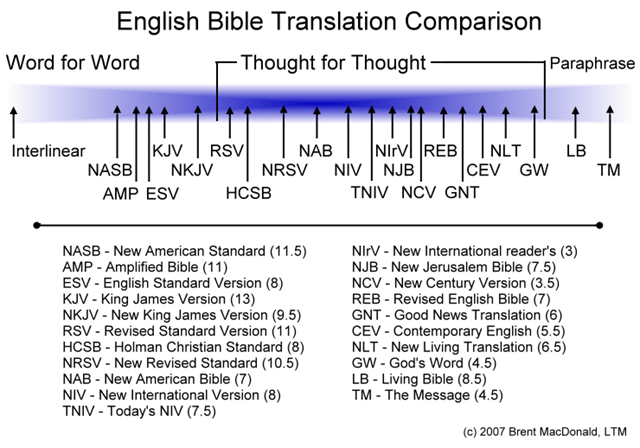
I personally put translation into 9 groups with the voice in the 8th group (loose dynamic):
- Hebrew/Greek, Diglot or Hebrew/Greek Reader (NA27, Majority /Byzantine Text, Textus Receptus, MT-Heb)
- Interlinear translation (Brown & Comfort, Marshall, McReynolds, Concordant interlinear)
- Highly literal (AMP, NASB, YLT, Mounce, Concordant)
- Formal (ESV, KJV, ASV, NKJV, NRSV, RSV)
- Balanced (TNIV, NET, NIV, HCSB, Price)
- Tight Dynamic (REB, NAB)
- Dynamic (NEB, NJB, CEV, NLTse, Gaus)
- Loose dynamic (NLT1ed, GNB, Voice)
- Paraphase (MSG, TLB, TAB, JBP)
While I think the formatting works very well in all aspects except one. The Voice footnotes aren't numbered in the text, instead a generic asterisk is used and the verse referred to in the note. You can see an example of this in the John chapter on page 161 (John 1:23-8). I think this format is difficult, it can be unclear which phrase the note is applying to. But even in the best case this requires looking backwards through the text for the verse number, looking down to find the associated note and then on a few pages having to looking up to find the chapter number. Given the demographics of The Voice I'd assume most people are comfortable with standard footnoting conventions, this seems like a mistake. Footnotes are used for translation commentary, glossary and cross reference so they aren't rare though not overwhelming either.
In terms of the internet, this is an emerging church product so basically conservative reformed Christians bash it. No one has really written a decent reply so, I guess I will. The most detailed and accurate review is a hostile one by Chris Rosebrough of Extreme Theology (review part1 part2). He's an ESV guy so not unexpectedly he hates the theology of the The Voice. A good example (using one from the free sample in case you want to check context) is John 1:13:
- Brown & Comfort (literal): The ones not of bloods nor of [the] will of flesh nor of [the] will of a husband but of God were born.
- ESV (formal): who were born, not of blood, nor the of the will of the flesh, nor of the will of man, but of God.
- NET (mediating): children not born by human parents or by human desire or a husband’s decision, but by God.
- NLT (dynamic): They were reborn -- not of a physical birth resulting from human passion or plan, but a birth that comes from God.
- Voice (12-13)(loose dynamic): He bestows this birthright not by human power or initiative but by God's will. Because we are born of this world, we can only be reborn to God by accepting his call.
If I were translating I personally would mix dynamic and formal here. I wouldn't want to lose John's clausal structure but I think the "bloods" to "blood" translation is far too literal, and men rather than husband is just plain wrong. The reference to bloods here is critical, but it relies on the Greek idiom that the fetus grows on blood which is not an American English idiom. You could translate it keeping blood with a technical term, something like "not from fetoplacental circulation" but that shifts the tone too much. The key is to retain the spirit vs. flesh theme from John while changing idioms i.e. being dynamic to be made more explicit. Anne Nyland's The Source Bible does a great job for this verse "children not born from a woman nor from the purposes of the natural realm nor from the purposes of a man, but born from God". Suzanne McCarthy goes similarly with:
children not born from the womb of a mothernor from the will of the natural bodynor from the will of a father,but born from God.
Incidentally I use the ESV here for the formal because Mr. Rosebrough does. The NRSV is similar, "who were born, not of blood or of the will of the flesh of man, but of God." I think it is interesting he picks this verse to defend formal because in my opinion it show the relative merits of both. The ESV's use of "man" over husband here, especially because they use man for so many other Greek words, and then being literal with blood desexualizes and thus loses the connection between the man and the birth. I also don't like the tense changes, the ESV is far too free with tenses for a formal translation. The NET and the NLT IMHO do a much better job in capturing the key connection lost by the ESV. On the other hand the NET/NLT is completely artless, this is a poem loaded with the height of imagery in Christianity and while they capture the meaning better their text is flat.
So what about The Voice? You get the gospel message without any of John's flavor. Those who accept the divine voice of God are reborn as children of God not children of flesh. Mr. Rosebrough in his critique blows a gasket because this is the Arminian gospel and not the Calvinist gospel. The ESV drops the sexual metaphor to emphasize unconditional election and irresistible grace, "not by the will of man", The Voice drops it to emphasize decision theology. From my perspective, both are equally bad. Flesh vs. spirit is one of the five main themes of John, I don't want either Arminius or Calvin to pollute John. But I think this sort of simplification is acceptable in The Voice, this sort of theological commentary in the text is much worse in a bible whose stock and trade is its "essentially literal accuracy" than in a bible whose stock and trade is "first time readers will get it, and it sounds good when read out-loud". By the time someone is ready to discuss limited vs. unlimited atonement I hope that they wouldn't use The Voice, and I believe Chris Seay would agree with me. So with Rosebrough (and again I picked his review because he did the best job in a hostile critique) by seeing what this looks like from the other side might appreciate "turnabout is fair play" and perhaps appreciate why the English Standard Version raises such strong objections.
In short while I've read the hostile reviews, I don't think they address the core function of The Voice. Blow through at normal reading speed John 1:1-14 out-loud with a reader unfamiliar with the them from the ESV and see what someone is actually retains. Or if you want an actually accurate translation the same thing would happen with the NRSV. Then try it with The Voice, I think they would get a lot. This bible is designed for verbal retention from unfamiliar readers, the critiques aren't analyzing assuming the intent it was designed for.
Pieces of The Voice are available separately:
- The Voice, amazon link to main book
- The Voice of Romans: The Gospel According to Paul by Chris Seay
- The Voice of Hebrews: The Mystery of Melchizedek Greg Garrett
- The Voice of Mark: Let Them Listen Greg Garrett
- The Voice of Luke: Not Even Sandals by Brian D. McLaren
- The Last Eyewitness: The Final Week (John 13-21) Chris Seay et al, illustrated
- The Voice Revealed: The True Story of the Last Eyewitness by Chris Seay
- The Voice of Acts: The Dust Off Their Feet: Lessons from the First Church by Chris Seay
- The Voice from on High: God Announces His Son as Israel's Liberating King by Lauren Winner
- Son of the Most High: The Christmas Story Retold in the Voice
As a closing note Thomas Nelson also published The Truth War which is essentially an anti-Emerging church hate piece by MacArthur, as well as the MacArthur Study Bible. I'll give them a lot of credit for being open minded, but I wouldn't want to be around when they have author's Christmas party.
See Also:
- Apologetics Index on the Voice, hostile
- Subversive Influence, friendly review and recommendation as a replacement for The Message.
- The voice of unreason hostile review.
- IndyWatchmen, a "I haven't read it but it is going to suck" warning before it came out.
Friday, July 10, 2009
Calvin's 500th birthday
 Well I wasn't ready for a big post on Calvinism today. I probably should have been. Calvin is going to have a very good 500th birthday. 20 years ago Arminianism was still the rage and Calvinism quite out of fashion, the fashion has completely shifted. As we have approached the 500th Calvin and TULIP have made a come back. Individually I've never been able to get over the basic problem that I can't believe myself to be morally responsible for anything I have no control over. So:
If I am born in a state of Total depravity my rejection of God is not an immoral act. If election is Unconditional then God is the one doing the choosing not man. The morality of choosing or not choosing sits entirely with him not the creation. If atonement is Limited then by preselection then the actual sacrifice is of no meaning to those outside the circle of the eternally elected. It has nothing to do with me anymore than Polish law. If grace is Irresistible then even those saved have no merit. Finally with Perseverance of the saints we remove any merit to the saved for even keeping with the program.
The whole system turns salvation into a lottery. Whether you are saved or not becomes as moral an issue as whether you have brown or blue eyes: something you had no control over, predetermined at birth that you can't change or alter. I don't and shouldn't consider brown or blue eyes a moral issue. While there is fairly good biblical support for these doctrines the net effect of going to this extreme is to rob God's redemption of any sort of morality at all. From a human perspective you are either damned or saved completely at random, like winning at craps. The answer to faith vs. lordship in this system turns out to be neither.
Calvin himself built a nightmare police state (see Calvin the totalitarian) that collapsed because of his petty jealousy, intolerance and inability to address the human condition as it really exists and not as he theorized it should exist (see Anne Le Fert (Questionable Excommunication part 2)).
His current followers have created the most dishonest translation of the bible in a generation to back their views. I've celebrating 21 years on the internet, and when I compare the religious dialogue today to what existed on places like soc.religion.bible, or talk.misc.christian 21 years ago there is no question that a culture of intolerance exists today that did not exist then. Virtually every bible blogger has been banned from one board or another, there is a casual culture of "I don't like that view so I won't allow it to be expressed" that the moderators 2 decades ago (equivalent of blog owners) would have seen as outright anti-American. In society at large the new Calvinism hasn't had a chance to have much impact. But the traditional arminian baptists were firmly in the camp of Roger Williams (founder of Rhode Island) and believed that religion in America (at the time the colonies) should be always consensual. Today ideas like Christian reconstructionism, which argue that the state should enforce religious codes get their legitimacy among Protestants from Calvinism (though the Catholic Church suffers from a similar confusion). The fact that I'm having to write posts like Why not to keep going on with discipline after a member leaves is a direct reflection of a general rejection of Williams core idea that religion is something freely entered into between a person and their god. The very defense that Machen presented at his trial involved Christian liberty from Church taxes (see Excommunication of Gresham Machen for details) and would be rejected by the very churches he has founded today.
The mechanism by which this casual intolerance has spread is the the idea and ideology of presuppositional apologetics, and this has led to this breakdown in communication that existed 2 decades ago. While presuppositional apologetics are fully consistent with TULIP, they create a situation in which one of the parties believes the other is simply not worth discoursing with. The "unelected" are in an permanent irreparable state of delusion. Refutations of Reformed popular ideas don't need to be considered because they are true by presupposition. Counter arguments are satanic, because they contradict these presuppositions. Counter evidence is dismissed because it challenges the sufficiency of scripture. And on and on and on. Under this model dialogue becomes impossible.
It is from the reformed camp that the Patriarchy and complementarian movements are arising, creating a biblical mandate for the causal sexism of the 19th century (see defense against patriarchy part 6).
So on his 500th birthday I'd like to congratulate Calvin on making fashionable once again the absolutely worst aspects of European religion. There is no question that Calvin is one of the great theologians and biblical thinkers of all time. It is unfortunate that his short comings and not his strengths are what we are today confronted with.
Monday, July 6, 2009
ESV-onlyism on the blog sphere

Nice series of posts going on right now on ESVonlyism. What is wonderful is that quite a few of them are conservative reformed Christians who are willing to address the fact that this movement is fundamentally dishonest, trying to advance sectarian interests by misrepresenting the bible. It started with the article on Aberration blog where A.Admin indicated he was so offended by a sermon of Sproul's misrepresenting the translation debate that he is walking away from him. Here is a current list, I'll update freely as I find more and please feel free to comment if I've missed any.
Aberration blog Bye bye Ligonier Ministries
The Church of Jesus Christ: Are Calvinists turning into ESV-Onlies?, The Rising ESV-Onlyism and Gender-Inclusive Language
Onward, Forward, Toward Are Reformers Becoming ESV Only?
Suzanne's Bookshelf: ESV onlyism and Sproul, ESVonlyism and Packer, Grudem and ESV onlyism, Why ESV onlyism, Reflections on ESV onlyism
For those interested in countering this:
Why the English Standard Version (ESV) should not become the Standard English Version by Mark Strauss
And of course this has been one of my hobby horses for a long time (I helped invent the phrase "ESV-onlyism") Is the ESV "essentially literal"?, Mark 1:41 and the ESV, Censorship and dishonesty in evangelical Christianity, Why be an ESV hater?.
Friday, July 3, 2009
Michael Bell on inflows and outflows
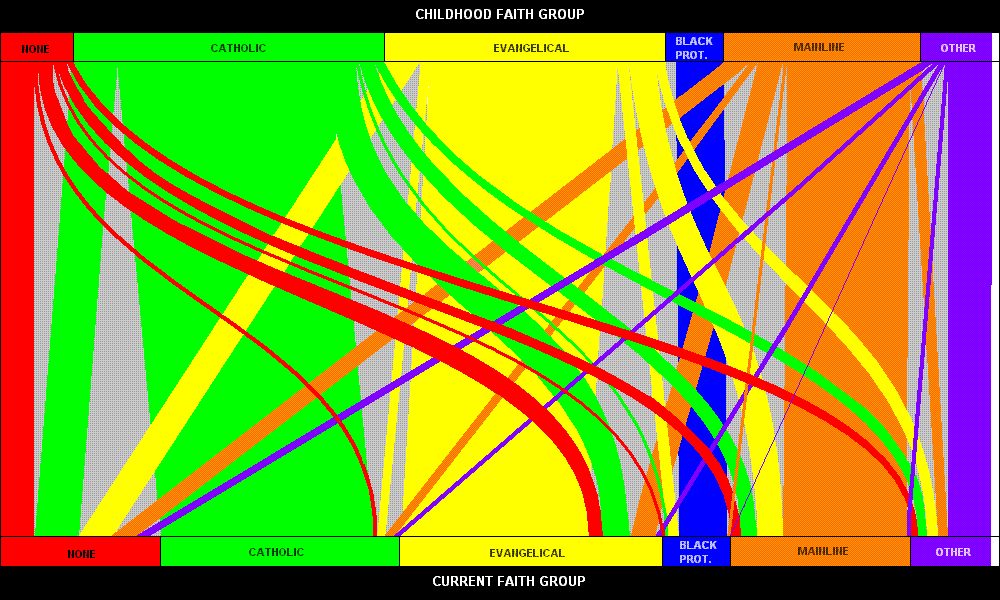
Somehow I managed to miss one of the best post in May written by Michael Bell, Looking at the Pew Forum’s “Changes in Religious Affiliation” Data. You can Pew Report for the source data. This is a statistical analysis of inflows and outflows from major religions to one another tracking people longitudinally not as groups/percentages of the population. This graphic is from the article and shows how the major groups flow into one another. Because this is a longitudinal study you get interesting results. For example, Catholicism in the graph is shrinking because US catholics convert out in high numbers but other convert in in low numbers. On the other hand there has been strong Hispanic (Catholic) immigration which why their percentage of the population has remained steady if you don't look longitudinally.
It is also worth noting these are self identification numbers, which are much much higher than measures that use attendance. Bell followed this up with a follow up strategy post and then a post on non religious retention rates ( Its a lot easier to be non religious).
Main points:
- My comments above about Catholic retention.
- None (no affiliation): This group has terrible retention (about 50%) but fantastic evangelism. The growth of this group and a new form of Christianity targeted to them has generally been what has led to revivals. Yet more evidence that the Emerging Church is correct in their assessments.
- Evangelical Christianity is facing a falling retention rate and this is creating a demographic problem similar to the one that the mainline churches faced over the last 2 generations. It is not growing and is aging rapidly, which could cause a drop in retention ....
- Mainline churches aren't losing members and have break even retention. They were suffering from a low birth rate and they just swap members with evangelical churches.
- Explicitly and exclusively black protestant church are currently pulling people in from other groups and demonstrating the best retention. It appears Sunday morning going to be more segregated moving forward and black protestantism is going to continue to be a very important part of the religious landscape.
- People who are going to change 79% of the time do it by 23 and about 3.5% after 36. The age change numbers are essentially the same for all groups. Basically if you are interested in evangelism, late high school and college age is essentially the only opportunity to do this in large numbers (again consistent with emerging church views).
- Non religious retention (that is not just not affiliated but rather atheist, agnostic...) has skyrocketed. This is what the graph on the left shows.

See also:
Wednesday, July 1, 2009
A defense of Driscoll to the left
 This is an unusual post for me. Normally this blog attacks Patriarchy and Complementarianism. My opinion hasn't shifted on that. This blog has ended up being very critical of Conservative Reformed Christianity, and my opinion on that has shifted in the last 2 years in a very negative direction. When I started I thought the problems were much less frequent and much less deep than I do today.
So why write a defense of Mark Driscoll? Well because a great many of the problems in conservative reformed Christianity are countered by Driscoll. He separates off the bible from a whole range of political and social conservative positions and presents a new vision for what evangelical Christianity could look like. In other words he achieves the goal of the emerging church movement even though he no longer associates himself with it. It is the missional core which I think puts him in a totally different category than the Josh Harris, John MacArthur, R.C. Sproul.... clan.
Quite simply the core idea of the neo-evangelical movement founded by Harold Ockenga was to separate Christian theology from Christian culture as a matter of working principle. A good example which is less controversial today was Moody's belief that there was no need to change the dietary habits of Eastern European converts, "The great commission is not a command to convert the world to Anglo-Saxonism". If one considers neo-evangelicalism to be a legitimate endeavor, that is disagrees with fundamentalism and liberalism that such a separation is impossible then it is hard to see what Driscoll is doing as being inconsistent with the absolute core goal of the neo-evangelical movement.
Without directly implicating MacArthur, Driscoll distinguishes between missionaries who study culture and fundamentalists who try to avoid culture."Fundamentalism is really losing the war, and I think it is in part responsible for the rise of what we know as the more liberal end of the emerging church," Driscoll says. "Because a lot of what is fueling the left end of the emerging church is fatigue with hardcore fundamentalism that throws rocks at culture. But culture is the house that people live in, and it just seems really mean to keep throwing rocks at somebody's house." (Christianity today article on Driscoll)
Driscoll built his ministry on 4 points.
- The Church is primarily middle aged and female. In particular men 22-25 are the least likely to go to church. This is very bad.
- Thus the church needs an outreach to young men.
- However, the reason young men are not attracted to the church is a systematic problem with the way church is usually conducted. So churches that want to break from this mold need to "do church" with a very different flavor.
- In particular what is needed is a to build churches that are theologically orthodox but culturally young and masculine.
One can watch the video the Church needs dudes to hear Driscoll reconstruct this argument in his own words. And if you look at the Acts29 churches I think his objective has been achieved. The core defense of Driscoll from within a neo-evangelical framework is whether people agree with these 4 points or not.
The first question is, is it bad that church is primarily female? Do we need an outreach to young men, and is acceptable to change the character of churches so that they become young men friendly; that is "affirming" of their gender and their identity?
I'd assume most neo-evangelicals would answer this question that yes it is bad. Christianity seeks converts of both sexes and if churches are some way systematically failing to reach you men that should be addressed. Driscoll himself makes an interesting argument that not only is it bad from an evangelical standpoint but leads to lack of aggression and creativity.
As he puts it "the church is run by nice soft 'chickified' church boys". Church attire in his opinion is very effeminate for example men's clothing in pastels. In his opinion the decor in most churches is effeminate and the music is emotionally charged and effeminate. This sort of environment is hostile to to aggressive young men. That is exactly the sorts of young men who are likely to be entrepreneurs. That is a marketing strategy targeted at women in their 40s will be unsuccessful with men in their 20s. So all of these aspects need to change in a church targeting young (20s) single men who are college educated and innovative (aggressive). All those aspects changed, further Driscoll developed a preaching style that he modeled on Chris Rock, a communicator who is able to effectively communicate with young men.
In terms of longer term goals, Driscoll believes that if that aggressive men are involved when young then they will marry and bring in their families so that this style of outreach is not self limiting. Moreover he sees this failure as being why evangelical Christianity is shrinking. In Driscoll's view Church planting is primarily a matter of natural talent followed by training. Most churches choose men who lack the correct natural talent and then apply an aggressive training program. The reason they do this is that most churches can't handle young entrepreneurial men. These men are the ones who are likely to question leadership, are thus seen as "trouble makers" and driven away. But in Driscoll's view, if you want innovative churches you need this sort of man.
Finally, Driscoll believes that the church environment is unbiblical. He cites David, Paul, John the Baptist, as being the sort of man he has trouble picturing "wearing sweater vests singing love songs to Jesus".
I'd also conclude by addressing the issue of Driscoll on sex. In my opinion where Driscoll has been most often attacked is for saying uncomfortable truths about male sexuality. His comments on things like middle aged weight gain, lack of oral sex or lack of frequent sex as being causes of adultery are politically incorrect and true. The question for the left wing critics is can a preacher honestly address women on the issue of male sexuality or do we need to keep pretending that sexual boredom and adultery are uncorrelated events?
See also:
- Freedom4captives A pro women's blog that contains the sort of arguments addressed in this post
- MacArthur v. Driscoll addresses the right wing criticism.
Subscribe to:
Posts (Atom)


