Showing posts with label emerging church. Show all posts

Monday, July 13, 2009

Voice Translation

The Voice translation is a new translation by Chris Seay and co. The group's goal in the project was to produce a “holistic,” “beautiful,” “sensitive” and “balanced” New Testament that present-day readers could identify with. In short their goal was to produce a modern liturgical version, designed to be read out-loud or at the chapter level. To be excellent for quick reading or public reading the bible needs to avoid complex vocal constructions, which generally means short sentences or clauses and connection of ideas. Also obviously contemporary language. Such a bible would not designed for line by line study.

In addition to the use of modern language and aggressive punctuation; the way The Voice translation creates a verbal flow is by using a a play-like format with italicized in-text explanations. There is also occasional commentary to pull the structure together dramatically. Each book in the New Testament is preceded by a brief introduction explaining its background and significance. You can see this in the free online version of the Voice's John.

What is interesting about this new translation is that “writers rather than the scholars were tasked with producing the first draft.” Then, scholars, “working from the Greek or Hebrew, adjusted the translation to capture the nuances of the original.” That is typically a bible is written by translators and then edited. This bible was written and then translational issues were corrected. The puts the focus is on flow not on detailed accuracy. I think the accuracy is fine I recommend this bible for its intended uses. In particular:
  1. This is a great choice for a first read of the bible. The text notes assume unfamiliarity which is rare in most study bibles. It reads as almost as easily as The Message and keeps the focus on the text itself unlike any study bibles.
  2. This is one of the very few bibles I know that work well for informal out-loud reading. There are huge differences between what is retained vocally vs. visually. For preaching through a large section of a chapter or any other reading outloud.
  3. This out-loud readability makes it a good choice for an informal liturgy.
So I fully concur with Thomas Nelson's press release:
And we have a significant change in the liturgy of many churches that excludes that appointed time allotted for the specific reading aloud of the Sacred Text (sometimes in concert with a Lexionary and sometimes just as a focus where the whole congregation stands for the reading of the Word). Both of these changes have been made at the sacrifice of the oral experience of the Bible....The Nelson team created The Voice translation with this perspective in mind. Specifically, the screen-play format, the linguistic and historical information included in italics, and the contextualization that is present in the commentary makes The Voice ideal for public reading and understanding. (Thomas Nelson press release)
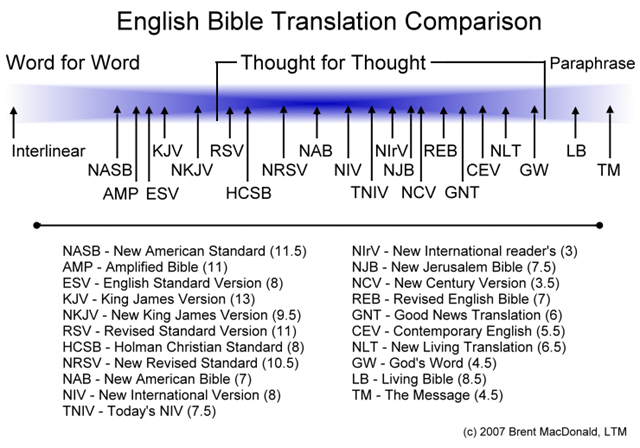
This focus on flow and readability however does come at a cost. Since, there aren't many reviews of the The Voice I hope my regular readers will forgive me if I'm a I'll be a bit more pedantic than normal and assume some readers not familiar with translation philosophies might be reading this review. In translation the closer you stay to the text the more accurately you capture the original structure but the less you can accurately capture the meaning. As you move away from the original structure you are able to better capture meaning. As you move even further away from the original structure you in effect rephrase the ideas of the text in your own language. It ceases to be translation and instead becomes a paraphrase. The graphic below shows the major translations as they move from the most literal, interlinears which preserve Greek word order to formal translations which preserve the positions of phrases with a sentence, to dynamic which preserver the order sentences to paraphrase which preserve the order of ideas.


I personally put translation into 9 groups with the voice in the 8th group (loose dynamic):
  1. Hebrew/Greek, Diglot or Hebrew/Greek Reader (NA27, Majority /Byzantine Text, Textus Receptus, MT-Heb)
  2. Interlinear translation (Brown & Comfort, Marshall, McReynolds, Concordant interlinear)
  3. Highly literal (AMP, NASB, YLT, Mounce, Concordant)
  4. Formal (ESV, KJV, ASV, NKJV, NRSV, RSV)
  5. Balanced (TNIV, NET, NIV, HCSB, Price)
  6. Tight Dynamic (REB, NAB)
  7. Dynamic (NEB, NJB, CEV, NLTse, Gaus)
  8. Loose dynamic (NLT1ed, GNB, Voice)
  9. Paraphase (MSG, TLB, TAB, JBP)
I've bolded The Voice as a recommend loose dynamic translation preferring it to either of the two others that I'm familiar with, the Good News Bible or the 1st edition of the New Living Translation (note: the 2nd edition is what is generally available that appears under item 7 and is bolded). Loose dynamic translations like The Voice are very good at getting across "the main idea" but not so good at getting across secondary ideas in the text. So they are really not suitable for anything where verse by verse reading matters in particular this is a poor choice for expository preaching or bible study. As I mentioned above this was written than corrected so the translation philosophy is highly inconsistent. Finally, it goes without saying that the informal liturgical style is the exact opposite of what would be desired for formal liturgical church or function.

While I think the formatting works very well in all aspects except one. The Voice footnotes aren't numbered in the text, instead a generic asterisk is used and the verse referred to in the note. You can see an example of this in the John chapter on page 161 (John 1:23-8). I think this format is difficult, it can be unclear which phrase the note is applying to. But even in the best case this requires looking backwards through the text for the verse number, looking down to find the associated note and then on a few pages having to looking up to find the chapter number. Given the demographics of The Voice I'd assume most people are comfortable with standard footnoting conventions, this seems like a mistake. Footnotes are used for translation commentary, glossary and cross reference so they aren't rare though not overwhelming either.

In terms of the internet, this is an emerging church product so basically conservative reformed Christians bash it. No one has really written a decent reply so, I guess I will. The most detailed and accurate review is a hostile one by Chris Rosebrough of Extreme Theology (review part1 part2). He's an ESV guy so not unexpectedly he hates the theology of the The Voice. A good example (using one from the free sample in case you want to check context) is John 1:13:
  • Brown & Comfort (literal): The ones not of bloods nor of [the] will of flesh nor of [the] will of a husband but of God were born.
  • ESV (formal): who were born, not of blood, nor the of the will of the flesh, nor of the will of man, but of God.
  • NET (mediating): children not born by human parents or by human desire or a husband’s decision, but by God.
  • NLT (dynamic): They were reborn -- not of a physical birth resulting from human passion or plan, but a birth that comes from God.
  • Voice (12-13)(loose dynamic): He bestows this birthright not by human power or initiative but by God's will. Because we are born of this world, we can only be reborn to God by accepting his call.
If I were translating I personally would mix dynamic and formal here. I wouldn't want to lose John's clausal structure but I think the "bloods" to "blood" translation is far too literal, and men rather than husband is just plain wrong. The reference to bloods here is critical, but it relies on the Greek idiom that the fetus grows on blood which is not an American English idiom. You could translate it keeping blood with a technical term, something like "not from fetoplacental circulation" but that shifts the tone too much. The key is to retain the spirit vs. flesh theme from John while changing idioms i.e. being dynamic to be made more explicit. Anne Nyland's The Source Bible does a great job for this verse "children not born from a woman nor from the purposes of the natural realm nor from the purposes of a man, but born from God". Suzanne McCarthy goes similarly with:
children not born from the womb of a mother
nor from the will of the natural body
nor from the will of a father,
but born from God.
Incidentally I use the ESV here for the formal because Mr. Rosebrough does. The NRSV is similar, "who were born, not of blood or of the will of the flesh of man, but of God." I think it is interesting he picks this verse to defend formal because in my opinion it show the relative merits of both. The ESV's use of "man" over husband here, especially because they use man for so many other Greek words, and then being literal with blood desexualizes and thus loses the connection between the man and the birth. I also don't like the tense changes, the ESV is far too free with tenses for a formal translation. The NET and the NLT IMHO do a much better job in capturing the key connection lost by the ESV. On the other hand the NET/NLT is completely artless, this is a poem loaded with the height of imagery in Christianity and while they capture the meaning better their text is flat.

So what about The Voice? You get the gospel message without any of John's flavor. Those who accept the divine voice of God are reborn as children of God not children of flesh. Mr. Rosebrough in his critique blows a gasket because this is the Arminian gospel and not the Calvinist gospel. The ESV drops the sexual metaphor to emphasize unconditional election and irresistible grace, "not by the will of man", The Voice drops it to emphasize decision theology. From my perspective, both are equally bad. Flesh vs. spirit is one of the five main themes of John, I don't want either Arminius or Calvin to pollute John. But I think this sort of simplification is acceptable in The Voice, this sort of theological commentary in the text is much worse in a bible whose stock and trade is its "essentially literal accuracy" than in a bible whose stock and trade is "first time readers will get it, and it sounds good when read out-loud". By the time someone is ready to discuss limited vs. unlimited atonement I hope that they wouldn't use The Voice, and I believe Chris Seay would agree with me. So with Rosebrough (and again I picked his review because he did the best job in a hostile critique) by seeing what this looks like from the other side might appreciate "turnabout is fair play" and perhaps appreciate why the English Standard Version raises such strong objections.

In short while I've read the hostile reviews, I don't think they address the core function of The Voice. Blow through at normal reading speed John 1:1-14 out-loud with a reader unfamiliar with the them from the ESV and see what someone is actually retains. Or if you want an actually accurate translation the same thing would happen with the NRSV. Then try it with The Voice, I think they would get a lot. This bible is designed for verbal retention from unfamiliar readers, the critiques aren't analyzing assuming the intent it was designed for.

Pieces of The Voice are available separately:
As a closing note Thomas Nelson also published The Truth War which is essentially an anti-Emerging church hate piece by MacArthur, as well as the MacArthur Study Bible. I'll give them a lot of credit for being open minded, but I wouldn't want to be around when they have author's Christmas party.

See Also:

Wednesday, July 1, 2009

A defense of Driscoll to the left

This is an unusual post for me. Normally this blog attacks Patriarchy and Complementarianism. My opinion hasn't shifted on that. This blog has ended up being very critical of Conservative Reformed Christianity, and my opinion on that has shifted in the last 2 years in a very negative direction. When I started I thought the problems were much less frequent and much less deep than I do today.

So why write a defense of Mark Driscoll? Well because a great many of the problems in conservative reformed Christianity are countered by Driscoll. He separates off the bible from a whole range of political and social conservative positions and presents a new vision for what evangelical Christianity could look like. In other words he achieves the goal of the emerging church movement even though he no longer associates himself with it. It is the missional core which I think puts him in a totally different category than the Josh Harris, John MacArthur, R.C. Sproul.... clan.

Quite simply the core idea of the neo-evangelical movement founded by Harold Ockenga was to separate Christian theology from Christian culture as a matter of working principle. A good example which is less controversial today was Moody's belief that there was no need to change the dietary habits of Eastern European converts, "The great commission is not a command to convert the world to Anglo-Saxonism". If one considers neo-evangelicalism to be a legitimate endeavor, that is disagrees with fundamentalism and liberalism that such a separation is impossible then it is hard to see what Driscoll is doing as being inconsistent with the absolute core goal of the neo-evangelical movement.
Without directly implicating MacArthur, Driscoll distinguishes between missionaries who study culture and fundamentalists who try to avoid culture.
"Fundamentalism is really losing the war, and I think it is in part responsible for the rise of what we know as the more liberal end of the emerging church," Driscoll says. "Because a lot of what is fueling the left end of the emerging church is fatigue with hardcore fundamentalism that throws rocks at culture. But culture is the house that people live in, and it just seems really mean to keep throwing rocks at somebody's house." (Christianity today article on Driscoll)
Driscoll built his ministry on 4 points.
  1. The Church is primarily middle aged and female. In particular men 22-25 are the least likely to go to church. This is very bad.
  2. Thus the church needs an outreach to young men.
  3. However, the reason young men are not attracted to the church is a systematic problem with the way church is usually conducted. So churches that want to break from this mold need to "do church" with a very different flavor.
  4. In particular what is needed is a to build churches that are theologically orthodox but culturally young and masculine.
One can watch the video the Church needs dudes to hear Driscoll reconstruct this argument in his own words. And if you look at the Acts29 churches I think his objective has been achieved. The core defense of Driscoll from within a neo-evangelical framework is whether people agree with these 4 points or not.

The first question is, is it bad that church is primarily female? Do we need an outreach to young men, and is acceptable to change the character of churches so that they become young men friendly; that is "affirming" of their gender and their identity?

I'd assume most neo-evangelicals would answer this question that yes it is bad. Christianity seeks converts of both sexes and if churches are some way systematically failing to reach you men that should be addressed. Driscoll himself makes an interesting argument that not only is it bad from an evangelical standpoint but leads to lack of aggression and creativity.

As he puts it "the church is run by nice soft 'chickified' church boys". Church attire in his opinion is very effeminate for example men's clothing in pastels. In his opinion the decor in most churches is effeminate and the music is emotionally charged and effeminate. This sort of environment is hostile to to aggressive young men. That is exactly the sorts of young men who are likely to be entrepreneurs. That is a marketing strategy targeted at women in their 40s will be unsuccessful with men in their 20s. So all of these aspects need to change in a church targeting young (20s) single men who are college educated and innovative (aggressive). All those aspects changed, further Driscoll developed a preaching style that he modeled on Chris Rock, a communicator who is able to effectively communicate with young men.

In terms of longer term goals, Driscoll believes that if that aggressive men are involved when young then they will marry and bring in their families so that this style of outreach is not self limiting. Moreover he sees this failure as being why evangelical Christianity is shrinking. In Driscoll's view Church planting is primarily a matter of natural talent followed by training. Most churches choose men who lack the correct natural talent and then apply an aggressive training program. The reason they do this is that most churches can't handle young entrepreneurial men. These men are the ones who are likely to question leadership, are thus seen as "trouble makers" and driven away. But in Driscoll's view, if you want innovative churches you need this sort of man.

Finally, Driscoll believes that the church environment is unbiblical. He cites David, Paul, John the Baptist, as being the sort of man he has trouble picturing "wearing sweater vests singing love songs to Jesus".

I'd also conclude by addressing the issue of Driscoll on sex. In my opinion where Driscoll has been most often attacked is for saying uncomfortable truths about male sexuality. His comments on things like middle aged weight gain, lack of oral sex or lack of frequent sex as being causes of adultery are politically incorrect and true. The question for the left wing critics is can a preacher honestly address women on the issue of male sexuality or do we need to keep pretending that sexual boredom and adultery are uncorrelated events?

See also:

Tuesday, June 30, 2009

MacArthur v. Driscoll

I had figured this issue was going to die down but it seems that's its going into the fifth round or so. Essentially the question here is whether it is acceptable for a preacher to speak naturally on sexual topics or not. In other words can you as a Christian minister discuss sex the same way you would discuss auto repair or is hemming and hawing and being vague a requirement.

Since this charge is being led by MacArthur I think it makes sense to start by quoting him. All of the quotes come from a series of 4 sermons that MacArthur gave on Driscoll entitled "The Rape of Solomon's Song" (Part1 Part2 Part3 Part4)
[Y]ou can[not] make a biblical case for Christians to embrace worldly fads—especially when those fads are diametrically at odds with the wholesome speech, pure mind, and chaste behavior that God calls us to display. At its core, this is about ideology. No matter how culture changes, the truth never does. But the more the church accommodates the baser elements of the culture, the more she will inevitably compromise her message. We must not betray our words through our actions; we must be in the world but not of it. . . . . It's vital that you not send one message about the importance of sound doctrine and a totally different message about the importance of sound speech and irreproachable pure-mindedness.

Mark Driscoll’s response to that admonition and the things he has said since have only magnified my concern.

Mark did indeed express regret a few years ago over the reputation his tongue has earned him. Yet no substantive change is observable.


The first misconception some have regarding this debate is that this is new for MacArthur based on a particular television appearance. So I'd just counter this by noting that MacArthur has been arguing this case against Driscoll for years. For example he attacked Driscoll "vulgarity" in his "Grunge Christianity" article. And I have heard claims this is personal, and I don't think it is personal. Over the years MacArthur has attacked so many different people on some many different ideological grounds with these sorts of campaigns there is no reason to believe that this is merely a cover. His followers have broadly attacked Missional Christianity as per the image to the left.

What I really see though as the base underlying cause is not vulgarity, but rather postmodernism. In The Truth War: Fighting for Certainty in an Age of Deception MacArthur also attacked Driscoll as the cursing pastor. But the big issue in this book is epistemological. Driscoll is philosophically postmodernist while completely orthodox in his theology. Driscoll argues that Christian have a responsibility to engage the last 200 years of epistemology in an effective way. MacArthur in a book on epistemology displays a shocking ignorance of the topic. That is in many ways a replay of the classic question of Galileo, "Does the bible teach what moves the heavens or how the heavens move" just applied to another sphere of human inquiry.

With that preface lets hit the 4 issues in this debate
  1. Legitimacy of cursing, or vulgarity.
  2. Legitimacy of expositional preaching on poetry.
  3. Legitimacy of expositional preachong on the Song of Songs in particular.
  4. General attack on postmodernism.
First with respect to the first charge I'm not sure Driscoll is actually guilty a sin here. Here is the latest joke that everyone is in a tizzy about. What I should mention though is you'll rarely see the actual joke. Where I come from a statement of charges should be specific, not vague. If Driscoll is to be disciplined for "jokes" the specific jokes should be listed with citations of where they came from. OK here goes:
Question: What does the bible say about masturbation
Answer: Whatsoever thy hand findeth to do, do it with thy might (Ecc 9:10)
OK, were you shocked? Not did you feel like you are supposed to be shocked; were you actually shocked? My guess is no, that joke is tame. The sort of joke that anyone who understands it isn't going to be shocked by. I can't even imagine anyone being aroused by it, which is core to the definition of obscenity, so I'd immediately dismiss any claims about this joke being obscene. Now I think the reason the joke isn't repeated is because it is so borderline, far better to say "I can't repeat the obscene joke on my site...." and convict Driscoll without even a complete statement of the charges. The fact is that this joke is so far from obscene that television censors had no problem with it during daytime. If MacArthur (who preaches in Hollywood) thinks that is an obscene joke there are about 5 of the country's top comedy clubs within 10 miles of his church, where he can find out how off base he is.

Now "corse jesting" is prohibited by Eph 5:4, as is "silly talk". Even if I were to grant that MacArthur has gone a lifetime without making a course joke, I'd say he's the pot calling the kettle black when it comes to this verse given the mountain of sillyness that comes out of him. So the question is do we want to remove pastors from office for Eph 5:4 violations and if so which ones would remain standing at the end?

So having dismissed obscenity lets move on to the second charge Driscoll's interpretation of the Song of Songs. First off, Driscoll has a dedicated site on Song of Songs, Peasant princess, where you can see for yourself he does a good job doing a very standard poetical deconstruction of a love poem. Nothing particularly out of the ordinary you wouldn't hear in any high school literature class taking apart a poem with lots of metaphor and allegory. The interpretation itself is not particularly unusual either, it is standard fare that you would find in most good commentaries. Adele Reinhartz opens his analysis with “The Song of Songs is the bible’s only extensive discourse on human, erotic love.” The idea that this erotic treatment is some innovation of Driscoll's is nonsense. Driscoll presents the material well but in a very direct way.

So now lets get to the charge, we have notes on Driscoll's sermon with "objectionable" parts highlighted. Now there is no question this is on the level of a 7th grade sex ed class in a sermon only given to people over 18 while discussing a love poem. Is this over the line? Is deconstruction of a biblical poem a legitimate activity. Tim Challis as well as MacArthur answered this question in the negative. I think this point can be immediately dispatched by noting that the Book of Hebrews is an exposition of the poetry of Psalm 103. God cannot forbid what is commanded.

So then we have to turn to a more specific question if there is something unique about Song of Songs that prohibits it. And in general the answer comes back to sex. That is the MacArthur position is that a preacher can discuss politics, law, history, theology, the news, sports, movies.... from the pulpit without hemming and hawing but you can't say things like "when woman are sexually aroused blood flows to the inner and outer labia". To prove this is sexually specific would anyone object to the equally explicit, "when a person is having a heart attack they often feel stabbing or shooting pain down the arms". Was the heart attack comment obscene? I'd say no, it was good medical advice. And that is precisely my opinion about the first comment as well.

But this is a tricky point. And it gets to the very core with the debate regarding missional Christianity. Missional Christianity rejects Churchianity and the standards of Churchianity when it comes to behavior whether in dress, attitudes towards body modification, in speech, in layout of the church. It says that it is going to walk away from some aspects of Churchianity to be able to actually reach people who would otherwise not be reachable. The bible never commands this sort of bashfulness, it is rather part of the "Christian culture". Paul lived in a culture vastly more explicit and open regarding sexuality than our own and never prohibited living in the culture, rather he demanded the opposite outreach.

What Driscoll did speak openly about a sex act he did so the the same way one would speak about grocery shopping or driving. And I think this is what people are reacting to, it was not the sexual content of anything Driscoll said but rather his lack trepidation in discussing it. Driscoll is not embarrassed to speak openly and sex that I think that not the content is MacArthur really found distressing. I had a similar experience on this board when trying to have an adult discussion of Christian Domestic Discipline. What I found then as well as every time this topic comes up, was that Churchianity's insistence on in treating sex differently than driving on adult boards is to impose upon sex the very obscenity that people like MacArthur are supposedly objecting to.

And this finally brings us to MacArthur's general attack on postmodernism. For MacArthur postmodernism is a chance to relive his hero's battle (see Spurgeon and the Down-Grade Controversy), (and Fed Up by Johnson). For Driscoll it is an opportunity for the church to reform its literature and make itself relevant to a culture which is altering its opinion on core issues about the connection between mind and world. The ideological struggle between Driscoll and MacArthur, deserves its own post and further should be broadened . Driscoll himself asserts that the primary division he has with MacArthur is over the contextualization of gospel.

MacArthur is Reformed, were he Arminian we could ask for a clear number like, how many souls should be lost due to an unwillingness to be missional: five, a hundred, a thousand, ten thousand, five hundred thousand...? How many would would just be "collateral damage" and not induce a policy change and how many would make outreach worth it. Since the answer is most likely in the millions, today I think this is a worthwhile question. MacArthur cannot reach the people that the missional Christian movement meets and reaches out too. So were he and his followers successful in delegitimizing it the number who would leave or never join the faith would hopefully only be in the tens of millions over the next century. But MacArthur is reformed so essentially he can be as ineffectual as he wants in outreach, since his works have no part in people being saved. So I close with question to readers who disagree with me, what your number?


See also:

Thursday, March 5, 2009

Postmodernism, how do we know a text means?

There was a request for a follow up where we can have an actual conversation.

This reply came from Jugulum. It was censored on Team Pyro:
CD-Host,

You said,
"The meaning doesn't reside in the comments themselves, but rather in the shared culture which allows me to predict the meaning you and they are likely to assign."

OK... I can sort of accept that there is no "inherent" meaning in the particular combination of shapes that make up the content of these comments. Nor is there inherent meaning in the sounds that they map to, if we speak the comments aloud. For communication to work--or, for me to be able to predict what meaning you will assign to my words--there has to be some "shared culture", in your terminology. At the very least, we must all be English-speakers. (But that's not all there is to it. There are other degrees of "shared culture". For instance, an isolated hill-billy will misunderstand a Brit's comment about carrying a torch onto a lift. i.e., there's lingo, jargon, slang, regional dialects, etc.)

I get that much. As far as that goes, I see merit in what you're saying.

But...

Can't we still say that my comments have an inherent meaning, based on the context of my culture? Or if you don't like that phrasing: That there is a meaning which I intend--a meaning that is graspable by anyone with access to my culture? A predictable understanding, in your terminology? That there is an authorial intent, accessible to others? (I'm not claiming that anyone will necessarily perfectly understand that intent. Our horizons of cultural understanding will never perfectly coincide. But we can approach each other.)

In fact, we could say this: Any time we try to read or hear someone else's words, we should seek to understand their culture/language. When I speak, I assume that there is a shared culture. And I expect that my listeners will pay attention to that. That they'll seek authorial intent.

If you insist that there isn't inherent meaning in the collection of symbols I put together--isn't there inherent meaning in, "Those symbols, put together by Jugulum, a 21st-century American native English-speaker"?

All of this translates to, "We should seek to use an authorial-intent hermeneutic. The better we exercise such a hermeneutic, the better we will understand. (i.e., The better we achieve shared culture, the better we will be able to predict the intended or received meaning.)"


The hope for this thread is to have an open ended discussion on this. All are welcome.

Monday, May 19, 2008

What people under 30 think

On many of the boards I'm on there is a constant fear that any sort of critique of the church would lead people away. Barna research did a survey of the attitude of young people 20-30 towards Christianity. Their complaints were not about failure to address problems or honestly confront difficulties rather what they were upset about was essentially the "meanness", in particular:
* antihomosexual 91%
* judgmental 87%
* hypocritical 85%
* old-fashioned 78%
* too political 75%
* out of touch with reality 72%
* insensitive to others 70%
* boring 68%
(from unChristian: What a New Generation Really Thinks about Christianity... and Why It Matters, By David Kinnaman)
This is precisely the issue the emerging church is trying to address. While in a later post I intend make a more serious philosophical defense of postmodern theology, I think critiques of the emerging church on moral grounds that fails to take into account this reality are off base. I think its high time those that attack the emerging church be asked the simple question of what is their counter strategy to address this reality. Or to ask the question I asked in goth music:
Moreover I've even seen gospel outreach towards goths be attacked. For example Karen Ward (abbess of apostle's church in Seattle, leader / one of the founders of the emerging church movement) runs a very successful outreach to goth teens / 20-somethings called the Santorum Mass which is essentially a 16th century high episcopal mass done very traditional, very high church style. The kids love it, and it consistently draws huge crowds of people that would otherwise not go to church. I would consider this to be successful evangelism. Yet this has been specifically cited as an example of the "engage but don't critique flaw" of the emerging church. I suspect most readers would agree with the "successful evangelism" position. And if so then the fact that the goth movement is spontaneously creating fantastical scores for prayers and hymns should be something to be applauded.

_____

See Also:


Wednesday, February 13, 2008

Goth Music

I just discovered another group which has been around for a long time: Within Temptation. Which reminded me of a point I've thought of making on this blog regarding Evanescence. There is a bit of a renaissance going on with regard to Christian music that with the exception of the emerging church is going completely unnoticed by the broader Christian community.

In 1959 African American Chicago musicians like Ray Charles, Little Richard and James Brown combined the gospel music with R&B to create a new form or rock called soul. Musically there was inspiration from gospel, but lyrically soul music was about the same themes as rock is typically about. With goth music there is often a rock sound, while lyrically inspiration seems to come (perhaps subconsciously) from hymns. Arguably a great deal of goth music is a hymn put to rock music. For example Our Solumn Hour by Within Temptation (Santus espritus is latin for holy spirit):
Sanctus espiritus redeem us from our solemn hour
Sanctus espiritus insanity is all around us
Sanctus espiritus! Sanctus espiritus! Sanctus espiritus!

In my darkest hours I could not foresee
that the tide could turn so fast to this degree
Can't believe my eyes
How can you be so blind?
Is the heart of stone, no empathy inside?
Time keeps on slipping away and we haven't learned
So in the end now what have we gained?

Sanctus espiritus, redeem us from our solemn hour
Sanctus espiritus, insanity is all around us
Sanctus espiritus, is this what we deserve,
can we brake free from chains of never-ending agony?

Are they themselve's to blame, the misery, the pain?
Didn't we let go, allowed it, let it grow?
If we can't restrain the beast which dwells inside
it will find it's way somehow, somewhere in time
Will we remember all of the suffering
Cause if we fail it will be in vain

Sanctus espiritus, redeem us from our solemn hour
Sanctus espiritus, insanity is all around us
Sanctus espiritus, is this what we deserve,
can we brake free from chains of never-ending agony?

Sanctus espiritus, Sanctus espiritus
Evanescene's Fallen (which has sold around 20 million copies) is essentially an exploration of salvation (Arminian theology), though the band has played that down the religious language is striking. The top single from the album Bring Me To Life reads like a salvation prayer (well actually its poetically far better than most of them): just to excerpt the song (which has overlapping lyrics) the chorus reads as follows with the male chorus in in parenthesis and the female chorus without parenthesis:
(Wake me up)
Wake me up inside
(I can’t wake up)
Wake me up inside
(Save me)
call my name and save me from the dark
(Wake me up)
bid my blood to run
(I can’t wake up)
before I come undone
(Save me)
save me from the nothing I’ve become

Bring me to life
(I've been living a lie, there's nothing inside)
Bring me to life
Christianity today has covered the issue of Evanescene's lyrics twice (on the band's lyrics, and on the group Skillet). Another example from the album is the song Tourniquet which was originally authored by Soul Embraced (part of the Christian death metal movement):
I tried to kill the pain
but only brought more
so much more
I lay dying
and I'm pouring crimson regret and betrayal
I'm dying, praying, bleeding and screaming
am I too lost to be saved
am I too lost?

my God my tourniquet
return to me salvation
my God my tourniquet
return to me salvation

do you remember me
lost for so long
will you be on the other side
or will you forget me
I'm dying, praying, bleeding and screaming
am I too lost to be saved
am I too lost?

my God my tourniquet
return to me salvation
my God my tourniquet
return to me salvation

I want to die!!!

my God my tourniquet
return to me salvation
my God my tourniquet
return to me salvation

my wounds cry for the grave
my soul cries for deliverance
will I be denied Christ tourniquet
my suicide
I'd invite readers to comment. Clearly the goth movement is one of the ones that has come under the greatest deal of attack and music an issue that children are frequently disciplined (at least at home for). Its hard to argue lyrics like the above are not glorifying.

Moreover I've even seen gospel outreach towards goths be attacked. For example Karen Ward (abbess of apostle's church in Seattle, leader / one of the founders of the emerging church movement) runs a very successful outreach to goth teens / 20-somethings called the Santorum Mass which is essentially a 16th century high episcopal mass done very traditional, very high church style (podcast link). The kids love it, and it consistently draws huge crowds of people that would otherwise not go to church. I would consider this to be successful evangelism. Yet this has been specifically cited as an example of the "engage but don't critique flaw" of the emerging church. I suspect most readers would agree with the "successful evangelism" position. And if so then the fact that the goth movement is spontaneously creating fantastical scores for prayers and hymns should be something to be applauded.