Showing posts with label editorial. Show all posts

Thursday, March 15, 2012

Why Natural Family Planning (NFP) is a non answer

The problem with NFP is the results in practice.  It is the case among people with years of experience who practice in a disciplined way that NFP has a pregnancy rate of .6-1.8% which is in line with chemical methods (study). But actually doing this is rather difficult, for example in the study cited above 13% of the women who had originally expressed interested in NFP refused to continue to use NFP in practice, even with extensive support services made available to them.  Support far beyond what can be given in a widespread way.

When NFP is used by people who take it semi-seriously they have 7.5% chance of getting pregnant per cycle, to put that in perspective couples having frequent sex with no contraception of any type have 28% chance of pregnancy per cycle.

Because differences like this, though generally not this large, are common, when measuring birth control effectiveness: means are evaluated using a "typical use" scale not a "perfect use scale".  So for example condoms when used every time and with a spermicidal gel have a 98% effectiveness rate (i.e. with perfect use a sexually active woman will get pregnant only 2% of the time).    When used by actual people mistakes happen and the actual actual effectiveness rate is measured at 85%.   Where NFP methods are heavily used unintentional pregnancy rates among sexually active women are about 24%. Considering we are talking several decades of sexually active fertility even a 10% failure rate would mean 2-3 extra children over the course of a woman's lifetime.

Western women seem to be heading towards a fertility rate of 1.3 children per woman, and even in America non immigrant woman are at 2.1 children per woman; NFP simple doesn't seem effective enough in the absence of heavy use of abortion.

Moreover, there is a bit of irony.  If one adopts the currently fashionable definition that life begins at conception NFP greatly increases the incidence of implantation failure, which would be miscarriage under this definition, by encouraging sexual activity during the period when women still conceive but the fetus tends to fail to implant successfully. NFP, the Catholic church's recommended practice causes vast vast numbers of natural abortions over the course of a couple's life. So I would strongly disagree with the church, that it is not the intentional killing of children, if one defines life to begin at conception, and one defines "intent" in any consistent way.

The church is simply aiming for an irreconcilable situation:
  1. They have over the last 200 years redefined abortion to apply much earlier than quickening, i.e. when the woman first feels fetal movement. This eliminates the sorts of birth control methods that were popular in previous centuries, which we would today call "abortion inducing drugs". It also introduces the moral issues with NFP I cited above.
  2.  
  3. They have redefined marriage to be primary about sex rather than primary about property and legitimate heirs. Thus there is no longer any distinction made between non-marital and marital pregnancy, as well as making much distinction between adultery and fornication. This to some extent is compounded in our society that has moved towards late marriage.
  4.  
  5. They dismiss artificial contraception of virtually any type as immoral. Thus eliminating the only means humans have discovered that in a widespread and reliable way is capable of keeping a woman's fertility down to 1-3 children per lifetime without heavy use of abortion (in the modern sense of the word).
  6.  
  7. They do aim for their standards to be adopted in a widespread way, and not seen as just theoretical goals that no one in practice actually follows.
When people talk about supporting birth control what they mean is keeping the fertility numbers down at the 1-3 children per woman over the course of their life. Standards of living correlate very strongly with per capita energy consumption. Energy production is not substantially boosted by population, it should be thought of as a limited resource growing slowly. High energy demand, effectively high energy prices, have been "a" if not "the" primary cause of global economic growth being constrained for the last 2 generations.  That is, what is primarily preventing 3rd and 4th world people from having a good standard of living are these high energy prices. While technology is allowing us to boost energy production somewhat every percentage point of population growth is a percentage point of growth not available to raise the living standards of the poor.  This tradeoff translates into millions of lives lost every year, not even discussing quality of life. Quite simply, overwhelming number of people, even people who care deeply about the sanctity of life, on this planet would prefer less children being born to everyone being subjecting to grinding poverty.

If the church wants Humane Vitae to be taken seriously they either need to indicate:

i) What is the unknown secret for massive energy production to allow for a growing population?

ii) How to maintain fertility at the rate of around 1-2.25 children per woman over the course of their life in practice using NFP?

-----
See also


Wednesday, June 22, 2011

100 year predictions of the biblical landscape

So I figured a fun topic is what will bibles look like in 100 years. I invite anyone who wants to crack out their crystal ball to give it a shot. Here are my predictions.


 I think the idea that a bible should be “general purpose” will die in the next generation.   This in my mind is a legacy of the KJV pre Living Bible / Good News Bible tradition where the same bible was used for liturgy, study, devotion.  Translations will stop aiming to be all things to all people and instead will focus on a niche like most products do in America.  The KJV may very well survive for “high liturgy” like funerals, being treated like Shakespeare or the Old Latin liturgy of the Catholic church.  Study bibles, will no longer be based on liturgical bibles and thus can do the obvious thing of forking off both a literal and a dynamic translation marked up with notes.  Thus they will be explicating the text using a dual strategy having a literal translation at least as much so as the NASB and possibly more like a good interlinear and a profoundly dynamic translation capturing the meaning of the Greek. The concern with preserving traditional phrasing will be gone since these bibles will be made exclusively for study.   Churches will use liturgical bibles designed to be understood best when read out-loud, translation like the Voice and highly poetical bibles for liturgical functions.  The pew bible will be one of these read out-loud bibles.  


I think the fact that evangelicals, including the most conservative with the ESV, have adopted the UBS/NA text is a fundamental shift in their relationship with the bible. Evangelicals today read bibles with “some texts contain X while others say Y", or "while the majority of the Greek texts say X the Syriac / Latin says Y”, etc…. In other words a view of translation has emerged which says:

  1. The actual originals are unknown, what you are reading is an estimate.
  2. The act of compilation is active not passive
  3. The act of translation induces inevitable distortion in meaning.

That’s not a small thing. Evangelicals are undergoing what liberals did in the mid 19th century, but while liberals were having to follow a trail blazed first by radicals Evangelicals will be following the trail blazed by large institutional mainline Christianity, a much wider trail.  Evangelical Christianity is fundamentally (no pun intended) about the bible, the gospel and being born again.   Evangelicals have always focused heavily on bible study, the popularity of study bibles today which is far beyond what it was a generation ago. With computerization the amount of information in the tools used for lay study is exploding.  I think these 2 trends merge and the study bibles of 100 years are loaded with lower criticism and textual variants, made much simpler since study bibles will be computerized interfaces and not books.

On the liberal side, I think this adaption of lower criticism by the right is going to push them further to the left over the next 50 years.  Liberal bibles today are still very conservative.  I've written elsewhere on this blog how delightful it was to read a translation of John in Bultmann’s order.  Given how easy it is for a computerized book to have multiple arrangements I think this transition, a switch to go back and forth will become common.  And once it happens for John we might see arrangements in other books, like Corinthians with Schmithal's decomposition.  For the Synoptic Gospels,  given how well know Q and the documentary hypothesis is, I think we'll see the Q material clearly delineated and since Q is now such a common term possibly broken out further according to the internal structure of Q.    So while conservative bibles will incorporate lower criticism, liberal bibles will incorporate higher criticism.

This shift left by the mainstream churches will force texts teams to begin to assemble more comprehensive documentary break downs, i.e. mainstream biblical scholarship / divinity schools to go in its natural direction towards where Religious Studies professors are today.  So in terms of the UBS/NA40 (or whatever it is called) the Greek (and maybe even the Hebrew ) will present a tree view of the origins of the text (see Mack the Knife and biblical development). The books will show trees of descent, you will be able to track lines as they evolved in the 5th century from a host of sources. For example the UBS/NA Luke will clearly show what came from Ur-Lukas (Gospel of the Lord), which came from later Q additions or refinements from Matthew, which came from Mark and which came from reading the epistles back into the gospels.

As an aside, of course if divinity scholar have moved to where Religious Studies professors are today, its hard to know where these scholars will be 100 years from now.  But if the last generation is any hint I imagine they will be reconstructing the sects that gave birth to Christianity and by then people will have a fairly thorough timeline of Christianity's parents, its birth and its childhood.

Getting back to bibles, I think the debate on the canon will be fiery in 100 years. In the last 15 years we’ve started to see several bibles that are arguing for changes to the canon. Today almost no evangelical believes that Hebrews is “Paul’s epistle to the Hebrews” and it is becoming acceptable to question the authorship of the Pastoral Epistles even within conservative circles. The counter evidence is just too strong, in the same way that evolution was absolutely rejected in 1850 and considered the norm in Evangelical circles in by 1980; I believe the political nature of the canon will be mainstream.   So once 100 now the idea that the canon is essentially political in nature not religious is mainstream the big theological question will be how to respond. It took the first 200 years of the reformation for evangelicals to admit that the corrupt theology of the 16th century church really went all the way back to the 5th century and that revolution not reformation was the goal.

Today the fringe view that evangelical Christianity is free to construct their own canon rejecting the Catholic canon will be a well represented minority view. So put me down for Gospel of Thomas in at least one mainstream translation by then.    The Jesus Seminar's 5 Gospels included it in 1996 and  John Henson's Good as New which was directed at liberals in Great Britain included it in 2004 so this prediction, it wouldn't shock me if it were fulfilled by 2030, other bibles will have followed suit by 2070 though I believe in 2111 Evangelical bibles will retain their current canon.  But the debate on canon once opened will be raging, and this change will open the door to other revisions, though I'm unsure what specifically people will want since today they consider the canon closed.


So feel free to comment on my 100 year predictions or go for it and give your own.

Friday, August 21, 2009

UBS process, ecumenicalism at its best


The United Bible Society publishes the most heavily used Greek text the Novum Testamentum Graece. Now like everyone else who gets involved in translation discussion I disagree with their choices, their are times I would have made gone the other way. But what I think is fantastic is how they have created a successful ecumenicalism, providing a model that is truly able to cross the divide and get a major complex religious issue resolved in a way that everyone can stand behind the final product. Roman Catholics participate in the UBS process the same as Protestants. Jehovah’s witnesses and Adventist translations are pulling from the same UBS text. And not only across denominations: from the ESV (conservative) to the NRSV (NCC) to the very liberal scholars version to even atheist translations like Price the UBS/NA is the standard. Asian and African churches are pulling from the same source. The Jewish Publication Society is a member of the UBS and the NJPS (1985) is pulling from the UBS Hebrew which means that even the Jews are part of this ecumenical unity. This is one of the great ecumenical triumphs of this century that doesn't get appreciated nearly enough.

This didn't have to happen. Had the IBS/Zondervan stuck with the MT or the TR for the NIV we could have had a very situation today where Christians wouldn't even have agreement on what the original texts say.

But more than this I’ve argued that this process is a model for ecumenicalism that actually worked and continues to work. I’m not sure why people who are interested in ecumenicalism don’t pay more attention to an area where the goals were achieved, full Christian unity. Think about that for a second, at least in one example humanity was are able to publish unified collection of books on an important topic which is authoritative to all Christiandom! We don’t have this breadth of consensus on the creeds.

What makes it work is the focus on consensus. Essentially the system looks like
  1. A scholar makes a proposal about a verse based on manuscript evidence.
  2. If that proposal gains wide acceptance as a variant in the academic community it will become a textnote in the UBS. For a new one that probably be around the NA29, but this is one going back a long time.
  3. Some translators will start to incorporate it, generally as a possible variant which will draw larger debate and discussion.
  4. If that proposal continues to draw a consensus it will become the default reading in the Greek.
  5. At that point essentially all translations will attach a note similar to the one for 1John 5:7-8 that you see in Protestant bibles. This creates awareness of the issue and builds consensus among the whole community.
  6. Some translations will start to move the older variant to an appendix which will again widen the debate. If there are strong objections the process may stop here.
  7. Most translations will move the older variant to an appendix
  8. Some translations will start to drop the appendix.
  9. The older variant will be dropped entirely across the board.
Which is to say everyone is treating everyone respectfully and consensus emerges. At every step their is a check back. The system is very conservative but is open to discussion and reason inside the system.

Friday, July 10, 2009

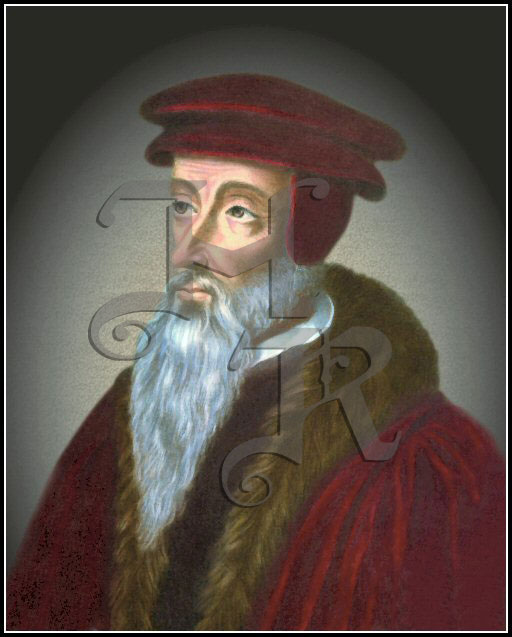
Calvin's 500th birthday

Well I wasn't ready for a big post on Calvinism today. I probably should have been. Calvin is going to have a very good 500th birthday. 20 years ago Arminianism was still the rage and Calvinism quite out of fashion, the fashion has completely shifted. As we have approached the 500th Calvin and TULIP have made a come back. Individually I've never been able to get over the basic problem that I can't believe myself to be morally responsible for anything I have no control over. So:

If I am born in a state of Total depravity my rejection of God is not an immoral act. If election is Unconditional then God is the one doing the choosing not man. The morality of choosing or not choosing sits entirely with him not the creation. If atonement is Limited then by preselection then the actual sacrifice is of no meaning to those outside the circle of the eternally elected. It has nothing to do with me anymore than Polish law. If grace is Irresistible then even those saved have no merit. Finally with Perseverance of the saints we remove any merit to the saved for even keeping with the program.

The whole system turns salvation into a lottery. Whether you are saved or not becomes as moral an issue as whether you have brown or blue eyes: something you had no control over, predetermined at birth that you can't change or alter. I don't and shouldn't consider brown or blue eyes a moral issue. While there is fairly good biblical support for these doctrines the net effect of going to this extreme is to rob God's redemption of any sort of morality at all. From a human perspective you are either damned or saved completely at random, like winning at craps. The answer to faith vs. lordship in this system turns out to be neither.

Calvin himself built a nightmare police state (see Calvin the totalitarian) that collapsed because of his petty jealousy, intolerance and inability to address the human condition as it really exists and not as he theorized it should exist (see Anne Le Fert (Questionable Excommunication part 2)).

His current followers have created the most dishonest translation of the bible in a generation to back their views. I've celebrating 21 years on the internet, and when I compare the religious dialogue today to what existed on places like soc.religion.bible, or talk.misc.christian 21 years ago there is no question that a culture of intolerance exists today that did not exist then. Virtually every bible blogger has been banned from one board or another, there is a casual culture of "I don't like that view so I won't allow it to be expressed" that the moderators 2 decades ago (equivalent of blog owners) would have seen as outright anti-American. In society at large the new Calvinism hasn't had a chance to have much impact. But the traditional arminian baptists were firmly in the camp of Roger Williams (founder of Rhode Island) and believed that religion in America (at the time the colonies) should be always consensual. Today ideas like Christian reconstructionism, which argue that the state should enforce religious codes get their legitimacy among Protestants from Calvinism (though the Catholic Church suffers from a similar confusion). The fact that I'm having to write posts like Why not to keep going on with discipline after a member leaves is a direct reflection of a general rejection of Williams core idea that religion is something freely entered into between a person and their god. The very defense that Machen presented at his trial involved Christian liberty from Church taxes (see Excommunication of Gresham Machen for details) and would be rejected by the very churches he has founded today.

The mechanism by which this casual intolerance has spread is the the idea and ideology of presuppositional apologetics, and this has led to this breakdown in communication that existed 2 decades ago. While presuppositional apologetics are fully consistent with TULIP, they create a situation in which one of the parties believes the other is simply not worth discoursing with. The "unelected" are in an permanent irreparable state of delusion. Refutations of Reformed popular ideas don't need to be considered because they are true by presupposition. Counter arguments are satanic, because they contradict these presuppositions. Counter evidence is dismissed because it challenges the sufficiency of scripture. And on and on and on. Under this model dialogue becomes impossible.

It is from the reformed camp that the Patriarchy and complementarian movements are arising, creating a biblical mandate for the causal sexism of the 19th century (see defense against patriarchy part 6).

So on his 500th birthday I'd like to congratulate Calvin on making fashionable once again the absolutely worst aspects of European religion. There is no question that Calvin is one of the great theologians and biblical thinkers of all time. It is unfortunate that his short comings and not his strengths are what we are today confronted with.

    Saturday, March 7, 2009

    10 reasons men should not be pastors

    1. A man’s place is in the army.
    2. The pastoral duties of men who have children might distract them from the responsibility of being a parent.
    3. The physique of men indicates that they are more suited to such tasks as chopping down trees and wrestling mountain lions. It would be “unnatural” for them to do ministerial tasks.
    4. Man was created before woman, obviously as a prototype. Thus, they represent an experiment rather than the crowning achievement of creation.
    5. Men are too emotional to be priests or pastors. Their conduct at football and basketball games demonstrates this.
    6. Some men are handsome, and this will distract women worshipers.
    7. Pastors need to nurture their congregations. But this is not a traditional male role. Throughout history, women have been recognized as not only more skilled than men at nurturing, but also more fervently attracted to it. This makes them the obvious choice for ordination.
    8. Men are prone to violence. No really masculine man wants to settle disputes except by fighting about them. Thus they would be poor role models as well as dangerously unstable in positions of leadership.
    9. The New Testament tells us that Jesus was betrayed by a man. His lack of faith and ensuing punishment remind us of the subordinated position that all men should take.
    10. Men can still be involved in church activities, even without being ordained. They can sweep sidewalks, repair the church roof, and perhaps even lead the song service on Father’s Day. By confining themselves to such traditional male roles, they can still be vitally important in the life of the church.
    Taken from Serving Bread blog

    Thursday, March 5, 2009

    Censorship and dishonesty in evangelical Christianity

    So I'm coming off a debate on TeamPyro blog where bunch of my comments are being deleted to effectively shift what I'm saying. That is to say that Dan Phillips is deliberately misrepresenting me, lying in other words.

    Now he is a well respected guy, and he was cavalier about it so I assume he does this sort of nonsense on a regular basis. What's interesting is not the dishonesty, but the pattern I've seen on these blogs. I have to wonder why is it that so many conservative Protestants do not consider dishonesty to be sinful in practice? This approach of casual misrepresenting what the other side has to say is considered perfectly acceptable on most conservative Christian blogs. I was just yesterday reading a review of the Voice translation which was quite good, but there was an underlying untruthfulness throughout the review. I've posted many times on the issues with the ESV supporters lying about the TNIV.

    The patriarchy people have certainly done it as documented a zillion times here. Of course the various Christian cults do it. You don't see this among liberal Christians or atheists, they are generally upset if they have misrepresented someone's view, and quick to correct. You see it much more rarely among Catholics. I don't have a good theory as to why this is. So I'll open the floor up. What is your feeling about Christians blogs and integrity? Do think it is lower for conservative protestants? Is so any idea why this is? Does it come from Calvin's influence?

    Sunday, January 4, 2009

    Six Degrees

    I've been seeing quite a bit of discussion on the issue of the dangers of climate change, so I thought I would throw my $.02 on the topic. I've been reading articles about carbon emission and climate change.... and the conventional wisdom seems about right. It is hard to know for sure how much C02 is required to get various levels of temperature change but most of the models seem sensible.

    The next issue is what is the effect of that climate change. Mark Lynas' Six Degrees is an attempt to put together a series of "what if" scenarios regarding temperature change. The book is scientific but heavily biased towards disaster. This is unfortunate because the book is really unique in trying to put together a good picture of what long term climate change means and address issues of positive feedback. Positive feedback is one of the great dangers. An example is as the earth warms there is less ice which reduces the reflectivity of the earth which increases the tempature even further. But there are also additional sources of carbon that are released as the earth heats, many environmentalists are of the opinion that we can see cycles like:
    3 degrees of warming causes the amazon to dry
    The Amazon trees aren't designed to be dry so this causes massive forest fire, i.e. the forest burns to be replaced by different vegitation
    That releases so much carbon that we hit 4 degrees.
    At 4 degrees of warming the carbon under the permafrost is released which casues 5 degrees of warming
    At 5 degrees of warming the ocean bottom warms and we get releases of hydrocarbons stored at the bottom of the ocean which gets us 6 degrees of warming

    That is they believe there are no equilibrium points close to our current temperature. Lyons does a nice job of explaining these sorts of positive feedbacks and documenting them. He introduces one to the literature on environmental impact quite well.

    Where I think he fails, is that he is generally pessmistic well beyond what is called for. For example he frequently talks about drought leading to crop loss, when describing changes in waterflow that humans have dealt with successfully for 6000 years. In a world with much more rain, more moderate tempatures and excellerated plant growth due to excess carbon he tries to make a case for famine and it implausible.

    A perfect example of this is his description of why plants can't migrate north fast enough, not counting the fact that humans can move plants north, particularly crops as fast they need.

    So I can recommend the book because it seems to be the best overview of the literature it feeds the very feeling many have that the environmentalist movement is screaming chicken. What we need is a version of six degrees which is written assuming aggressive adaption.

    Sunday, July 13, 2008

    Bible translation: Ebonics and the aorist tense

    Ebonics is the term for black English, what used to be called "Jive". The aorist tense is a verb tense that doesn't exist in standard English to indicate actions that are ongoing. "The river is flowing through the valley" gives an example of the sort statement that would be rendered in aorist, a river was flowing, is flowing now and will flow in the future. The NET bible has a great description of the aorist its notes:
    The aorist tense is characterized by its emphasis on punctiliar
    action; that is, the concept of the verb is considered without
    regard for past, present, or future time. There is no
    direct or clear English equivalent for this tense, though it is
    generally rendered as a simple past tense in most translations.

    The events described by the aorist tense are classified into a
    number of categories by grammarians. The most common of these
    include a view of the action as having begun from a certain
    point ("inceptive aorist"), or having ended at a certain point
    ("cumulative aorist"), or merely existing at a certain point
    ("punctiliar aorist"). The categorization of other cases can
    be found in Greek reference grammars.

    The lack of this tense in standard English creates all sorts of mistranslation and misunderstanding issues when translating the bible.
    Romans 6:8 Now if we have died (aorist) with Christ, we believe that we will also live with him.
    When did we die with him? At the time with of his crucifixion? Paul in Greek indicates it is an ongoing process we die with him at all time or outside of time, but this is not apparent in English. So why not borrow from Ebonics the aorist tense? They have one, and the dialect is understandable to most English speakers (even if it sounds less refined). To use it you use the verb to-be followed by an -ing verb. Many standard English speakers don't recognize this construction as being aorist but it is understandable and with very little effort they can learn the meaning with respect to time easily. In both standard English and Ebonics we do a similar thing with the verb "have" to adjust the temporal nature, so for example "had taken" is the past perfect for to-take in standard English. The past perfect indicates the "taking" happened at an indefinite time in the past and may be ongoing, as contrasted with "took" which is completed by the present.
    I had taken (past perfect) the train many times.
    I took (past simple) the train last week.

    Using the Ebonics aorist tense will sound ungrammatical but it is accurate. The English reader can then identify the tenses in the Greek. So we would translate the above as:
    Romans 6:8 Now if we be dying (aorist) with Christ, we believe (present simple) that we shall live (future simple) with him
    This cuts into the snob appeal but frankly I think accuracy is far more important than snobbery. Anyone agree or disagree?

    _____

    After this post was made Sepia Mutiny (in a post entitled Brown Man's Bible) seemed to agree with this assessment in their review of the NCB.

    Saturday, July 12, 2008

    6 principles of Christian debate

    Tom over at NeoFundamentalist had a great list of points which I think are terrific for any Christian debate. So I'm reposting them here (slightly decontextualized):
    1. Disagreement with you or your theology does not equal disagreement with God. Quit treating those who don’t accept your arguments as if they have rejected the gospel.
    2. Quit assuming things in your arguments that you refuse to affirm in their propositional form
    3. Admit it, you really don’t understand this as well as your confidence seems to indicate
    4. If what you are trying to articulate has contradictions (no human answer), admit it up front and don’t try to white wash that truth
    5. Don’t retreat to the theological hail mary, unless you are willing to let your opponent use the same shtick
    6. If you find yourself agitated and incredulous, go read 2 Timothy 2:19-25 with special attention to verse 24

    Wednesday, June 18, 2008

    The Excommunication of Saint Paul


    To Paul:

    Glory be to God the Father above who gives us the truth and who allows us to grow in the knowledge of him. It is through possessing and guarding the purity of this truth that our relationship with the Lord prospers.

    Our dearest brother, we are very encouraged to read how God has prospered your ministry and has brought many to a knowledge of him. We pray that God will mercifully guide you back to Jerusalem in complete safety, for we know that storms abound on the Great Sea at this time of year.

    The occasion for this letter our dear brother is that we have heard some disturbing news about your teachings and doctrine. We are sure that it is all a misunderstanding and that you will continue to follow the true teaching that we profess and guard. Yet being that we have the daunting office of guarding pure Judeo-Christianity, we must confront you on several accounts. For various doctrinal positions exist on the way of Christ, but Judeo-Christianity is the true doctrine that we must protect.

    As you well know, our Savior was born a Jew and preached his Gospel among Jews. All of his early followers were Jews and those in the highest Apostolic offices are all of Jewish lineage. Though it has been a rather difficult transition to navigate, we are doing our best to share the Gospel with Greeks on the Jewish terms in which The Way has been imbedded. It is our firm conviction that the Gospel must be preached in terms of our rich Jewish faith that we all trust you place tremendous confidence in. The Greeks must adopt the Jewish expressions of our faith, for to do any less would be to invite the very destruction of Jesus’ message. The only true understanding of The Way must be in keeping with the teaching of our Judaizing associates.

    And this brings us to the point of our letter. We have heard about several clashes between yourself and our Judaizing associates. Is it true that you actually told a Gentile congregation, “To the Greeks I have become like the Greeks”? Are you not aware of the dangers in such accommodation to Greek culture? Can you truly believe that you remain a follower of The Way while arguing for such a blatant abandonment of Judaism? Do you not realize that Greek culture is antithetical to the Gospel since it believes in a pantheon of gods and has unbridled immorality?

    What is worse than this is that you tell Greeks who would profess to follow our Lord that they need not abstain from consuming meat sacrificed to idols, making them double hounds of hell in their Greek accommodation and disdainfully pagan practices! In fact, in your attempt to “become like a Greek” you have even shared that you despise your Jewish heritage, considering it all for loss. And yet, it is this Jewish heritage and culture that bears the purest expression of our doctrine!

    We are also greatly alarmed to hear of your sermon on Mars Hill in the hellish city of Athens. Though your speech was rich in quotations from pagan literature that is vile and of no use to Judeo-Christians, we have no record of you directly quoting a passage of scripture. Is it possible that you have reduced the role of the Bible in your ministry to a mere footnote at the end of your message? Surely even you can see that you have fallen down a slippery slope away from Judeo-Christianity in your neglect to cite the Bible in your teachings.

    You may have love, but we have the truth. The truth is what sets us free, while you have accommodated to the Greek culture with your emphasis on love. To have only love without our doctrine is like a loud drum that makes a lot of noise, but never truly follows the score of the music, rendering it of no use. To have love apart from the doctrine of Judeo-Christianity is to ultimately have nothing. They’ll know we are Judeo-Christians by our doctrine.

    Are you not aware that you are sacrificing the pure doctrinal foundation of Judeo-Christianity? You have accommodated to a culture that is completely antithetical to the Gospel message. The world is going to hell and yet you persist in playing with the pantheon of the Greeks and their “unknown” God!

    If you dare to continue teaching a doctrine other than the pure Gospel message that is encapsulated in the Jewish culture, may you forever be anathema from Judeo-Christianity! You may call yourself a follower of our Lord, but you are surely not one of us. During our next meeting we will be voting on whether or not you should be excommunicated from our council. Your doctrine places you on the outside of our group and any hope of reinstatement rests solely on your return to the purity of our teaching on our terms.

    May the grace and truth of our Lord be with you.

    James
    Peter
    and The Judeo-Christian Apostolic Council

    ______

    The above article is not mine. I found it on the TheOoze, and asked the author, Ed Cyzewski if I could repeat it here. He graciously agreed. Ed Cyzewski is the author of Coffeehouse Theology: Reflecting on God in Everyday Life and blogs at In A Mirror Dimly. The essay is an exploration of Christianity's interaction with culture and is not intended by the author to have an anti-Semitic message in any way.

    Monday, May 19, 2008

    gossip vs. lobbying

    Whenever there is a movement to try and make change within churches that structural problems (particularly abusive ones) those people involved are accused of gossip. Since this word is being misused to cover political activity I think its worth giving a real definition:

    gossip- Idle talk or rumor, esp. about the personal or private affairs of others. That is talk about others with no intent to take action

    What is really going on is not gossip but rather:

    lobbying- a group of persons who work or conduct a campaign to influence to alter policy towards the group’s interests.

    Lobbying is not idle dissent rather it is a necessary and important part of any process of being governed and participating in that government. Another part of clarity:

    undermine- to injure or destroy by insidious activity or imperceptible stages, sometimes tending toward a sudden dramatic effect.

    So the good way to determine if you are gossiping or lobbying is this. If your goal is to change policy you are lobbying if it is to change leadership you are undermining them. These two often get confused

    The SBC has faced a pretty strong attack by the blogsphere on the their leadership in the Georgia Convention and drafted resolution on blogging which essentially these mixes  two issues in a way that is very common:
    BE IT ALSO RESOLVED that we reaffirm the historic method of administering our agencies and institutions through elected boards of trustees, and we call upon bloggers to cease the critical second-guessing of these elected leaders; and
    Leaders whose choices and policies can not be "second-guessed" and critiqued are not in any meaningful sense "elected". That's why the constitution grants this as a fundamental right to people, even above and beyond voting. That is many classes of people denied the vote were still permitted to join into organizations to lobby for redress of grievances. The historical method for administration of government in the United States most certainly includes an open discussion of policy and lobbying for changes in said policy. Not merely conducting elections without a press.

    Friday, January 18, 2008

    Stepping off the bus

    I waited a day to post this to check my feelings and they haven't changed. The discussion on Domestic Discipline went very badly. My original interest in anti-Patriarchy was accidental this blog picked up traffic when I explored the Jen Epstein (original and follow-up) case and I went where the need was. While I am still willing to help people who are fighting church discipline in Patriarchal churches, and I don't retract one word of Defense against Patriarchy I'm today publicly breaking with the anti-patriarchy crowd.

    An argument has come forth again and again that Patriarchal churches encourage domestic violence. Christian Domestic Discipline was often used as an example of this encouragement.
    This has now come to be a deliberate lie spread with malice and forethought. That is a strong charge that demands clarity and I will move to that directly below.

    First off it is a lie. It is clear that Patriarchal churches are no more tolerant of DDers than they are of any other sexual minority, they show the same hostility and persecution. It is clear that every time I've asked people about this topic in their own churches whether the activity was either encouraged or even meaningfully addressed the answer is no. It is clear that patriarchal churches deal with domestic violence badly but they do consider it a sin. It is clear that every single example examined of people participating in CDD/DD do so in a fully consensual way completely in line with their cousins in the wider BDSM community. Quite simple Patriarchal churches do not encourage CDD/DD and CDD/DD is not domestic violence.

    Second it is deliberate. On numerous occasions I've attempted when this issue has come up to raise the issue that CDD/DD is not domestic violence. Every time that has occurred there has been censorship. I raised the issue on this blog and faced controversy about even allowing for links. Yet the claim continues. When confronted with counter evidence most of the people spreading this lie simply refuse to discuss it.

    Those that did discuss it that had pushed this agenda have in general done so with a level of maturity I would understandable but disappointing in a middle school child but intolerable in a high school age child. Without exception taking part in these discussions are parents and the vast vast majority are over 40.

    Still, I struggled with my conscience here. Was I really asking too much in asking Fundamentalists to discuss this topic like adults. Was I simply imposing my own values and demanding they conform to them? The claim was being made over and over again that to discuss such a thing is inappropriately and immoral, and I was wrong to be doing so. I've thought about this and I have come to the conclusion I was not asking to much. I remembered an incident from a decade ago which was similar:

    When I taught bio statistics there was a section in the book with a large number of problems which about plant reproduction, that assumed a detailed understanding. Almost without exception the students had forgotten how plants have sex. So in teaching the material I always had to do a refresher on plant reproduction and I always used as my basis human reproduction since it was one piece of related materials that I was sure the students were at least somewhat familiar with. The lecture was explicit and graphic much more so then I have been asking for the last six months.

    For example to explain the various purposes of certain chemical reactions I used the analogy of male ejaculate and its effects on the vagina. I walked through in detail the production of male ejaculate and the corresponding chemicals. I did so with a diagram of the male and female reproductive system on a projected slides. At one point there was a question a type of plant where the pollon could fall down the wrong tube and I made an analogy to anal sex.

    There were muslim woman with head coverings, fundamentalists, evangelicals, jehovah's witnesses, Sikh's who were in that lecture. They took notes, asked questions and did a nice job on a problem set that took them about 4 hours. That is, quite simply secular and religious student alike were able to engage with and absorb material about sex in an age appropriate manner. They had no problems there were no complaints, and the students certainly had no problems complaining about many other issues. I had a greater number of students turn in that assignment then most and the grades were higher, secular and religious students alike.

    So no I don't think I'm asking too much. I have no choice but to conclude that there is simply a reluctance to honestly admit that what was claimed is occuring is not in fact occuring. The why brings us to the next point.

    It is malicious. Patriarchal leaders have continuously rebuffed the assertion that their teachings lead to an uptick in domestic violence. CDD/DD seems to be an effective propaganda tool in convincing people that patriarchy can lead to domestic violence. That is this assertion is designed to humiliate patriarchal leaders. The fact that it further victimizes a sexual minority is seen as being of no consequence.

    And finally forethought. This topic has come up before on multiple occasions in multiple forums. Many of the people spreading this lie have been challenged on it before. To spread a lie because one refuses to hear the truth constitutes forethought.

    I've tolerated homophobia because I understand that from their perspective it is not a lie. But this issue has been bothering me for six months. I've tried my best to assume good faith.

    If the anti-Patriarchy bus has gotten to the point that it is willing to defame Patriarchy with deliberate lies, its time for me to step off. In no way should this be seen as an endorsement of patriarchy. Their one case of this does not begin to rise to the level of the dozens or hundreds on the other side. But for me at least I can't see enough of a difference between the two shades of gray.

    Sunday, December 30, 2007

    Come some ye faithful

    I thought I'd write a Christmas Carol expressing many people's actual views:

    O come, some ye faithful,
    Joyful and triumphant,
    O come ye, O come ye to Bethlehem;
    Come and behold him,
    Born the King of angels;
    O come, let heterosexuals adore him,
    O come, let heterosexuals adore him,
    O Come, let heterosexuals adore him, Christ the Lord.

    God of God,
    Light of Light,
    Lo! he abhors not the Virgin's womb:
    He abhors just most other woman
    Very God,
    Begotten, not created;

    O come, some ye faithful,
    Joyful and triumphant,
    O come ye, O come ye to Bethlehem;
    Come and behold him,
    Born the King of angels;
    O come, let the married men adore him,
    O come, let the married men adore him,
    O Come, let the married men adore him, Christ the Lord.

    Sing, choirs of angels,
    Sing in exultation,
    Sing, all ye republican citizens of heaven above;
    Glory to God
    In the highest;

    O come, some ye faithful,
    Joyful and triumphant,
    O come ye, O come ye to Bethlehem;
    Come and behold him,
    Born the King of the USA;
    O come, let Republicans adore him,
    O come, let Republicans adore him,
    O Come, let Republicans adore him, Christ the Lord.

    See how the shepherds,
    Summoned to his cradle,
    Leaving their flocks, draw nigh to gaze;
    We too will thither not very hard
    and Bend our joyful footsteps;
    This be the last child of unmarried parents we need ever care about.

    O come, some ye faithful,
    Joyful and triumphant,
    O come ye, O come ye to Bethlehem;
    If you can afford the plane
    then Come and behold him,
    Born the King of angels;
    O come, let the middle class adore him,
    O come, let middle class adore him,
    O Come, let middle class adore him, Christ the Lord.

    Child, for us sinners
    Poor and in the manger,
    We would embrace thee, with love and awe;
    Who would not live thee,
    Loving us so dearly? Refrain

    O come, some ye faithful,
    Joyful and triumphant,
    O come ye, O come ye to Bethlehem;
    Come and behold him,
    Born the King of angels;
    O come, let us adore him,
    O come, let us adore him,
    O Come, let us adore him, Christ the Lord over all the right people.

    Thursday, December 27, 2007

    350th Anniversary of the Flushing Remonstrance

    The NYTimes had an editorial on this but today is the 350th Anniversary of the Flushing Remonstrance which was a predecessor to the 1st amendment protections. Its nice to see how far back the tradition of tolerance really goes. See this site dedicated to this key event.

    Monday, September 24, 2007

    Rules for Due Process

    This blog is mainly directed at standard members of churches. This is one of the rare posts directed at pastors. Its a series of some short advisories on how to avoid church splits and embarrassment due to discipline. The key point is due process, transparency and openness.

    1) Any excommunication will have substantially less support 2 years after it is administered.
    As the anger dies down more general issues begin to be questioned and people will become more circumspect. Make sure you will still have sufficient support even if people explore the issue from a variety of angles.

    One of the best ways to do this is to have a recorded vote of the majority affirming a specific statement (and allow for various statements), like what is done in superior courts. You want people on record agreeing to the statements and you want them to feel comfortable that the statement that they signed reflected their views at the time. It is not neccesary that the statements reflect their current view however.

    Another key point is to convict on the underlying issue or not at all. It can be very tempting to go for an easy conviction with the major crime in mind (see link for a pastor recommending exactly this approach). In the example the pastor advocates excommunication for contumacy when the underlying issue is embezzlement. Do not take the cheap way out and go convict on a minor offense when the major offense is the real reason. The evidence for the major offense will disappear and often the minor offense information is fairly weak. Without the major offense the actions on the minor offense will seem excessive and will soon lack support.

    2) Keep good records
    Make sure you have good records, regarding the facts and the debate. Think about how much effort courts go to in maintaining records. Make sure that you have written records from everyone. So for example if you assert that person X did Y to Z have a deposition from Z confirming that fact, and have Z sign it. If you can't do that then have 2 witnesses to every charge and again have them signed.

    If there was counter evidence presented at the time have excellent records as to how it was investigated and why it dismissed. The congregation will excuse leadership for making errors, they won't excuse leadership for not performing due diligence.

    3) Avoiding bullying the membership.
    Avoid things like bullying to get people to support leadership's position. Bullying of members will work in the short term and then fail in the long term. Members who reluctantly support will look for excuses to change sides as pressure increases. Leadership can easily get an excommunication motion through with 20-30% support. But they will need 65%+ support (and better yet 90%+) to defend it publically once the critique starts.

    So, if the congregation is split on the appropriate penalty choose the lessor one.

    4) Have a documented reconciliation / restoration process and keep it open.
    Often excommunication is confused with anathema if the disciplining church is not seen as having a reasonable reconciliation option. Be sure that the level of repentance required is understood in advance and supported during. A congregation can split after the fact if the convicted offers an apology that some see as insufficient and others believe is sufficient. 3 types of apologies should be differentiated:
    1. A censure does not require repentance just to stand for it i.e. the person needs to acknowledge the censure and remain in obedience after its administration. They are not required to affirm the justice of the censure
    2. A call for repentance can be met via. a simple apology
    3. A demand for restitution requires actual fruits.
    If you want a higher form make sure that is clear at the time that the punishment / excommunication occurs.

    5) Have the extent of punishment or shunning be public.
    Leadership should attempt to punish acts of cruelty perpetrated by members against former members, that your church does not approve of. Light censure of such acts is always seen as encouragement. Remember if you don't oppose it you encouraged it.

    6) Have a genuine appeals process
    It is important that the membership and outsiders believe the appeals process is genuine. Make sure the people involved in the appeals process were not the ones involved in the original conviction. If possible make sure that at least one appeal has been successful recently. The pre-existing appeals process will lower external criticism and will relieve pressure within the church. People who come to believe the original act was unjust or factually incorrect should be encouraged to enter into the appeals process. This helps separate dissent from division. There will always be a court of appeal, either the church will pick it or the public will.

    7) Have a clear policy about what to do about old sins successfully covered up.
    Either have a "statute of limitations" or indicate you excommunicating solely for the ongoing cover up. If there was no ongoing cover up then leave it be. People will be extremely angry about the cover up but anyone not lied to will think the anger is unjustified. These issues are very divisive.

    8) Get a detailed written summary from the accused.
    You want written statement of the accused's position on every specific acts and charges. There can be a great deal of disagreement about which facts were or were not confirmed after the fact. If you can get a confession even one with lots of clauses and justifications, get it.

    Monday, September 3, 2007

    Darkness at Noon and church discipline

    I had always felt church discipline was primarily mental and social. The defendant disciplines themselves and is torn apart by guilt. While the shunning is painful, remaining in the shunning community and desiring to be accepted by them is what makes shunning ultimately effective. The decision to allow a disciplinary situation to escalate to excommunication is the decision to break with that community. For example all non-Amish are essentially shunned by the Amish, but none of them are bothered by it.

    But the people being disciplined don't see it that way. In writing about church discipline one is often struck by the guilt factor at play. Christians who are stuck or are planning on their break can sometimes have trouble seeing cultish tactics for what they are. In email dialogs with people who are discussing their feelings about their own discipline the literary figure they most remind me of is Rubashov from the book Darkness at Noon. The book details the "discipline" of Rubashov who was an elder communist party official, during the time of the Stalinist purges.

    Throughout the book the readers, the interrogators and Rubashov all know the story will end with Rubashov being shot. Church discipline cases end with people being humiliated, shunned and emotionally damaged; not with a bullet; so this whole piece will need to be metaphorical. The story starts with Ivanov (a friend and contemporary of Rubashov that runs the detention center, the analogy would be a church elder) trying to convince Rubashov to participate in his own humiliation and not just simply die in an administrative trial. That is in this analogy, suicide plays the role of fleeing the discipling church. Choosing to go for a public trial is allowing the excommunication and the shunning to take place. While the sins are reversed once these two changes are made, I think one can read Ivanov charge to Rubashov as the condemnation that a person under discipline would receive for simply leaving the community and not allowing the discipline process to play out:
    "My point is this," he said; "one may not regard the world as a sort of metaphysical brothel for emotions. That is the first commandment for us. Sympathy, conscience, disgust, despair, repentance, and atonement are for us repellent debauchery. To sit down and let oneself be hypnotized by one's own navel, to turn up one's eyes and humbly offer the back of one's neck to Gletkin's revolver--that is an easy solution. The greatest temptation for the like of us is: to renounce violence, to repent, to make peace with oneself. Most great revolutionaries fell before this temptation, from Spartacus to Danton and Dostoevsky; they are the classical form of betrayal of the cause. The temptations of God were always more dangerous for mankind than those of Satan. As long as chaos dominates the world, God is an anachronism; and every compromise with one's own conscience is perfidy. When the accursed inner voice speaks to you, hold your hands over your ears. ..."
    Sins are reversed, but I can make minor changes and rewrite the above as:
    "My point is this," he said; "one may not regard the world as a sort of metaphysical brothel for emotions. That is the first commandment for us. Pride, fear, lust, the esteem of the world are for us repellent debauchery. To sit down and let oneself be hypnotized by one's own navel, to simply flee and disappear into the world --that is an easy solution. The greatest temptation for the like of us is: to deny the authority of the church, to repent, to make peace with oneself. Most people who fall away did so because they fell before this temptation. Most great reformers fell before this temptation, from Luther to Wesley to Muntzer and Machen; they are the classical form of betrayal of the church. The temptations of ego were always more dangerous for mankind than those of despotism. As long as sin dominates the world, ego is an anachronism; and every compromise with one's own will is perfidy. When the accursed inner voice speaks to you, hold your hands over your ears. ..."
    The reason I think this analogy is helpful is that it will allow the person being subjected to the discipline to separate the means from the ends. They will seem similar and analogous means being employed for evil ends. From this they can examine the means and methods without allowing the underlying "sins" to confuse the issue. None of my readers are likely to believe that advocating for larger tonnage submarines deserves being denounced and killed. In the case of Stalinist discipline the people were confessing to serious crimes they couldn't possibly have committed. In the case of Church discipline people are often targeted for non crimes they did actually commit both sides know is a non crime. Orwell commented on Kostler that he so well captured the fact that, "fanatics don't just want you to obey them: They want you to agree with them."

    Rubashev is guilty as well, and its his guilt that leads to him to plead guilty to six capitol offenses he never committed. Ultimately there was a "sin" he believes he deserves to be punished for. A few years before the book he had genuinely fallen for his secretary, and while she had trusted him completely he, earlier in the purges, had let her die in an act of cowardice:
    "What I don't understand," he said, "is this. You now openly admit that for years you have had the conviction that we were ruining the Revolution; and in the same breath you deny that you belonged to the opposition and that you plotted against us. Do you really expect me to believe that you sat watching us with your hands in your lap--while, according to your conviction, we led country and Party to destruction?"

    Rubashov shrugged his shoulders. "Perhaps I was too old and used up. ... But believe what you like," he said.

    Ivanov lit another cigarette. His voice became quiet and penetrating: "Do you really want me to believe that you sacrificed Arlova and denied those"--he jerked his chin towards the light patch on the wall-- "only in order to save your own head?"
    When this interrogation takes place he isn't ready to answer that final question "yes". Again with the analogy of death to humiliation this works the same way in many discipline processes. People can't stop obvious injustices within their own church because they are afraid of losing heir social position within the church. They feel dishonest and often they feel they deserve the ostracism once it happens, and this creates guilt along with anger. And just as it does in the case of church discipline these previous acts are what drives the subject to buy into the deceptive process and allow it to continue:
    "Listen, Rubashov," [Ivanov] said finally. "There is one thing I would like to point out to you. You have now repeatedly said ‚'you'--meaning State and Party, as opposed to‚ 'I'--that is, Nicolas Salmanovitch Rubashov. For the public, one needs, of course, a trial and legal justification. For us, what I have just said should be enough."
    In the end Gletkin is able to tie the sin Rubashov actually committed to the one he is being accused of:
    "You doubtless also know that the declaration you made at that time, which you have just described as a lie, was decisive for the passing of the death sentence on Arlova?"

    "I was informed of it." Rubashov had the feeling that the whole right side of his face was drawn into a cramp. His head became duller and heavier; it was with difficulty that he prevented it sinking on his breast. Gletkin's voice bored into his ear:

    "So it is possible that Citizen Arlova was innocent?"

    "It is possible," said Rubashov, with a last remainder of irony, which lay on his tongue like a taste of blood and gall.

    "... And was executed as a consequence of the lying declaration you made, with the object of saving your head?"... "And after all that, you demand to be treated with consideration?" Gletkin's voice went on, with the same brutal correctness. "You still dare to deny criminal activities? After all that, you demand that we should believe you?"

    Rubashov gave up the efforts to keep his head straight. Of course Gletkin was right not to believe him. Even he himself was beginning to get lost in the labyrinth of calculated lies and dialectic pretences, in the twilight between truth and illusion. The ultimate truth always receded a step; visible remained only the penultimate lie with which one had to serve it. And what pathetic contortions and St. Vitus's dances did it compel one to! How could he convince Gletkin that this time he was really sincere, that he had arrived at the last station? Always one had to convince someone, talk,argue--while one's only wish was to sleep and to fade out.

    And it is this sin which Rubashov actually did commit that leads to his deterioration and the distortion of the truth:
    For at their second or third meeting already, as it were, an unspoken agreement had come into existence between them: if Gletkin could prove that the root of charge was right--even when this root was only of a logical, abstract nature--he had a free hand to insert the missing details; "to dot the i's", as Rubashov called it. Without becoming aware of it, they had got accustomed to these rules for their game, and neither of them distinguished any longer between actions which Rubashov had committed in fact and those which he merely should have committed as a consequence of his opinions; they had gradually lost the sense of appearance and reality, logical fiction and fact. Rubashov would occasionally become conscious of this in his rare moments of clear-headedness, and he would then have the sensation of awakening from a strange state of intoxication; Gletkin, on the other hand, seemed never to be aware of it.
    In the end Gletkin for the discipline process and makes an explicit analogy to Christianity. The purpose of the discipline process is to allow the community to blame its problems on specific individuals rather than its own structural flaws:
    "You may be right in some ways," Rubashov said finally. "But it was you who started me off on this question. What use is it to invent scapegoats for difficulties, the natural causes of which you have just so convincingly described?"
    "Experience teaches," said Gletkin, "that the masses must be given for all difficult and complicated processes a simple, easily grasped explanation. According to what I know of history, I see that mankind could never do without scapegoats. I believe it was at all times an indispensable institution; your friend Ivanov taught me that it was of religious origin. As far as I remember, he explained that the word itself came from a custom of the Hebrews, who once a year sacrificed to their god a goat, laden with all their sins." Gletkin paused and shoved his cuffs into place. "Besides, there are also examples in history of voluntary scapegoats. At the age when you were given a watch, I was being taught by the village priest that Jesus Christ called himself a lamb, which had taken on itself all sin. I have never understood in what way it could help mankind if someone declares he is being sacrificed for its sake. But for two thousand years people have apparently found it quite natural."
    In the case of church discipline people who are disciplined are often told not to go public with their stories. They are told not to simply sever ties. Capitulate to the shunning and just cut the ties they have themselves. Again with the analogy of leaving community and death Rubashov also struggles with the same issue. Legitimate churches should have nothing to hide. "Airing the dirty laundry" is a common accusation thrown at those persons who have decided to tell their story. They are accused of damaging Christ's witnesses. Rubashov is also faced with the same choice. Now discredited the only thing he can do is act as the scape goat:
    "I don't see," he said, "how it can serve the Party that her members have to grovel in the dust before all the world. I have signed everything you wanted me to sign. I have pleaded guilty to having pursued a false and objectively harmful policy. Isn't that enough for you?" He put on his pince-nez, blinked helplessly past the lamp, and ended in a tired, hoarse voice: "After all, the name N. S. Rubashov is itself a piece of Party history. By dragging it in dirt, you besmirch the history of the Revolution."

    "To that I can also reply with a citation from your own writings. You wrote: " ‚'It is necessary to hammer every sentence into the masses by repetition and simplification. What is presented as right must shine like gold; what is presented as wrong must be black as pitch. For consumption by the masses, the political processes must be coloured like ginger-bread figures at a fair.' "

    Rubashov was silent. Then he said, "So that is what you are aiming at: I am to play the Devil in your Punch and Judy show--howl, grind my teeth and put out my tongue--and voluntarily, too. Danton and his friends were spared that, at least."

    Gletkin shut the cover of the dossier. He bent forward a bit and settled his cuffs: "Your testimony at the trial will be the last service you can do the Party."
    It is only right before his death that Rubashov ultimately repents of the sin that drove the whole process, "A sentence swam vaguely in Rubashov's memory: "It is the Revolutionary's duty to preserve his own life." Who had said that? He, himself? Ivanov? It was in the name of that principle that he had sacrificed Arlova. And where had it led him?"

    Christopher Hitchens wrote an interesting book review where he comments that Ivanov and Gletkin were so well presented in their interrogation that Darkness at Noon converted some to communism. Its my hope that the book offers a level of insight for those people trying to understand what happened to them. As an aside, seriously Sandeep blog has a similar take on the book to what is presented here.

    Wednesday, August 22, 2007

    How Kosher Was Khomeini?: The Case Against Religious Coercion

    This is an essay by Shmuley Boteach from the early 1990s when he was an Oxford. Its always been one of my favorites and so I'm copying an abridged version here
    __________

    .... Thus, when the students asked me to go and speak to the stall holders, I had no intention of disrupting these friendly terms, but rather to ask that they promote their own cause without needing to denigrate or scorn the cause of the Jewish students just across from them. Surely, there were aspects of Islam that were not militantly opposed to the existence of the State of Israel. But I met with a hostile response. We were told categorically that we had no right to interfere with what they were distributing.

    When we pointed out that we felt we did have a right to oppose literature which could be used to incite hostility, even violence, to the Jewish and Zionist organisations at the University, one of their representatives picked up one of the tracts by Khomeini and began to read aloud of the Zionist crimes and vices which had to be eradicated.

    Familial Origins in Iran

    I told this student that my father was born and raised in Iran, specifically from the city of Ispahan. Although he has lived for many years in the United States, all his culture and mannerisms were still distinctively Iranian. I, therefore, could not support the views of the new Iranian leader which were so blatantly hostile toward the many such Jews around the world who loved Iran and had contributed so much to its society.

    The student looked at me quizzically. 'You're a Rabbi, are you not?' I replied in the affirmative. ' 'Are you observant of your religion?' the Palestinian student inquired, to which I again responded in the affirmative. 'Then how could you not support this cleric who had done so much to rescue Iranian culture form Western atheism and the systematic destruction of religious belief that pervaded Iran before his rise to power.'

    Divide and Conquer

    This was a classic tactic. Divide and conquer. This clever student of course noticed that the six Jewish students surrounding me were not observant, they weren't wearing Yarmulkes. So better to establish how he had more in common with me, than even they, and thus obscure the real issue of his distribution of offensive material.

    But the Jewish students standing in the wings seemed uneasy with his question. Perhaps I, as a Chassidic Jew, indeed shared the goals of my Arab counterpart. Did I too not share this zeal for religious observance spreading and dominating secular culture. I did not want to debate the issue here, where the issue was clearly a different one. But when we got back to our stall, defeated because they did nothing in response to our protests, I told the students that I would address his question that Friday night at our Centre, and ever since then I have been forced to return to the issue of religious coercion, and explain the Jewish view on the subject, on many occasions.

    Khomeinism in a Jewish Guise

    I should say that it not only serves as a response to Khomeinism and religious coercion in general, but to Israeli politics in particular. Anger at the Israeli religious establishment has been quite vociferously expressed at Oxford since I arrived. The idea that small religious parties should blackmail the Israeli government into enacting religious measures in order for them to join a ruling coalition is one of the greatest sources of anger pertaining to Jewish matters that I have seen displayed by friends and acquaintances. Even those who are most sympathetic to the Jewish religion in general, and to traditional Judaism in particular, feel that these efforts are counter-productive, and I tend to agree. While I would support enforcing the closure of businesses on the Sabbath, the same way England has legislation penalizing businesses from opening on Sunday, I completely oppose the mixing of religion and politics, for the reason this article demonstrates.

    Rabbi Meir Kahane' Legacy

    When I first arrived in Oxford, I became friendly with an extremely left-wing Israeli D.Phil student who was writing a paper on Kahanism. While he despised everything Rabbi Meir Kahane stood for, he had a soft-spot for religious tradition, and once asked me to explain the differences between the policies of the Lubavitcher Rebbe, who clearly would like to see a more observant State of Israel, and those of Meir Kahane. 'It appears to me,' he told me, 'without wishing to be offensive, that the goals of your Rebbe and Rabbi Kahane are similar.'

    'In many aspects,' I retorted, 'that may be so. But there is a fundamental difference which separates them. Whereas Kahane has set out to change governments, the Lubavitcher Rebbe has set out to change people, one at a time,' and this answer sufficed for him.

    [I should mention that I had a great deal of respect for this student, because he didn't just talk about liberalism, but embodied it completely. He may have hated Kahane for his policies, but he was mature enough to separate that from any hatred of the man. When, two years later, I awoke to the BBC headlines that Rabbi Kahane was mercilessly gunned down by a Palestinian assassin, I called this student, who today teaches politics at Tel Aviv University, to tell him what had happened, and he was genuinely saddened. 'Shmuley,' he told me, 'I did not support a word he uttered. But he did not deserve this. Nobody deserves this.' Other students, who preach of how they value human life, and criticise the Israeli military for shooting Palestinian stone-throwers, openly chuckled and told jokes to each other, in my presence, when they heard the news.]

    Khomeini Is a Serious Force Reckon With

    For more than a decade an elderly sage with long white beard, traditional black head-dress, and passionate religious zealotry dominated world news in a manner equalled only by the State of Israel. He challenged the technologically advanced world we live in, and our appraisal of modern society and its meaning, by showing that a theocratic state, steeped in the uncompromising ways of ancient tradition, could sustain itself in relative stability despite its turbulent revolutionary beginnings. His name, of course, was Ayatollah Ruholla Khomeini, and although he is now gone,the legacy he left his people remains as strong as ever.

    Upon hearing of his death, I myself breathed a sigh of relief even while watching with sympathy the intense grief and anguish of the Iranian people as they abused their bodies at the funeral processions for the Imam. As I observed this spectacle, a powerful question suddenly overcame me. Why was I, an observant Jew, along with the entire body of traditional Jewry, not more sympathetic to his cause? Here was a man, as the Arab student at the Polytechnic had argued, who had rescued the mores and zealotry of religion from the secular and acculturated values of the Shah's regime. He acted like a modern-day Maccabee, rescuing a traditionally religious people from the smouldering cauldron of hellenism, the by-product of which is often the moral decadence of an atheistic melting-pot. He took a westernized society committed to the spiritual suicide of the people and delivered religious belief from systematic liquidation. Are these not values to which Judaism also aspires?

    Khomeini's reform and Transformation of Iranian Society

    A brief examination of the Ayatollah's legacy will help clarify my inquiry. Khomeini denounced the immorality of Western civilization to the point where Western and immoral tended to become synonymous. 'Westernisation,' in his vivid language, meant "[a man] parading around the streets with a European hat on [his] head watching the naked girls" (i.e., the women in provocative Western dress).

    The look up in origianl published version in Chai Today for this.IRP programme is required reading in Iranian schools and argues: "For decades our society has been consuming imported culture and education. In order to strengthen their political and economic imperialism, the world-devourers have used cultural imperialism." Therefore, Western patterns of life had to be eliminated in all areas: food habits, clothing fashions, architecture and city planning, education and manners.

    In order to gain 'cultural independence,' Khomeini declared a 'cultural revolution' in the spring of 1980 (Khomeini's speech on 26 April, 1980) and established the 'Headquarters of Culture' to coordinate the effort.' To date, the government Islamisation programme has indeed affected nearly every area of life in Iran. Media, art and entertainment, clothing, and the family all became subject to moral regulations. Prostitution and pornography were of course totally outlawed, carrying with them severe punishments. The fundamentalist regime also imposed hijab (the Islamic code of dress) on women so that none could be immodestly attired. Western-dressed Iranian women were denounced as "cabaret dancers" by Khomeini. Even coeducational schools were outlawed having been classified as "houses of prostitution, and thought of adversely affecting the concentration of the student due to the emotional appeal of the opposite sex (NY Times, 22 April, 1979)."

    Khomeini's regime converted the media, artistic expression, and films into morality exercises promoting religious culture and values. The IRP characterized the media as a 'university' for the education of the population. It declared that 'printing anti-religious ideas and beliefs is not permitted in Islamic society.' Radio and TV programmes were changed to reflect 'the true message' of religious life,' as well as 'art so that it be in conformity with genuine Islamic and religious themes.'

    Watching Iranian television became the kind of experience any parent could trust would only serve to enhance a child's Islamic education, rather than exposing their son or daughter to secular violence and nudity. A typical day's broadcasting is as follows: Channel 1: 4:30 pm - Sign On; 4:35 - Verses of the Holy Koran; 4:45 - English News; 5:00 - Programme for children; 6:00 -Provincial News; 6:30 - Sports Report; 7:10 - Call To Prayer; 7:30 - Desert Architecture; 8:30 - Iranian and World News; 9:30 - Economics Programme; 11:00 - Programme in Arabic Channel 2: 10:00 - Sign On; 10:05 - Verses from the Koran; 10:10 - Children's Programme; 11:05 - Family Programme (lessons in sewing, child care); 16:45 - Sign on Again; 6:50 - Verses from the Koran; 7:00 - Cultural, Art and Economic News; 7:10 - Call to Prayer; 7:20 - Lessons in Arabic; 9:20 -Selection of Students by the university; 9:50 - Miscellaneous (cartoons, etc.); 21:50 - The Shrines of Iran; 22:30 - Iranian and World News.

    The regime also monopolised all means of mass communication, banning secular papers in an attempt to prevent sexual perversion from infiltrating the country's consciousness. Religious songs became the principle musical expression, replacing rock and disco; mixed dancing was forbidden.

    No one in Iran seems to doubt that since the Revolution, and the introduction of its fierce penalties, crime rates, and violent crime in particular, have dropped considerably. Iran at present enjoys one of the lowest urban crime rates of any country in the world.

    Consonance with Jewish Goals

    In striking similarity to the rudimentary principle of Judaism being a complete way of life, Khomeini's Iran represents a return, not simply to the ideals of Islam, but to the maximalist conception of it as a guide to the details, great and small, of everyday life. As it happens, Khomeini published his own commentary on these matters. In the 1950's, at the Faizieh Theological School in Qom, his reputation as a teacher was growing and people would write to him from all over Iran to ask his opinions on points of religion. These opinions were collated and turned into a book, which he published in 1960; after this he was entitled to refer to himself as an ayatollah.

    The book, Towzhih al-Masa'il, or 'Explication of Problems', is a best-seller in Iran, an immense volume which contains more than three thousand rulings on the conduct of daily life and religious observances, from laws on inheritance to matters of personal cleanliness and the right way to slaughter animals.

    Nothing was private enough to prevent Ayatollah Khomeini from laying down the law on it. In Western eyes, at any rate, it seems intrusive to describe the different varieties of bleeding in a woman's menstrual flow or to prescribe the correct way to face when defecating, and the correct way to clean oneself afterwards. Similarly, the Torah espouses laws governing all of our actions, encouraging one to know G-d 'in all your ways'.(editor, please check reference)

    A further significant point to note is that Khomeini did not only heighten the observance of Islam in Iran, but in many cases he coerced Jews into observance of their religion as well. In one instance, told to this author by one of the individuals who personally witnessed the event, he summoned a group of wealthy Jewish industrialists to his chambers. All of them had factories that were operative on Shabbos and, to their amazement, he condemned them for forsaking their commandments. He declared that in an Islamic country, just as Friday was revered by Muslims, the Sabbath had to be revered by Jews. He concluded by ruling that henceforth, if any Jewish factory opened on Shabbos the owner would be punished with a firing squad. All present complied.

    Clearly, ideologies differ in cmplexity, and although it may not be so complex as others, Iranian fundamentalism, like many totalitarian ideologies, nevertheless provides its adherents with a sense of mission and a holistic concept of persons and society, and it has its own distinctive style and rhetoric. The original question posed to me then returns: In light of the moral, ethical, and religious achievements of this man of faith, why was no voice heard from within the camp of traditional Jewry to applaud this religious leader while alive, or eulogize him at his death?

    Khomeini's Brutality Is not A Complete Response

    No doubt Khomeini's brutality serves to repulse us from praising the Imam's achievements, and it may well be argued that the results in Iran may not owe as much to the vigilance of the Komitehs as to the punishments that are inflicted. But in explaining traditional Judaism's outright rejection, nay repulsion, of everything Khomeini stood for, means aside, the reason of his brutality alone remains somewhat superficial. Aside from the means taken to achieve his ends, traditional Judaism has so far latched onto somewhat incomplete reasons for its outright dismissal of Khomeini's regime. Surely, in the quest for intellectual maturity humans should have learned to extract good from evil. If the Imam's goals were good but his means evil, we should at once commend his ambitions and achievements, yet remain able to decry his methods. Yet Khomeini as an icon of religious values and leadership has been utterly rejected by the Jewish world, goals and methods alike.

    When Politics ousts Religion

    I suggest that Khomeini was rejected not merely because the gore of his use force to accomplish religious ends repelled the traditional Jew. Rather, it was the light that this use force shed on the Imam's very perception of religion as a whole, a perception which is loathsome to traditional Judaism, which has engendered a loathsome response to his policies.

    There are those who believe that religion is a mountain to be climbed, a goal to be reached. To them, a person's status in the eyes of G-d is ascertained solely by where he or she now stands. If any actions manifest any tendency toward evil, then, in essence, the person has accomplished nothing. It is only the one who arrives at the peak of the mountain, whose journey has reached its climax, who has banished all evil from within him, who may justly be referred to as 'a religious individual'. In the minds of the leaders of this school of thought, it is not a person's slow progression in affinity with G-d which is commendable, but his rapid rise to the throne of the Creator.

    Judaism does not subscribe to this outlook. In the eyes of Jewish thought it is not the goal which is significant, but the path. The distance a person has traversed, how far they have progressed, is what G-d measures. Of the Talmud's most central themes is the idea that a returnee to Judaism (Baal Teshuva) is far greater than a tzaddik, the reason being that the returnee has come much further, and travelled a far more torturous path. The Talmud even declares, 'In the place where a ba'al teshuva (returnee) stands, a tzadik cannot stand. look up the referenceThe tzadik, whose righteousness and good deeds by far outweigh those of the returnee, may indeed be standing at the mountain's summit, and from his vantage point he may gaze down at the struggling climb of the ba'al teshuva, as he slowly rises from the ash-heap in search of sublime and transcendent meaning. Yet, the tzadik is pronounced inferior for he did not travel any great distance to reach the mountain's top. Everything was handed to him on a silver-platter, from the cheder he was sent to by his parents, to the yeshiva he attended with the rest of his friends. The Baal Teshuva, on the other hand, has clambered from the abyss of spiritual despair and has, at the very least, started back onto the proper path by his or her own efforts.

    Not Righteousness But Transformation

    Stated in other words, what the A-mighty searches for in man is not righteousness, but transformation. A person's gradual change from being a materialistically inclined, indulgent organism governed by physical needs and tendencies, to a being with spiritual foresight and disposition. This is the purpose of religion and G-d's calling to man. What the A-mighty desires is that we make and effort to change ourselves for the better. Not that we merely become good. He desires to see a significant expenditure of effort on our part. He want to see that we give a damn. Therefore, if one is born righteous and is reared in a religiously wholesome environment, he will not be judged by how good he is, but by how much better a person and more righteous an individual he became, after embarking on the road of life.

    Becoming an Outwardly Oriented Individual

    Torah and mitzvot are the critical ingredient in the development and growth of humans. With every passing mitzvah one slowly becomes an outwardly oriented individual. Whereas a child's first words on learning to speak are 'Mine!', or 'Give me', each mitzvah is a lesson in reorienting this natural state to one of giving, rather than taking. As a living organism man first learns to take rather than give. It is vital to his existence. One needs to be clothed, fed, bathed, nurtured, and loved if one is to survive. Our initial stage of life is almost completely passive, and as our first lesson about life we internalize the idea of drawing in all that others are prepared to do for us. What changes this process of taking is of course responsibility. People become older and they learn that their contribution on a microcosmic level, such as family and friends, and on a macrocosmic level, such as community and the world at large, is very much needed if the world is to continue.

    But before life makes any demands of the human, the very first calling to which he must respond is to that of His Creator. Before a child is old or responsible enough to help Mommy around the house, he first learns that he must say a blessing before eating food, and must give a coin to charity every day. The reason: because G-d needs him, and he must therefore learn to give, and not just to take. In slow gradual increments, then, man learns, through a religious education, to transcend physical necessity and focus on the needs of others.

    Further still, the spiritual person learns to utilize their own physical desires for the purpose of understanding another's needs as well. When one understands how vital it to feel loved, one understands how critical it is to display love to someone else, for their needs are the same. And as in the process of learning how to give, and in the process of becoming an outwardly-oriented individual, man learns to discover G-d and simultaneously emulate His ways. In the words of the Talmud, 'Just as He is kind, so too should you be kind.'editor; find ref. and add one or two more lines from the quote. It is not good for Man to be alone

    Marriage serves as the classic illustration of the principle of growth outwards to reach others. While a mitzvah in its own right, marriage is also the premise for the fulfilment of many other mitzvot, not least among them being the perpetuation of humanity and the Jewish people. Why did G-d choose the framework of marriage as necessary for human existence? To paraphrase the Bible, why indeed is it not good for man to be alone?

    Marriage serves as the classic illustration of this principle, and the ultimate institution to constantly reeducate an individual away from his or her natural predisposition. Even the mechanical structure of marriage is such that one must learn to give constantly, from the highest things, like comforting a husband during tragedy, to the seemingly insignificant, like refraining from eating until one's wife comes to the table. It is precisely these 'mechanical' matters which are of pivotal importance to the success of every marriage.

    Children Continue a Process of Reorientation

    Soon children follow and every parent is faced with a new challenge in the art of generosity: giving without receiving in return. An infant is born with no saving grace, save that of the parent's intuitive love for the child. They have not yet become doctors or lawyers, or generated any nachas for their parents. Yet their dependence on their parents is absolute, needing everything from food to mobility. There are no guarantees that the child will ever reciprocate. Indeed, scores of adult children abandon their parents to nursing homes in their old age. Nevertheless, the idea of a parent coercing his offspring to sign a contract at birth mandating that child-care will be provided only on the express condition that child agree to aid his parents in their hour of need, is laughable. No mountain is too high, no sea to vast, to impede the unrestrained love of parent to child. But, why is this all so important?

    Because through the love, giving, kindness, and compassion of everyday experience, a married man or woman learns to find G-d. An man slowly transforms himself into an outwardly oriented being, he learns to perceive an existence higher and greater than himself. One learns to obey the commands of that Being. Not for the prospects of reward, but out of deep-seated love and conviction. And man becomes G-dly.

    G-d's laws are for people, not states

    When religion is practised for any external consideration, force being the extreme amongst them, inner transformation cannot follow. Nothing changes, no-one becomes spiritual, and the purpose of religion is defeated.

    Ayatollah Khomeini changed government without changing people. His theocracy was not merely tarnished by the methods it pursued in procuring religious observance, but was actually supplanted by those methods. He succeeded in bringing about a religious government, but not a religious society. And although, it may be argued, Iranian society today may indeed exist at the summit of the spiritual mountain, officially void of sexual deviance, theft, rape, or impropriety, the population did not climb that mountain. Rather, they were like a cannonball shot there by the religious zeal of the Iranian National Guard, with fear and intimidation serving as gunpowder. The population did not traverse any distance; no-one struggled with internal self-doubt, none felt the terrible tension of religious turmoil that tears the soul asunder, and the internal dialectic that make up the religious experience. In short, they were not personally touched by the sublime hand of G-d which can only be felt when one works with oneself decades to reshape oneself into a vessel for G-d. Time will tell whether the changes Khomeini brought to Iranian society will have any permanency, but one suspects that if the constraints were removed the people would naturally fall back to their previous existence.

    Khomeini's Objective: Seize the Reigns of Government

    The transformation of government, irrespective of whether the people kept pace, was Khomeini's intention all along. It accounts for his infatuation with absolute governmental control. He always argued the importance of politics and domination of the political and social systems by 'true believers'. In his own words:

    "If in a society all its members are Muslim and they observe Islam in their personal lives while their social relations are not governed by pure Islamic laws, it is not an Islamic society. On the other hand, if in a society all its members are not Muslim.... or some of its members are weak Muslims and do not behave according to Islam in all their personal obligations, while the values and laws governing social relations are Islamic, that society is Islamic." (Mavazihi-Ma pg. 26)

    In yet another of Khomeini's works, Al-Hukumat-ul-Islamia, he states:

    "When a Mujtahid who is just and learned stands up for the establishment and organisation of the government, he will enjoy all the rights in the affairs of the society that were enjoyed by the Prophet, and it will be the duty of the people to listen and obey (him) and this Faqih and Mujtahid will hold the supreme power in the government and the management and control of social and political affairs of the people in the same way as the Prophet and Hazrat Ali (used to do)." Clearly, to Khomeini the exercise of governmental control was the highest religious achievement, something Judaism cannot embrace. The Jewish world-view is about changing people through direct exposure. It sees religious ultimately growing from the grass-roots level of the human condition and human experience.

    put shagalov in hreReligious Conviction and Governmental Control Become Synonymous

    Samuel Huntington has commented that "the most important political distinction among countries concerns not their form of government but their degree of government." (Political Order in Changing Societies) The main characteristic of Khomeini's fundamentalist ideology is its totalitarian approach to politics. The regime sought to promote the politicisation of all spheres of social and even private affairs: its world view is in fact predicated upon a removal of these distinctions. In Islamic government, Khomeini had asserted: "there is not a single topic in human life for which Islam has not provided instructions and established norms." (Islamic Government in Islamic Revolution, pg. 80) The IRP program states that it aims at establishing a 'tawhidi' ('unitary') society, "a society in which Islamic values, commands, and laws govern all social relations." (Mavazihi-Ma, pg. 26)

    What this has lead to is the politicisation of religion itself. In his many fiery speeches, Khomeini favoured violence and oppression to bolster religious observance, but did not offer a convincing, positive argument for the beauty and necessity of religion. The lack of explanation was not due to personal ignorance; after all, he was a recognised scholar. Rather, it is fundamentally inconsistent with his view of religion. In his eyes the only matter which was of importance was that the people should adhere to Islamic living standards. As government serves this purpose well, it has become the personification of Khomeini's religious zeal. He had no desire for the inner transformation of his people. Shiite fundamentalism has abrogated its intellectual dimension, and when this happens, fanaticism is sure to follow.

    Suppressing Human Development

    Khomeini has indeed expressed a distaste for the natural state of humanity, preferring to stunt it rather than allow it to fully develop. "An Islamic regime must be serious in every aspect of life," the Imam said in a broadcast on Iran Radio six months after the Revolution. "There is no fun in Islam. There can be no fun or enjoyment in whatever is serious." To Judaism, happiness is representative of extraordinary energy and fervour which should be cultivated and nurtured for the service of G-d. Like everything, it can be utilised for evil or for good. Khomeini was disinterested in Man's spiritual growth and chose to eliminate any form of joyous expression, fearing that if frivolity were allowed to coexist with religion it might prevail. Judaism thrives on our constant use of material existence for good, despite the temptation that it be used otherwise. In this manner one constantly reaffirms that everything is in G-d's possession, thus substantiating His absolute sovereignty over creation.

    Thorn in the side of Khomeini

    This uncompromising outlook on life led Khomeini to oust his self-appointed successor, Ayatollah Montazeri, only months before he died. While Khomeini genuinely believed that the establishment of Islamic government in Iran was an end in itself, Montazeri saw the capture of political power by the clergy only as a means which ought to be used in order to improve the material and spiritual conditions of the people. Khomeini maintained that, if need be, people should be forced to behave in an Islamic way. Montazeri, for his part, argued in favour of persuasion through setting good examples.

    Both men advocated a return to the simple life and helped popularise such notions as frugality, a reduction in one's expectations from life, a cut in consumption and a distaste for luxuries. Both wanted the Iranians to sleep on the ground, sit on the floor, eat only one or two simple meals a day, make do with very few clothes and be content with living in one or two rooms (Amir Taheri, The Spirit of Allah, pg. 294.)

    The difference was that Montazeri believed that human nature of itself tends towards good if given the chance. Khomeini, however, pinpointed the little devil he saw hiding within every person, and thought nothing of enforcing the good at bayonet point if necessary. Between 1981 and 1985, the two leaders adopted basically contradictory positions on almost every major issue, with Montazeri playing the liberal and Khomeini remaining true to his image of the uncompromising radical.

    Good Cop/Bad Cop

    Opponents of the regime accused the two men of offering an Islamic version of the soft-cop/tough-cop interplay in order to confuse the people. This is almost certainly unfair: the two men genuinely had variant approaches. The difference between Khomeini and Montazeri extended to the important issue of exporting the revolution as well. Montazeri emphasized proselytisation and propaganda; Khomeini inclined to see an effective answer only in the use of force. In 1981 the Imam ordered the creation of an 'Army of Twenty Million' which, when and if fully ready, would fight to hoist the flag of Allah in every capital of the world.

    In the light of the foregoing considerations, Judaism chooses to reject and finds repulsive Ayatollah Khomeini's entire perception of religion, not merely its implementation. The individual to Khomeini's conception of religion is what the incongruent piece of a puzzle is to the hammer. Although the piece may not fit or even belong to that puzzle, it must be banged in place. The puzzle must be complete overall. Needless to say, with sufficient banging its form will eventually be altered, and it will enter, but the fact that it has a different picture printed on it will forever remain. Judaism does not believe in people being banged out of shape so that they fit the spiritual puzzle. Rather, it advocates an inner transformation so that the human pieces fit the puzzle both in shape as well as content, in deed as well as in heart. The result is a truer, more beautiful whole that will no longer be a puzzle.

    Attacked by Colleagues

    When I first expressed this idea in print, in an American Jewish magazine by the name of Chai Today, I received several letters of disagreement, one of which was exceedingly abusive and was subsequently published in an alternative Jewish periodical. In the letter, the author attacked me for my 'misrepresenting Judaism' and accused me of possessing 'a severely misguided understanding of Judaism at best, and a liberal mind-set at worst.'

    The author, who is an Orthodox rabbi from California, made the following argument, which I shall summarize.

    He maintained that I had misrepresented Judaism because indeed Judaism did possess many of the mechanisms employed by Khomeini. Judaism calls for very severe physical punishment, in many cases capital, for religious transgression. For example, one who breaks the laws of Shabbos can be put to death if all the criteria is met, such as witnesses and warning, etc. Moreover, for even the slightest religious infringement, the offender would receive lashes from a Jewish court, in Temple times. 'What Rabbi Boteach is seeking to do,' he concluded, 'is to whitewash Judaism of its similarities to the Khomeini regime, so that it conforms with today's liberal values.'

    To be sure, the good Rabbi, whose attack saddened me because of its hostile tone, is correct. Indeed Judaism does mandate physical punishment for religious offenders. Where he grossly errs, however, is in his understanding of the purpose of these warnings and punishment, and what the Torah is seeking to achieve by stipulating them.

    One Apple Should Not Infect Another

    The purpose of these punishments is not to make the population religious. Rather, their purpose is to preserve the religious observance and devotion of a population that is already religious.

    To explain: G-d wishes that people approach religion from a stance of joy, interest, and personal involvement and conviction. There are numerous statements throughout Jewish literature which show that these qualifications are not just preferable in serving G-d, but rather they are what it is all about. If so, the question may be asked, why did G-d institute such severe punishments for religious infraction? The answer is that these laws were instituted for a society which used to be the norm, i.e., the majority of the population were observant and devout. The problem was, what if a few rotten apples began to appear within the group? In order to prevent them from infecting everyone else with their faithlessness, and to protect the offenders themselves from acting upon their faithlessness, the Torah instituted that punishment be instituted both as a deterrent, as well as a way of weeding out those who could adversely effect the faithful.

    The Sanhedrin Exiles Itself

    That this is true is easily demonstrated by a passage from the Talmud, which tells of how forty years before the destruction of the second Temple, when the terrible suffering which was being visited upon the Jews caused them to be a lawless people, many of whom having incurred a capital penalty under Jewish law, the Sanhedrin, the high Jewish court, exiled itself from its chambers on the Temple Mount. The reason: They were only allowed to pass capital judgments when they were in the chamber, and there were so many who were deserving of it, they did not wish to put so many to death.

    In other words, once the death penalty no longer proved an effective means of retaining and preserving the spiritual devotion of the people, it was abandoned. And although the Sanhedrin could have used it as a means to reinstall fear into the population and thus make them religious again, this is not what Judaism is about. It is not engendered by fear or intimidation, but by love, allegiance, and an inner desire on the part of man to reach out to his Creator.

    ______

    See Also:
    • Aaron Blumer, Are rules dangerous part1 part2 (takes the opposite position from this essay)