Showing posts with label interfaith. Show all posts

Friday, January 6, 2012

Sects to the Reformation


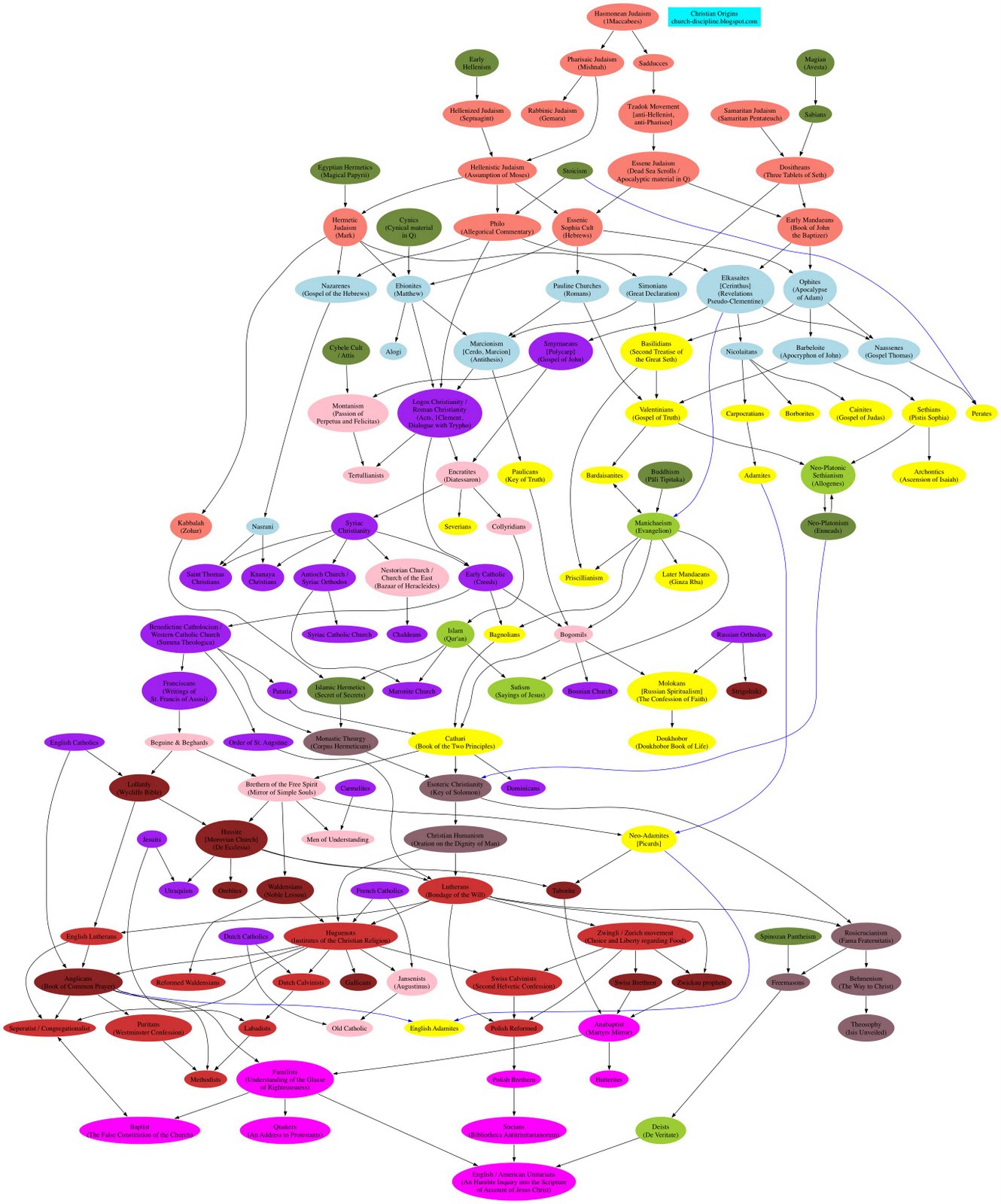
This image is large and may not be laying out clearly on your browser.  Try clicking on the image to see it better, and magnify if you need to.  Or click on this link to download or view isolated.    I had originally put this image together up to about the year 1000 for a debate on Christian origins.  I got inspired to expand when I had to discuss origins of the Reformation and ideas from it.  I think this is a useful reference post, and also might lead to some good discussion.

Because the reformation is so huge, I had to limit scope.  At this point the chart covers the origins of the those sects that came to America from England, the English reformation and development.  It doesn't include the minor dissenting sects that don't appear to have had influence on America.

Arrows are for strong influence or descent, these sects are interacting with one another and passing ideas between them just as religions today do.  Coloring of the arrows is to help reduce visual complexity, and it doesn't mean anything beyond that.  Where possible I've tried to include a sample work in parenthesis for each sect making it clear how I'm using the term and also demonstrating at a glance the evolution in thought.  It is also for the early part, letting the chart do double duty explicating the origins of the bible.

In terms of the colors of the circles:

Salmon is for groups that are Jewish sects.  They may have Christian aspects but they are not yet meaningfully Christian and are in some sense fundamentally Jewish or Samaritan.
Light Blue are proto-Christianities.
Yellow are full blown alternate Christianities, from ancient times.  "Gnosticism" used in the religious sense.
Purple is for groups that I can meaningfully call Catholic, western or eastern rite.
Pink  groups that broke away Catholicism. Sects that I would agree are "schismatic".
Dark Olive Green non-Christian religions.
Yellow-Green is for non-Christian groups with strong Christian influence.
Muddy Pink I'm using for Hermetic Christianity.
Dark-Brown for proto-Protestantism
Red-Brown for Protestantism
Magenta for the non-creedal sects of the Radical Reformation and their descendants 
___

A few things worth noting.

  1. Christianity originated from a variety Jewish and Samaritan cults, which were not part of the mainstream nor the branch that survived.  
  2. Catholicism represents a coming together of various groups.  An early partial consensus, not some sort of original revelation.
  3. Christianity has always been highly diverse.  
  4. The elements of the Protestant Reformation are very old.  In a way, the Cathari and the Beguines are the father and mother of the reformation, with Christian Humanism playing an important role.  Everything develops from the 13th century combination of:
    • primitivism
    • a desire for a lay church
    • a theological neo-gnosticism lite
    trying to fight their way to the surface for the next 300 years. While the specifics in classical Landmarkism are a bit off, the general idea of Christian primitivism are quite correct.   
In terms of remaining issues there are two that bother me.  The first is that the Catholic section is terrible.   Originally the chart just covered Catholic development up to the ancient world, so I only needed a 1/2 dozen Catholic sects.   This one covers Catholicism in the middle ages, so to do it justice I'd probably need over a 100 sects and the diagram would be a sea of purple with a border in the other colors.  I think top priority for the next round, is a full treatment of the origins of the Eastern Sects.

The other is I'm not sure about the Ebionites and the Elkasaites.  If anyone has any suggestions there about the relationship please jump in.  I think I'm going to need to jump into some Dead Sea Scrolls material to work this out.

______________________________________________

See also:

Saturday, July 30, 2011

Data on anti-Mormonism

So I ran into some interesting data on anti-Mormonism from How Americans View Mormonism.  They asked the question of why people didn't trust or support Mormons in positions of leadership 45% of Americans were able to answer that question.  And there answers basically amounted to: I don't know enough about the religion and what I know I don't like, but it was all about the religion:

25% Ignorance -- Don't know enough about Mormons to trust them
9% Different Beliefs -- Non biblical beliefs.
8% Polygamy -- Belief that this practice is still widespread though secret.
6% Non Christian -- Openly don't like non Christians and don't consider Mormons Christian.
5% Fear of unknown -- People don't know enough about Mormons and thus fear them.
5% Book of Mormon -- Disapprove of making your own bible
4% Joseph Smith -- Believe he is a false prophet
4% History -- racism, polygamy....

Conversely I did an article a few years back with corresponding numbers for Evangelicals relative to people under 30s (includes Christians) and you can see the stark differences:
  • antihomosexual 91%
  • judgmental 87%
  • hypocritical 85%
  • old-fashioned 78%
  • too political 75%
  • out of touch with reality 72%
  • insensitive to others 70%
  • boring 68%
There was no complaints what-so-ever that people didn't know what Evangelicals stood for.  The Mormon list is primarily defined by knowing Mormons and elsewhere on the site they comment quickly on how knowing any Mormons drops the antagonism of these issues down.  Their religions doctrines seem to create opposition, and some level of fear.  But other than polygamy and history there is a complete lack of stuff Mormons have done that irritates people.  I was actually shocked proposition 8, or the anti-ERA position didn't show up.  I think in both cases the LDS took a strong political stand and then backed off when they started picking up enemies on the left faster than they were making friends from their activism.

This contrasts strongly with evangelicals where depending how you could only a single issue of doctrine is on the list, antihomosexual.  Rather everything else comes down to some variant of obnoxiousness.  And the percentages are much much higher.  Which is something I'd also point out to Mormons who seem intent on joining evangelicals.  This looks like a perfect case of out of the frying pan into the fire.

As an aside the authors give an example of where Mormonism becomes non-understandable , which I found interesting. The claim to be the only restored church is viewed very negatively.  Quite simply the vast majority of people are unable to even understand the claim that Mormons are making. Slightly rephrasing to this triple:
  1. Christ organized a church.
  2. Men changed it.
  3. It has been brought back.
Brings to light the vast majority of Christians are not rejecting #3 but rather have never considered #1 before.  Once the position is understand 48% agree immediately with point #1.  Of that 48%, 74% agree with point #2 immediately.  And that probably corresponds to a all but a few percent of non-Catholics,  And then from there 1/2 the people that agree to points #1 and #2 are willing to consider the Mormon claim for #3.  Once this is understood as 3 separate claims:
  • 17% -- Maybe Mormons are right
  • 36% -- Mormons are probably wrong
  • 29% -- Mormons are definitely wrong
  • 18% -- No opinion
Without the need for anything more than a 3 paragraph explanation.

____


See also

  • Poll on American attitudes towards Mormons from 2011 (link)

Friday, August 21, 2009

UBS process, ecumenicalism at its best


The United Bible Society publishes the most heavily used Greek text the Novum Testamentum Graece. Now like everyone else who gets involved in translation discussion I disagree with their choices, their are times I would have made gone the other way. But what I think is fantastic is how they have created a successful ecumenicalism, providing a model that is truly able to cross the divide and get a major complex religious issue resolved in a way that everyone can stand behind the final product. Roman Catholics participate in the UBS process the same as Protestants. Jehovah’s witnesses and Adventist translations are pulling from the same UBS text. And not only across denominations: from the ESV (conservative) to the NRSV (NCC) to the very liberal scholars version to even atheist translations like Price the UBS/NA is the standard. Asian and African churches are pulling from the same source. The Jewish Publication Society is a member of the UBS and the NJPS (1985) is pulling from the UBS Hebrew which means that even the Jews are part of this ecumenical unity. This is one of the great ecumenical triumphs of this century that doesn't get appreciated nearly enough.

This didn't have to happen. Had the IBS/Zondervan stuck with the MT or the TR for the NIV we could have had a very situation today where Christians wouldn't even have agreement on what the original texts say.

But more than this I’ve argued that this process is a model for ecumenicalism that actually worked and continues to work. I’m not sure why people who are interested in ecumenicalism don’t pay more attention to an area where the goals were achieved, full Christian unity. Think about that for a second, at least in one example humanity was are able to publish unified collection of books on an important topic which is authoritative to all Christiandom! We don’t have this breadth of consensus on the creeds.

What makes it work is the focus on consensus. Essentially the system looks like
  1. A scholar makes a proposal about a verse based on manuscript evidence.
  2. If that proposal gains wide acceptance as a variant in the academic community it will become a textnote in the UBS. For a new one that probably be around the NA29, but this is one going back a long time.
  3. Some translators will start to incorporate it, generally as a possible variant which will draw larger debate and discussion.
  4. If that proposal continues to draw a consensus it will become the default reading in the Greek.
  5. At that point essentially all translations will attach a note similar to the one for 1John 5:7-8 that you see in Protestant bibles. This creates awareness of the issue and builds consensus among the whole community.
  6. Some translations will start to move the older variant to an appendix which will again widen the debate. If there are strong objections the process may stop here.
  7. Most translations will move the older variant to an appendix
  8. Some translations will start to drop the appendix.
  9. The older variant will be dropped entirely across the board.
Which is to say everyone is treating everyone respectfully and consensus emerges. At every step their is a check back. The system is very conservative but is open to discussion and reason inside the system.