Showing posts with label interview. Show all posts

Tuesday, August 4, 2009

King James Onlyism Interview (Concluding points, part 4)

I've completed taking the stuff from Will Kinney's argument. You can read Part1 Part2 Part3 at these links. I will say that I did learn something important from the debate. It is essentially impossible to debate in favor of the "modern versions" vs. the KJVonly (MT/NA27 based) and maintain a belief in word for word inerrancy. 1 Samuel 13:1 is a perfect example from our conversation in the first part:
Even in the most conservative version around the ESV you drop the notion of word for word preservation:
Saul was . . .[a] years old when he began to reign, and he reigned . . . and two[b] years over Israel.
a. 1 Samuel 13:1 The number is lacking in Hebrew and Septuagint
b. 1 Samuel 13:1 Two may not be the entire number; something may have dropped out

Will gave another similar list:
The following short list is just a sampling of the divergent and confusing readings found among the contradictory modern bible versions. There are numerous other examples. Among these “details” are whether Jeremiah 27:1 reads Jehoiakim (Hebrew texts, RV,ASV, NKJV, KJB) or Zedekiah (NIV, NASB); whether 2 Samuel 21:8 reads Michal (Hebrew texts, KJB,NKJV, RV,ASV) or Merab (NIV,NASB), or 70 (NASB, NKJV, RV, ASV,KJB) being sent out by the Lord Jesus in Luke 10:1 or 72 (NIV), or the 7th day in Judges 14:15 (KJB, NKJV, RV, ASV) or the 4th day (NASB, NIV), or God smiting 50,070 men in 1 Samuel 6:19 (KJB, RV,ASV,NASB) or 70 men slain (NIV, RSV), or there being 30,000 chariots in 1 Samuel 13:5 (KJB, NKJV, RV, ASV, NASB, ESV) or only 3000 (NIV, & Holman), or 1 Samuel 13:1 reading - ONE/TWO years (NKJV, KJB, Geneva,Judaica Press Tanach), or 40/32 (NASB 1972-77) or 30/42 (NASB 1995, NIV), or _____years and.______and two years (RSV, ESV), or even “32 years old...reigned for 22 years” in the 1989 Revised English Bible!; 2 Samuel 15:7 “forty years” (Hebrew, Geneva, NKJV, NASB, RV) OR “four years” (NIV,RSV, ESV,NET), or whether both 2 Samuel 23:18 and 1 Chronicles 11:20 read THREE (Hebrew texts, RV, ASV, NKJV, NIV, NET, Holman or THIRTY from the Syriac NASB, RSV, ESV), or 2 Samuel 24:13 reading SEVEN years (Hebrew, ASV, NASB, NKJV) or THREE years (LXX, NIV, RSV, ESV) or the fine linen being the “righteousness” of saints or the fine linen being the “righteous acts” of the saints in Revelation 19:8, or where 2 Chronicles 36:9 reads that Jehoiachin was 8 years old when he began to reign (Hebrew texts, NASB, NKJV, RV,ASV,KJB, ESV) or he was 18 years old (NIV), or that when God raised the Lord Jesus from the dead it is stated in Acts 13:33 “this day have I begotten thee” (KJB, NASB, NKJV,RV, ESV) or “today I have become your Father” (NIV).
So then if you assume the scriptures were originally word for word inerrant and complete, I can't think of any way to argue for modern versions while maintaining a belief in word for word preservation, Will is correct here. You must have a more liberal definition of inerrancy, if you want your modern version to be inerrant. Thus if word for word preservation is true then some version must be authoritative. It is reasonable to suppose that if a preserved version exists it would be one of the more important versions in Christian history: Targum, Syriac, LXX, Vulgate, Old Church Slavonic, Geneva (German), King James, the Waldensians/Paterines/Cathar translations, Reina-Valera, Wulfila...

The LXX introduces the same multiplicity of versions as the MT/NA27 (for those readers interested in translation based on the LXX: NETS is considered best, and the apostolic interlinear seems quite useful). The Cathar bibles are lost. But some of the others do work, like the Vulgagte.

But at core the issue is really this for the English language speaking baptist they are confronted with a terrible dilemma. If the authoritative text are in another language then a class of experts is created undermining the meaningful priesthood of the believer in a sola scriptura environment. So instead a plausible but readable translation needs to be "God's word". In some sense the Protestant community faces a desire for:
  • sola scriptura
  • priesthood of the believer / perspicuity of scripture
  • historical accuracy
with the rules they may only pick 2. Throwing historical accuracy overboard may seem like the least harmful option, the most spiritually enlightened option.

What clarified this to me was by coincidence I was debating conservative Catholics at the same time I was editing these articles. For them the issue is did Christ found a historical church, if so does it still exist today, "the gates of hell will not prevail”.
  • There was a historic church founded by Jesus
  • This church has existed through the centuries as the primary Christian church
  • This church has remained perfectly faithful to the gospel, i.e. taught perfect faith and morals
Therefore the catholic church is the true church even today.

Again you run into the same problem. On almost any issue where you examine the churchs position over time you see substantial changes in its teachings with respect to faith and morals. If there was a historical church founded by Jesus it was James' church that was destroyed during the First Jewish Roman War (66-73); perhaps in keeping the John 4:20-4 Jesus did not want a distinguished church but wanted coequal congregations. But regardless. Christianity was far more diverse than just this one church in the first century and there was no single church of importance. The second through fifth centuries was where Christianity was pulled together from a broad based philosophical and spiritual movement into a single religion with a single governing body. Jesus did not found a historic church that survived, but Irenaeus, Ambrose, Tertullian, Constantine.... most certainly did. The Catholic church as we know it today was not the battle ground of the debates of the second through fifth century but rather the product of those battles. In the same way as the KJV is not the bible handed to the first century church by God but rather the outcome of a 16 century long process or redaction and modification.

But similar to the KJVonly case what are the alternatives?
  • Be unfaithful to history and support the Catholic myth?
  • Believe that some other church is the faithful remnant, the traditional Baptist position or the Mormon position.?
  • Or believe that god did not in fact provide a perfect church and man has to decide?
While Catholics have no fondness for the KJV, and KJV supporters no fondness for Catholics it was interesting coincidence that I ran into exactly the same dilemma back to back like that. I had originally gotten interested in KJVonlyism because of the connection to ESVonlyism. ESVonlyism is a brand identity "the Yankees are better than the Mets" sort of movement, it has no intellectual content just a bunch of fallacious advertising pap put out by Ryken and Grudem. KJVonlyism though clearly dying is a much more interesting idea.

As an aside my own opinion of the KJV is that it is a historical landmark. It works wonderfully as a liturgical bible for high church (formal) type activities. Nothing "sounds like the bible" as much as the KJV. In terms of poetic excellence it is hard to find a translation that is remotely close, Robert Alter frequently talks about how strong a job the KJV did on capturing the poetry of the OT. As a translation it is rather formal (a 4 on my scale) and so picks up the advantages and disadvantages of formal. The KJV translation is based on old lexicons so much less accurate even when translating from the textus receptus than something modern and formal like the NRSV. Finally of course, I consider the textus receptus a large drop in accuracy to the originals from the Nestle-Aland.


See also:

Sunday, August 2, 2009

King James Onlyism Interview (Lower criticism and the Vulgate, part 3)

This is a continuation of the King James Only series. You can read Part1 Part2 and the conclusion at these links.

Questions will be in purple answers in black. Headings in red, explanatory comments by CD-HOST in green
____________


Textual Criticism

The usual tap dance performed by those who deny any Bible or any text in any language is now the inerrant, complete and infallible words of God is typified by the following quote: "Inerrancy applies to the autographa, not to copies or translations of Scripture. This qualification is made because we realize that errors have crept into the text during the transmission process. It is not an appeal to a “Bible which no one has ever seen or can see.” Such a charge fails to take into account the nature of textual criticism and the very high degree of certainty we possess concerning the original text of Scripture."

Well, this may sound very pious and good, but the undeniable fact is that this Christian scholar is talking about "a Bible no one has seen or can see".
As for this gentleman's "nature of textual criticism" is concerned, this so called "science" is a giant fraud and a pathetic joke played on the unsuspecting saints who might think these men actually know what they are doing. I have posted a series on the "science of textual criticism" that reveals the true nature of this hocus-pocus methodology of determining what God really said. You can see all parts of this study, here.

This could open up a major side issue, the nature and correctness of textual criticism. I'm not sure if I know enough about where you are coming from to have this discussion. But this might be worth hitting on later.

I think the whole "science" of textual criticism is a farce and leads to further unbelief.

Do you see those two as connected. Is it theoretically possible it could be true and lead to further unbelief? Are those independent or dependent claims?

I don't understand your question here. By the very fickle nature of textual criticism, the only logical conclusion to reach is that there is no fixed and infallible Bible text. This necessarily leads to the conclusion that there is no infallible Bible.

Reality and maturity require that textual criticism face unsettling facts, chief among them that the term 'original' has exploded into a complex and highly unmanageable multivalent entity.

Lets work through this for a moment because I think it is an interesting point of contact. I'm of the school that believes for many of the books there are no originals in the sense evangelicals mean them. What's your response to Christians who understand the implications of the lower (and possibly higher) criticism and still embrace it?

The point would be that they do not believe in a complete and infallible Bible in any language. This is in direct and sharp contrast to the King James Bible believer.

In terms of my beliefs I see progress. I believe the NRSV is better than the RSV is better than the ASV is better than the RV is better than the KJV is better than the Bishops Bible is better than the Great Bible. I'm looking forward to Edito Critica Major (essentially the NA28). I'm thrilled about the copitic Hebrews, Colossians, and 1 Thessalonians we found with the gospel of Judas collection. I see a thrilling process where every Christian is invited a world of mystery through the ancient texts. Answers slowly revealing themselves and opening the door to new questions. I don't disagree with you about what's happening but where you are seeing something bad I'm seeing something delightful and wonderful. In this generation for the first time in 1800 years or so we can reconstruct an entire quasi-Christian sect's literary path.

There is no question there but if you would like to respond you can.

Sure, we definitely see this issue in very different ways. That is because I believe that God has in fact already given us His perfect "book of the LORD" and you see it as an ongoing process that will never be finished in this world.

I see it as; "Thus saith the LORD, Stand ye in the ways, and see, and ask for the old paths, where is the good way, and walk therein, and ye shall find rest for your souls. But they said, We will not walk therein." Jeremiah 6:16

I see your side as a fulfillment of the prophesy "This know that in the last days perilous times shall come...Ever learning and never able to come to the knowledge of the truth." 2 Timothy 3

I certainly have noticed the change in my lifetime. Christian are getting less and less comfortable saying "the bible says X" or even more strongly "God says X". It is changing to "my bible says X", which is far weaker.

Yes, I agree with you on this.

The explosion of modern versions has encouraged the student to pick and choose his own preferred readings and has created a tendency to treat every Bible lightly and to look upon none as the final words of God.

Let me stop here for a second. I participate in bible translations quite frequently. I have generally found that the people who engage in translation debate and own 20 different bible translations treat the bible quite seriously. I don't believe they treat it lightly. Nor do I find they choose their preferred readings. Let me give you a personal example. I really wanted malaki arsenokoiti (1 Cor 6:9, what the KJV translates as effeminate / abusers of themselves with mankind) to be slave traders or pimps and male prostitutes. You can make a case based on the financial ties to the word, and the fact that modern homosexuality isn't financial, but in the end the counter case for the traditional translation was stronger. There is absolutely no question in my mind which is preferred reading, and I'm greatly pained that I can't make the case that homosexuals is a mistranslation. I don't believe I'm treating it lightly at all. What exactly do you mean by this?

I disagree. I have seen many people try to push through a point of doctrine or teaching, and when a certain bible version doesn't match want they want to teach, then they go to one that does support it. Or every man does that which is right in his own eyes and makes up his own translation because of his personal belief system, much like you are trying to do with 1 Cor. 6:9. You are not treating "The Bible" seriously, but you own opinions. Quite a difference.


I'd like to walk through a detailed timeline for a book of the bible in your theory. I'll take 1John if you don't care, just to pick one that is likely not to complex. All questions assuming 1John
Who wrote it and when?

The apostle John wrote it. Probably around 90-95 A.D.

Did it go through a redaction process? Is the 1John we have in the TR today the 1John as (John I'm assuming that is your author) wrote it? If it went through a redaction process can you describe that? (The question for is referring to a middle clause in 1John 5:7-8 the Comma Johanneum, a part of the verse not found in any ancient manuscript but that is found in the later manuscripts and the KJV). So we must have a situation where between the original 1John and Papyrus 9 a hundred years later corruption slipped in. How did that happen? Then what happens after that and so on? I'm looking for details in your theory.

You will not get any details that will satisfy your point of view. You can argue textual criticism all day long, and you will still end up with no complete and infallible Bible. That is your starting point and that is where you will end up. I address the issue of 1 John 5:7 here. Most people are unaware of all the early witnesses and of all the Bible scholars througout time who have confidently held 1 John 5:7 as being inspired Scripture.

Thank you for the evidence for 1John 5:7. But that still doesn't answer the question of how we ended up with so many manuscripts without it. How did this happen?

That was addressed in the article under reasons why it may have been omitted.

Mr. Nolan gives two reasons why I John 5:7 is seemingly scanty in reference to quotations from the church fathers:
One - The passage in I John 5:7 is among those like I Timothy 3:16 and Acts 20:28 that have all been tampered with in the manuscript tradition, all three having to do with the deity of Christ as "God."
Two - That the major reason for NOT QUOTING I John 5:7 was based on its wording, chiefly, purporting Jesus Christ as the "WORD" instead of the "SON." Hence, with the Sabellian heresy being debated that Jesus Christ is the Father with no distinction, I John 5:7 would further propagate that notion. Therefore it wasn't quoted.
Jesse Boyd also suggests the following reasons why the passage may have "dropped out" of 1 John 5:7. He says: "The heresy of Gnosticism is also of notable importance with regard to the historical context surrounding the Johannine Comma. This "unethical intellectualism" had begun to make inroads among churches in John's day; its influence would continue to grow up until the second century when it gave pure Christianity a giant struggle. The seeds of the Gnostic heresy seem to be before John's mind in his first epistle; the Johannine Comma would have constituted an integral component of the case the Apostle made against the false teachings of the Gnostics, especially with regard to the nature of Christ. The Gnostics would have completely disregarded the truth promulgated in the Johannine Comma. In fact, they may have excised it from the text in the same way that Marcion took a butcher knife to the New Testament in the second century. Also, the Arian heresy, which taught that Jesus was not God but a created being, grew out of Gnosticism. In fact, it was widespread in the Church during the third and fourth centuries. Not long after the Council of Nicea (A.D. 325), an ecumenical council that denounced Arianism, "the whole world woke from a deep slumber and discovered that it had become Arian." Perhaps the prevalent influences of these heresies were responsible for the text falling out of many manuscripts and versions of the New Testament. This hypothesis is at least as plausible as competing theories which suppose that someone added the verses to combat heretical teaching."

Vulgate

I don't see how this presentation regarding the KJV is consistent with your belief that the LXX or the Vulgate are not the words of God. The vast majority of Christians through the vast majority of Christian history considered the Vulgate to be the bible. It really wasn't until Erasmus that Western Christians even questioned this. Even today in 2009 most translations maintain "continuity with the Christian tradition" which is to say they translate consistently with the Vulgate. This is a key point of the theory that is complex.... because the claim for the KJV is that "God's word" is the text in major usage but the translation with the greatest degree of usage is the Vulgate. How would you respond?

Neither the Vulgate nor the so called LXX were the complete and 100% true Bible. There can be much truth found in any version, but it is always mixed with lies, poor translations and omissions or additions.

How do you know without falling back on the KJV?

Because I and thousands of other Bible believers have an absolute Standard. Your side does not. So you can never know and even admit it. You may think we KJB believers are wrong, and that is fine. But the simple reason why we know or at least believe that we know is because we have The Standard by which all others are to be measured and weighed in the balance.

God has promised to preserve His wordS IN A BOOK here on this earth till heaven and earth pass away. He either did this and we can know where they are found today, or He lied and He lost some of them, and we can never be sure if what we are reading are the true words of God or not.

I don't see how this squares with your belief that the LXX or the Vulgate are not the words of God. The vast majority of Christians through the vast majority of Christian history considered the Vulgate to be the bible. It really wasn't until Erasmus that Western Christians even questioned this. Even today in 2009 most translations maintain "continuity with the Christian tradition" which is to say they translate consistently with the Vulgate. This is a key point of the theory that is complex.... because the claim for the KJV is that "God's word" is the text in major usage but the translation with the greatest degree of usage is the Vulgate. How would you respond?

Neither the Vulgate nor the so called LXX were the complete and 100% true Bible. There can be much truth found in any version, but it is always mixed with lies, poor translations and omissions or additions.
The following passage involves some post Trent history of the Vulgate. Since most Protestants are unfamiliar with the history of the Vulgate a short paragraph of background is in order.
The Jerome Vulgate was written 390-405
During the dark ages various minor revisions flourished particularly taking verses from the Old Latin (Vetus Latina) back into the Vulgate. There were also some attempts at restoration leading to several dozens versions with minor differences.
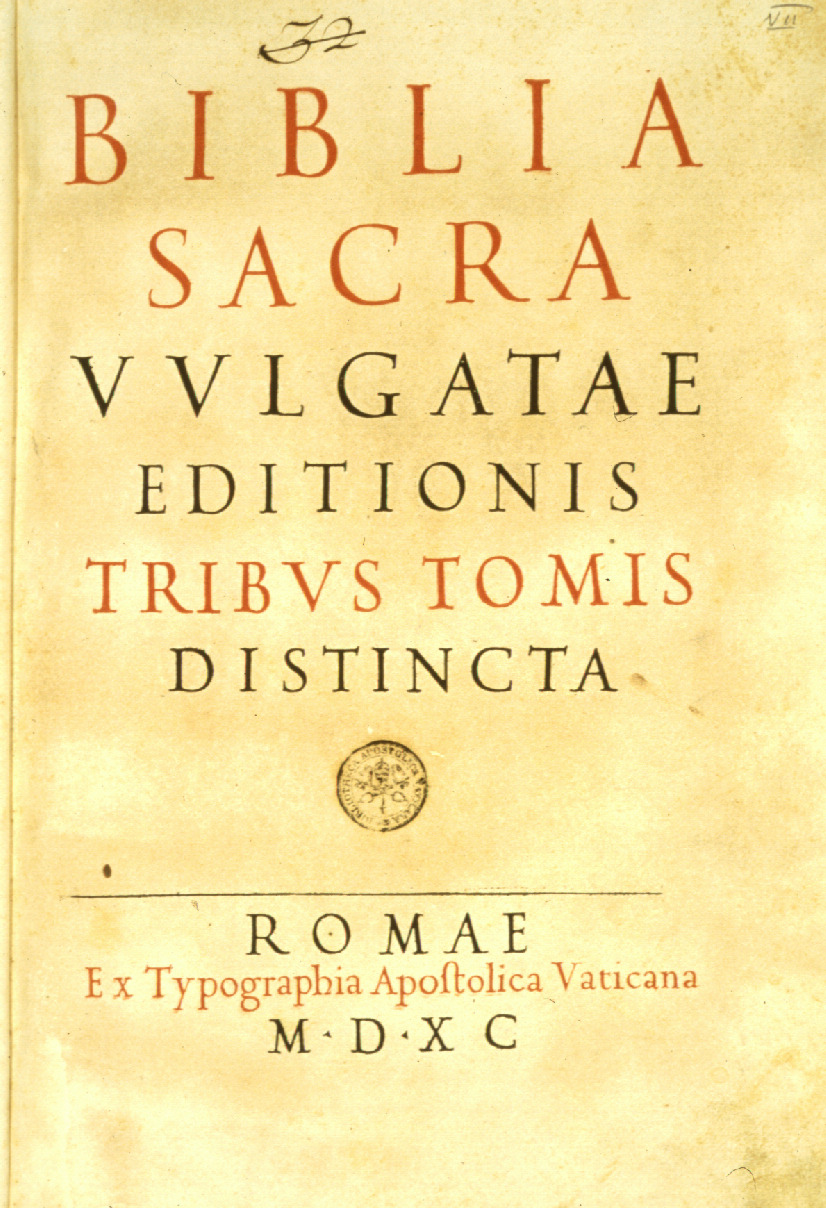
After Trent Pope Sixtus (1585-90) created a Vulgate as the "official version" called the Sistine Vulgate, it was widely rejected. His successor Pope Clement VIII (1592-1605) created a minor revision addressing the complaints people had with the Sistine Vulgate and created the Clementine Vulgate which was universally accepted Vulgate from 1598-1979.

One common complaint I hear all the time and mentioned by Mr. Norris in his book is that we who believe there is only one Bible that is the pure, complete, and infallible word of God is that this is similar to the Catholic view concerning the Latin Vulgate.
Allow me to briefly address this accusation. The Council of Trent met from 1545 to 1563 in an effort to rally the forces of the Catholic church to combat what they considered the heresies of the Reformation and their Bibles.

The Catholic church decided that the Latin Vulgate should be their official bible and none other allowed. Problem was, even when they made this decree, there was no settled text or single Latin Vulgate considered authoritative. Their own language reveals this. Here is a quote taken from the Council of Trent's own decree issued in 1556 "Moreover, the same sacred and holy Synod,--considering that no small utility may accrue to the Church of God, IF IT BE MADE KNOWN WHICH OUT OF ALL THE LATIN EDITIONS, NOW IN CIRCULATION, of the sacred books, IS TO BE HELD AS AUTHENTIC,--ordains and declares, that the said old and vulgate edition, which, by the lengthened usage of so many years, has been approved of in the Church, be, in public lectures, disputations, sermons and expositions, held as authentic; and that no one is to dare, or presume to reject it under any pretext whatever. Furthermore, in order to restrain petulant spirits, It decrees, that no one, relying on his own skill, shall,--in matters of faith, and of morals pertaining to the edification of Christian doctrine, --wresting the sacred Scripture to his own senses, presume to interpret the said sacred Scripture contrary to that sense which holy mother Church,--whose it is to judge of the true sense and interpretation of the holy Scriptures,--hath held and doth hold." (end of quote)

A papal commission worked for many years after the Council of Trent, but was not able to produce an authentic edition. Pope Sixtus took matters into his own hands and produced his own revision, which appeared in May 1590. The Sixtus Latin Vulgate was full of errors, "some two thousand of them introduced by the Pope himself" (Janus, The Pope and the Council, Boston: Roberts Brothers, 1870). In September 1590 the College of Cardinals stopped all sales and bought up and destroyed as many copies as possible. Another edition finally appeared in 1592, which became the official Bible of the Roman Catholic Church (H. Wheeler Robinson, Ancient and English Versions of the Bible, Oxford: Clarendon Press, 1940, p. 120).

There are several fundamental differences and similarities to what the Catholic church tried to do with the Latin Vulgate, and the Bible version issue as it stands today.

The Differences:

First - the Catholic church wanted to place the words of God in a DEAD LANGUAGE which most people could not read and they forbad translations into other languages to be made. Thus they were keeping the words of God out of the hands of the common people and making them dependent on a special class of priests to interpret it for them.

Second - This official bible had no settlted text at the time the decrees were made. There were several competing Latin Vulgate bibles circulating at the time and one was not settled upon till 36 years later.

Third - This official bible was produced by an apostate church which denied salvation by faith alone in the finished work of Christ; denied salvation outside of this Catholic church system, and established a special group of priests who alone could interpret the Scriptures for us.

The King James Bible believer does not deny salvation to anyone who happens to read any Bible version other than the KJB. We approve of the translation of Scripture into other languages, desiring only that they attempt to follow the same underlying Hebrew and Greek texts, and the meaning as found in the King James Bible, as best as possible and not omit some 3000 to 4000 words, including 17 to 24 whole verses, from the New Testament as do versions such as the RSV, NASB, NIV, ESV. All these modern versions just mentioned also depart frequently from the Hebrew texts that underlie our King James Bible.

The Similarities:

First - the modern versionist has no settled text, just as the Council of Trent did not when they made their decree. The Greek text that underlies the modern versions such as the NIV, NASB, ESV, ISV, Holman Standard, etc. is in a continual state of flux and constant change. Every new version changes the actual TEXT, as well as the meanings of other verses, from the previous versions.

Second - The modern versionist would likewise place the Final Authority in the hands of a special group of religious leaders - the scholars. They affirm that no translation is the inspired words of God and that we must "go to the original Hebrew and Greek texts" (which don't even exist). Thus they remove the common people from the words of God by appealing to DEAD LANGUAGES as their final authority.

However, it is painfully obvious that these same scholars cannot agree among themselves WHICH Hebrew and WHICH Greek texts are authentic. This is similar to the case of the conflicting Latin Vulgate versions that were circulating at the time of the decree of the Council of Trent in 1556.

Third - The everchanging Greek text now used to translate most modern versions is compiled by men who themselves are apostates who believe no Bible is inspired and much of what we do have is "ancient folktale, popular legend, and traditions penned by unknown authors". (See Bruce Metzger, Cardinal Carlo Martini, and the other liberal editors of the UBS Greek text.)

Satan counterfeits every spiritual truth. If there really is One true Holy Bible, then the devil will say there is only one true bible and it is the Catholic bible. Guess which bibles today generally OMIT ALL THE SAME VERSES from the New Testament as do modern Catholic bible versions. You got it.
___

The new versions like the NIV, NASB, ESV, and Holman Standard all reject the Traditional Greek Text, and instead rely primarily on two very corrupt Greek manuscripts called Sinaiticus and Vaticanus. These so called "oldest and best" manuscripts also form the basis of all Catholic versions as well as the Jehovah Witness version.

There is no question the JW were one of the earliest major groups to adopt the Westcott-Hort. The 19th century Arianist movement were big fans of Westcott-Hort. But what about Catholic? The Nova Vulgata (new Vulgate 1969+) which is the official Catholic Bible is based on texts older than the Clementine Vulgate but doesn't rely on the Sinaiticus and Vaticanus but mainly fragmentary latin manuscripts and quotes scattered throughout writings of the 5th and 6th centuries. Do you mean the NJB and the NAB which are based on the NA27 Greek just like the majority of Protestant bibles.

I have four modern day Catholic bibles, 3 in English and one in Spanish. The NAB St. Joseph, the Jerusalem bible, and the New Jerusalem. In Spanish I have the 1983 Versión Popular - all are primarily WH texts. The older Douay was actually much better since it did not always follow Vaticanus/Sinaiticus. Anything based on the Nestle Aland critical texts is wrong and a fake bible.

JB and NJB -- Have an Impimatur, which means they are free from major doctrinal error. Popular translations with Catholics
NAB -- translated by the CCD, most commonly used in Catholic churches
Nova Vulgata -- Published by the Holy See. This is the "official bible". And it is not based on the NA27.


The Nova Vulgata omits Matthew 6:13 For thine is the kingdom, and the power, and the glory, for ever. Amen" just like the NA27, as well as all of Matthew 17:21; 18:11 and 23:14, just like the NA 27 and the English versions based on it. Coincidence? nI address this issue here:


Prior to 1611 " good educated guess for the New Testament words would be that God preserved them in the Old Latin Bibles, and then in the Waldensian latinized Bibles till the time of the Reformation.

This is interesting. I know you are guessing and I want to get specific. If ultimately it ends here then OK but this I would love to vet.

Yes, that is an educated guess, the Old Latin. However as I go on to say, if push comes to shove, then I go with there was no perfect Bible anywhere until God brought forth the KJB.

Vetus Latina (old Latin) there are multiple versions of the various books. There isn't a "Vetus Latina bible" a modern equivalent would be something like "translations by evangelical Americans". So if I'm a Christian in 220 and I'm looking for God's real version of Luke (lots of different Latin versions) what am I going to do?

As for the Waldensian. Are you advocating something like Christian's view?

Basically another rabbit trail, but I understand why you ask the question. It's because of your naturalistic outlook on the bible. Some date the Waldensians back to 120 AD and the had a lot of things right. The KJB translators consulted several Waldensian influenced bibles.

What is the status of the Latin Vulgate?

There are several Vulgates plus the Old Latin witnesses, which often differ among themselves. In their totality they contain much of God’s words but are not the complete and inspired words of God.

OK if their status differs, lets break them down status wise.
Nova Vulgata, Stuttgart, Clementine, Sistine, Amiatinus (Pope's personal vulgate), etc... How are they different and why?


Pointless rabbit trail. They do differ textually from one another. That is obvious. They are not the true bible.

What is the status of the LXX?

No such thing ever existed as an authoritative, Pre-Christian LXX that was used or quoted by any apostle nor the Lord Jesus Christ. This is a very complicated subject and I have written on it pretty extensively. I believe the KJB translators were wrong in their assessment of the so called Greek Septuagint. The real truth is that many N.T. sayings, phrases or whole verses were placed in the various LXX versions AFTER the N.T. was complete. Agreeing with this idea are people like Jerome, John Gill, and John Owen.

You can begin the study of the other side of the story here:

Friday, July 31, 2009

King James Onlyism Interview (Initial points, part 2)


This is a continuation of the King James Only series. Part1 links here
Questions will be in purple answers in black. Headings in red, explanatory comments by CD-HOST in green
____________

What is the King James Bible

What do we mean by King James Bible? Does the inerrant part of the bible include bracketing information like chapter titles and conclusions. For example the ending in 1611 for Hebrews, "Written to the Hebrewes, from Italy, by Timothie" is this inerrant, that is can I be sure that Timothy wrote Hebrews and did so from Italy?

By the King James Bible I simply mean the actual TEXT of the King James Bible is the complete, inspired, preserved, infallible and 100% true words of God. I do not defend the Prefatory remarks, though some of them are quite good.

What is the status of translator notes and other more literal readings within the KJV?

Sometimes they are of value and other times not. They are not inspired. The so called “more literal readings” are not always the best means of communicating or translating God’s words. ALL modern versions like the NASB, NIV, RSV, ESV, NKJV are far less literal than is the King James Bible, so it is a little silly to bring this up as some kind of objection to the accuracy or inerrancy of the King James Bible. It is the TEXT alone that we defend as the inspired and inerrant words of God. We believe God Himself guided the translators as to the correct TEXTS and meanings of those texts.

Is there a single King James which is inspired and inerrant or are there multiple ones? If a single 1611, 1769; Oxford, cambridge; with Apocrypha (pre 1826) or without (post 1826) etc...

Here you are confusing two very different things. One is the alleged “various revisions of the King James Bible” with “printing errors” and stylistic changes. There has never been a revision of the King James Bible. The real issue of the Printing Errors Ploy that the “No bible is the inerrant words of God” side brings up. You will find these objections addressed in the following article.

What is the status of the King James version Apocrypha?

Apocrypha never was the inspired words of God. The King James translators themselves did not consider them inspired. It is more than a little inconsistent and hypocritical for the modern versionists to even bring up this criticism. Why? See the following article about Why the 1611 KJB and other bible versions included the Apocrypha (article with additional information)

What is that status of the various Greek and Hebrew manuscripts (like the Bomberg Hebrew, Stephanus Textus Receptus...)note for reader the Bomberg, Stephanus, Clementine Vulgate and LXX were the main source text.

God guided the KJB translators to the best texts among all the variant readings out there. The KJB is the sovereign work of God in history.


Translation issues

When you say, “The Old Testament is based solely on the Hebrew Masoretic texts, in contrast to the NASB, NIV, ESV, Holman CSB and other modern versions that frequently reject the Hebrew readings. “ What exactly do you mean that the NASB is less literal then the KJV? It would seem to me that something like Jay Green's (MT/TR interlinear) is much more literal than the KJV on the same underlying texts?

I mean exactly what I said. The KJB is far more literal than the NASB and the others I mentioned, but again, a strict literalness is not always a good thing.

OK let example on that. Take a classic example like Isaiah 7:14. The Masoretic Text does not say "virgin" here, that comes from Matthew and the LXX. Why is it acceptable for the KJV to diverge from the Hebrew here?

Again, I disagree. Translating that Hebrew word as virgin is perfectly acceptable and even many Jewish translations have done so too.

I'm not familiar with any. I presume you meant in English and not Christian/Jewish. Can you name an Jewish translation which uses virgin?

These 3 online Jewish translations all have "virgin" in Isaiah 7:14 and the clincher is the N.T. where the verse is quoted in Matthew 1:23 "Behold a virgin shall be with child, and shall bring forth a son, and they shall call his name Emmanuel, which being interpreted is, God with us."

Here is one online - BayithaMashiyach -- NASB with name changes
And another Jewish translation online - Word of Yah -- ASV with name changes
And another Jewish translation - House of Yahshua -- KJV with name changes

The word almah is only used 7 times in the Old Testament. It is translated 4 times as virgin in the KJB and 3 as maid. A maid or maiden was a young, unmarried virgin. See Exodus 2:8. The Hebrew Publishing Company 1936 Jewish translation has a "young woman" (who in Jewish culture were assumed to be virgins), but has translated the same word as "virgin" in Genesis 24:43 and in Song of Solomon 1:3 and 6:8.

I have one more question. The KJV was noted for replacing places in the Hebrew that are repetitive with variation. In other words the KJV translators altered structure of the Hebrew. You have been attacking modern versions for being too lose with the Hebrew. How would you respond?

Give some examples, and I will show you that the Jewish translators themselves do this very thing. However the nasb, niv, rsv, esv, Holman stuff clearly reject entire Hebrew readings. The KJB does not.

Genesis 32:20 and the repetition of face. The KJV notes themselves they are dropping the last face and breaking with the Hebrew; and while they don't say why it is pretty clear that you are allowed more repetition in Hebrew than in English.
20And say ye moreover, Behold, thy servant Jacob is behind us. For he said, I will appease him with the present that goeth before me, and afterward I will see his face; peradventure he will accept of me*.
* = of me: Heb. my face


The literal "face" is redundant in this case since it has already been mentioned. ALL bible versions and translations do stuff like this. Even 3 Jewish versions like the Jewish Pub. Society 1917, the Complete Jewish Bible, and the Hebrew Pub. Company 1936 all read exactly like the KJB here. So too do the RV, ASV, NASB, NIV, RSV, NRSV, ESV, NKJV and Holman.

Arguments for the uniqueness of the KJV

When you say , “So is it OK for you to believe that there was no perfect Bible before 1611 but not for me to agree with you?” What's outlandish is the claim of particularity. That this particular bible is in some way so far uniquely better.


Well, it may well seem outlandish to you because you do not believe such a things exists as a complete, inspired and infallible Bible. To me it makes perfect sense since I understand God's words as teaching that He would preserve His words in a tangible Book. I believe in this Book; you do not.

The English bibles before the KJB were generally quite good. They were not the perfect words of God, but quite good. You do not need to have a complete and perfect bible to get saved or to learn many good things about God, Christ and the history of redemption. Those bibles contained much of God's words, but they were not perfect.

Does that apply to today's bibles? Are they pretty good but not ideal?

Yes, basically, but I believe the modern versions like the NASB, RSV, ESV, Holman and NKJV are actually getting worse in many ways rather than better than even versions like Coverdale, Tyndale, Geneva and Bishops' bibles.

Do you believe there were supernatural resources. If so what was the mechanism and purpose of their interaction?

Other than the hand of the sovereign God, No.

So to make it clear. Do you believe:
1) The translators for the KJV had assistance from God in their selection of alternatives?
2) The translators for the KJV had actual revelation?


Yes, God guided their selections. That is what I believe. God led them to both the correct texts and the correct translations of those texts. That is what I believe. You do not have to accept this.

Referring to the thesis, "The King James Bible as being the only complete, inspired and inerrant words of God in Bible form", what we do we mean exactly by "only"?

Good question. We do not mean that ONLY those who read the King James Bible are saved. God can and does use any bible version out there no matter how poorly translated or no matter how much is missing. The gospel of salvation through the shed blood of the Lamb of God is still found in them all and God can use them to bring His people to faith in the Saviour. God can use a simple bible tract, a good hymn, the NIV, NASB, RSV, any Catholic version, the Jehovah Witness version or the Cabbage Patch version is He wishes. The gospel is still found in them all. However that does not make them the complete and inerrant words of God. They are not.

You said in your essay, "The King James Bible alone is without proven error, and this in spite of intense opposition and criticism from the Bible correctors and modern scholarship". We may have to swing back to this but would constitute a proven error? As far as I can tell you are rejecting the authority of the Greek over the KJV. Even in theory how would one prove an error?

Some errors are easy to prove. Can God be deceived? The nasb says He was. That is an error.

You had written in your essay, "The King James Bible is always a true witness and never lies or perverts sound doctrine. This is in contrast to all modern English versions that do pervert sound doctrine in numerous verses and prove themselves to be false witnesses to the truth of God." I don't quite follow how you would know this one way or the other. You believe in scripture as the source of doctrine. So "sound doctrine" comes from scripture. In particular base text plus interpretation yields a collection of doctrines. Obviously a different base text could result in a collection of different doctrine, but I'm not sure how you can call one sound and the other unsound. To determine soundness you would need a judge over and above the base text (the bible). What is that judge?

I.E. let say I have
Bible 1 which leads to the doctrine that salvation is from eating duck food
Bible 2 which leads to the doctrine that salvation is from playing jacks

How do I determine whether bible 1 or bible 2 is more sound?

False doctrine is determined by the consistent teaching of the Bible itself. If something clearly contradicts other parts of the Bible, then it is false. Did you read the article? I gave several examples (link to article mentioned)

For an article showing that the true Historic Confessional position about the inerrancy of the Bible supports the King James Bible view, rather than the recent position of "the originals only". See: link

The confessions relate directly to the Bible and the words of God; not doctrines of the Catholic church.

Yes but why not? Why couldn't you apply the same spirit of argument more broadly?

You are the one trying to come up with an argument here that has nothing to do with what I was talking about. I'm strictly talking about what the words of God are, not what they might mean as interpreted by any number of different groups or organizations.

God has promised to preserve His wordS IN A BOOK here on this earth till heaven and earth pass away. He either did this and we can know where they are found today, or He lied and He lost some of them, and we can never be sure if what we are reading are the true words of God or not.

___

Link to part3 of this series. 

Monday, July 27, 2009

King James Onlyism Interview (Introduction, part 1)

I have been a discussion with Will Kinney on King James Onlyism. Will runs a site, Brandplucked. I wasn't sure where this interview would end up going. It turned out there were 3 major areas of discussion:

1) The nature and definition of the bible
2) particular properties of the KJV
3) Why the vulgate doesn't meat the criteria for a complete inerrant bible and a historical timeline.


For those looking for more on this topic:

And with that I'll let Will Kinney open with a long introduction. Everything below this line is his (original http://www.geocities.com/brandplucked/NoInerrant.html). Note everywhere he has a scriptural reference the mouse over will point to the NET, this is a blog wide setting I can't change for this series.
_____


"The Bible is not the inspired and inerrant word of God"

Most Christians today do NOT believe The Bible IS the inerrant and infallible word of God.

This statement may seem shocking at first, and many pastors and Christians will give the knee-jerk reaction saying that they do believe the Bible IS the infallible word of God. However, upon further examimation, it will soon be discovered that when they speak of an inerrant Bible, they are not referring to something that actually exists anywhere on this earth. They are talking about a mystical Bible that exists only in their imaginations; and each person's particular version differs from all the others.

As one liberal theologian pointed out in his review of Harold Lindsell’s, The Battle for the Bible, the only real difference between the conservative and liberal positions on the Bible is that the conservatives say the Bible USED TO BE inspired and inerrant, whereas the liberal says it NEVER WAS inspired or inerrant. BOTH positions agree that the Bible IS NOT NOW inspired or inerrant.

As brother Daryl Coats so aptly says: "If the Bible was inspired only in the original manuscripts, no one in the entire history of the world has ever had an inspired Bible. The original autographs of Job and the books of Moses had disappeared more than a thousand years before the first book of the New Testament was written, so no one has ever owned a complete Bible made up of the “divine originals.” Nor, has anyone ever owned a complete New Testament made up of “inspired originals”, because the originals were distributed among more than a dozen individuals and local churches."

God said: "Behold, the days come, saith the Lord GOD, that I will send a famine in the land, not a famine of bread, nor a thirst for water, but of hearing the words of the LORD." Amos 8:11

The Lord Jesus Christ also stated in Luke 18:8 "Nevertheless, when the Son of man cometh, shall he find faith on the earth?"

The apostle Paul wrote concerning the coming of the Lord Jesus Christ and our gathering together unto Him: "Let no man deceive you by any means: for that day shall not come, EXCEPT THERE COME A FALLING AWAY FIRST..." 2 Thessalonians 2:3

The number of professing Christians who do not believe in a "hold it in your hands and read" type of inspired Bible has steadily increased over the years since the flood of multiple-choice, conflicting and contradictory modern bible versions began to appear about 100 years ago.

The following testimonies about the character of Evangelicalism today were made by key Evangelical leaders. The irony is that these same men are part of the problem they lament. Each of these men has been guilty of endorsing modern bible versions.

"MORE AND MORE ORGANIZATIONS AND INDIVIDUALS HISTORICALLY COMMITTED TO AN INFALLIBLE SCRIPTURE HAVE BEEN EMBRACING AND PROPAGATING THE VIEW THAT THE BIBLE HAS ERRORS IN IT. This movement away from the historic standpoint has been most noticeable among those often labeled neo-evangelicals. This change of position with respect to the infallibility of the Bible is widespread and has occurred in evangelical denominations, Christian colleges, theological seminaries, publishing houses, and learned societies" (Harold Lindsell, former vice-president and professor Fuller Theological Seminary and Editor Emeritus of Christianity Today, The Battle for the Bible, 1976, p. 20).

"WITHIN EVANGELICALISM THERE ARE A GROWING NUMBER WHO ARE MODIFYING THEIR VIEWS ON THE INERRANCY OF THE BIBLE SO THAT THE FULL AUTHORITY OF SCRIPTURE IS COMPLETELY UNDERCUT. But is happening in very subtle ways. Like the snow lying side-by-side on the ridge, the new views on biblical authority often seem at first glance not to be very far from what evangelicals, until just recently, have always believed. But also, like the snow lying side-by-side on the ridge, the new views when followed consistently end up a thousand miles apart. What may seem like a minor difference at first, in the end makes all the difference in the world ... compromising the full authority of Scripture eventually affects what it means to be a Christian theologically and how we live in the full spectrum of human life" (Francis Schaeffer, The Great Evangelical Disaster, 1983, p. 44).

The neutral method of Bible study leads to skepticism concerning the New Testament text. This was true long before the days of Westcott and Hort. As early is 1771 Griesbach wrote, "The New Testament abounds in more losses, additions, and interpolations, purposely introduced then any other book." Griesbach's outlook was shared by J. L. Hug, who in 1808 advanced the theory that in the second century the New Testament text had become deeply degenerate and corrupt and that all extant New Testament texts were but editorial revisions of this corrupted text.

As early as 1908 Rendel Harris declared that the New Testament text had not at all been settled but was "more than ever, and perhaps finally, unsettled." Two years later Conybeare gave it as his opinion that "the ultimate (New Testament) text, if there ever was one that deserves to be so called, is for ever irrecoverable."

H. Greeven (1960) also has acknowledged the uncertainty of the neutral method of New Testament textual criticism. "In general," he says, "the whole thing is limited to probability judgments; the original text of the New Testament, according to its nature, must be and remains a hypothesis."

Robert M. Grant (1963) adopts a still more despairing attitude. "The primary goal of New Testament textual study," he tells us, "remains the recovery of what the New Testament writers wrote. We have already suggested that to achieve this goal is well-nigh impossible." Grant also says: "It is generally recognized that the original text of the Bible cannot be recovered."

"...every textual critic knows that this similarity of text indicates, rather, that we have made little progress in textual theory since Westcott-Hort; that WE SIMPLY DO NOT KNOW HOW TO MAKE A DEFINITIVE DETERMINATION AS TO WHAT THE BEST TEXT IS; that we do not have a clear picture of the transmission and alteration of the text in the first few centuries; and, accordingly, that the Westcott-Hort kind of text has maintained its dominant position largely by default" (Eldon Epp, "The Twentieth-Century Interlude in NT Textual Criticism," Studies in the Theory and Method of New Testament Textual Criticism, p. 87).

"As New Testament textual criticism moves into the twenty-first century, it must shed whatever remains of its innocence, for nothing is simple anymore. Modernity may have led many to assume that a straightforward goal of reaching a single original text of the New Testament--or even a text as close as possible to that original--was achievable. Now, however, REALITY AND MATURITY REQUIRE THAT TEXTUAL CRITICISM FACE UNSETTLING FACTS, CHIEF AMONG THEM THAT THE TERM 'ORIGINAL' HAS EXPLODED INTO A COMPLEX AND HIGHLY UNMANAGEABLE MULTIVALENT ENTITY. Whatever tidy boundaries textual criticism may have presumed in the past have now been shattered, and its parameters have moved markedly not only to the rear and toward the front, but also sideways, as fresh dimensions of originality emerge from behind the variant readings and from other manuscript phenomena" (E. Jay Epps, "The Multivalence of the Term 'Original Text' In New Testament Textual Criticism," Harvard Theological Review, 1999, Vol. 92, No. 3, pp. 245-281; this article is based on a paper presented at the New Testament Textual Criticism Section, Society of Biblical Literature Annual Meeting, Orlando, Florida, November 1998).

George Barna, president of Barna Research Group, reported that a study exploring the religious beliefs of the 12 largest denominations in America highlights the downward theological drift that has taken place in Christian churches in recent years. The study found that an alarmingly high number of church members have beliefs that fall far short of orthodox Christianity. ONLY 41 PERCENT OF ALL ADULTS SURVEYED BELIEVED IN THE TOTAL ACCURACY OF THE BIBLE. Only 40 percent believed Christ was sinless, and only 27 percent believed Satan to be real.

Of the Baptists surveyed 57 percent said they believed that works are necessary in order to be saved, 45 percent believed Jesus was not sinless, 44 percent did not believe that the Bible is totally accurate, and 66 percent did not believe Satan to be a real being. Barna said, "The Christian body in America is immersed in a crisis of biblical illiteracy."

Pastor Michael Youseff's Message on His "Leading The Way" program. The title of todays message was "The Bible, The World's Most Relevant Book - Part 2. In his message he gave statistics of a poll that was conducted. Here is what the poll revealed:

85% of students at America's largest Evangelical Seminary don't believe in the inerrancy of Scripture.

74% of the Clergy in America no longer believe in the inerrancy of Scripture.

What Christians really believe

A book by George A. Marsden, "Reforming Fundamentalism" quotes a survey of student belief at one of the largest Evangelical seminaries in the US. The poll indicated that 85% of the students "do not believe in the inerrancy of Scripture."

This book also lists the results of a poll conducted by Jeffery Hadden in 1987 of 10,000 American clergy. They were asked whether they believed that the Scriptures are the inspired and inerrant Word of God in faith, history, and secular matters:

95% of Episcopalians,

87% of Methodists,

82% of Presbyterians,

77% of American Lutherans, and

67% of American Baptists said "No."

The Barna Research Group reported in 1996 that among American adults generally: 58% believe that the Bible is "totally accurate in all its teachings"; 45% believe that the Bible is "absolutely accurate and everything in it can be taken literally."

"Support dropped between that poll and another taken in 2001. Barna reported in 2001 that: 41% of adults strongly agrees that the Bible is totally accurate in all that it teaches."

"Seminary students, future pastors and leaders in the church, show very little support for the inerrancy of the Bible position. What does that foretell about the future of the church? Undoubtedly, just as the poll results show in the 1996 - 2001 time frame, THE NUMBER OF PEOPLE BELIEVING THE BIBLE IS INERRANT WILL DROP."

No Absolute Truth

The explosion of modern versions has encouraged the student to pick and choose his own preferred readings and has created a tendency to treat every Bible lightly and to look upon none as the final words of God.

Sam Kobia, Secretary, World Council of Churches, ENI 1-23-04:"Having a variety of translations available encourages the Bible to be read in a plural and ecumenical way. HAVING A VARIETY OF TRANSLATIONS AVAILABLE IS A PRECIOUS TOOL IN THE STRUGLE AGAINST RELIGIOUS FUNDAMENTALISM." (Caps are mine)

A popular New Age religious site that endorses all religions of the world is called Religious Tolerance. Org. http://www.religioustolerance.org

This site has some interesting comments regarding the doctrine of the inerrancy of the Bible. They ask: Does inerrancy really matter?

"From one standpoint, this doctrine is of great importance, because it determines, at a very fundamental level, how Christians approach Scripture."

"To most conservative theologians Biblical inerrancy and inspiration are fundamental doctrines. Unless the entire Bible is considered to be the authoritative word of God, then the whole foundation of their religious belief crumbles. If the Bible contains some errors, then conservative Christians feel that they would have no firm basis on which to base their doctrines, beliefs, morality and practices. The books of the Bible must be either inerrant, or be devoid of authority."

They continue: "To most liberal theologians, the Bible is not inerrant. They believe that its books were obviously written and edited by human authors: with limited scientific knowledge, who promoted their own specific belief systems, who attributed statements to God that are immoral by today's standards, who freely incorporated material from neighboring Pagan cultures, who freely disagreed with other Biblical authors." (Religious Tolerance.org)

What I personally found of great interest is the following comment in the same article. The people at Religious Tolerance noted: "Some Fundamentalist and other Evangelical Christians CONSIDER A PARTICULAR ENGLISH TRANSLATION TO BE INERRANT. THIS IS PARTICULARLY TRUE AMONG LAY MEMBERS IN THEIR BELIEFS ABOUT THE KING JAMES VERSION. But most conservatives believe that inerrancy only applies to the original, autograph copies of the various books of the Bible. None of the latter have survived to the present day. We only have access to a variety of manuscripts which are copies of copies of copies...An unknown number of errors are induced due to Accidental copying errors by ancient scribes or intentional changes and insertions into the text, made in order to match developing theology." (Religious Tolerance.org)

Most Christians who do not believe the King James Bible or any other version are now the inerrant, infallible, complete and pure words of God, define Inerrancy in the following manner: “When all the facts become known, they will demonstrate that the Bible IN ITS ORIGINAL AUTOGRAPHS and correctly interpreted is entirely true and never false in all it affirms, whether relative to doctrine or ethics or the social, physical or life sciences.” (P. D. Feinberg, s.v. “inerrancy, Evangelical Dictionary of Theology Inerrancy & the autographa.)

The usual tap dance performed by those who deny any Bible or any text in any language is now the inerrant, complete and infallible words of God is typified by the following quote: "Inerrancy applies to the autographa, not to copies or translations of Scripture. This qualification is made because we realize that errors have crept into the text during the transmission process. It is not an appeal to a “Bible which no one has ever seen or can see.” Such a charge fails to take into account the nature of textual criticism and the very high degree of certainty we possess concerning the original text of Scripture."

Well, this may sound very pious and good, but the undeniable fact is that this Christian scholar is talking about "a Bible no one has seen or can see".

As for this gentleman's "nature of textual criticism" is concerned, this so called "science" is a giant fraud and a pathetic joke played on the unsuspecting saints who might think these men actually know what they are doing. I have posted a series on the "science of textual criticism" that reveals the true nature of this hocus-pocus methodology of determining what God really said. You can see all parts of this study, starting with: http://www.geocities.com/brandplucked/science.html

Here are some facts taken directly from the Holy Bible. You do not need to be a scholar or seminary student to get a grasp of what the Bible says about itself. You either believe God or you don't.

The Bible believer first looks to God and His word to determine what the Book says about itself. The Bible cannot be clearer concerning it's preservation:

Psalm 19:7: "The law of the LORD is PERFECT, converting the soul: the testimony of the LORD is SURE, making wise the simple." The "law and testimony of the LORD" = His words.

Isaiah 40:8: "The grass withereth, the flower fadeth: but the word of our God shall stand for ever."

Psalm 12:6-7: "The words of the LORD are pure words: as silver tried in a furnace of earth, purified seven times. Thou shalt keep them, O LORD, thou shalt preserve them from this generation for ever."

Psalm 138:2: "I will worship toward thy holy temple, and praise thy name for thy lovingkindness and for thy truth: for thou hast magnified thy word above all thy name."

Psalm 100:5: "For the LORD is good; his mercy is everlasting; and his truth endureth to all generations."

Psalm 33:11: "The counsel of the LORD standeth for ever, the thoughts of his heart to all generations."

Psalm 119:152, 160: "Concerning thy testimonies, I have known of old that Thou hast founded them for ever. ... thy word is true from the beginning: and every one of thy righteous judgments endureth for ever."

Isaiah 59:21: "... My Spirit that is upon thee [Isaiah], and my words which I have put in thy mouth, shall not depart out of thy mouth, nor out of the mouth of thy seed, nor out of the mouth of thy seed's seed, saith the LORD, from henceforth and for ever."

Matthew 5:17-18: "Think not that I am come to destroy the law, or the prophets: I am not come to destroy, but to fulfil. For verily I say unto you, till heaven and earth pass, one jot or one tittle shall in no wise pass from the law, till all be fulfilled."

Matthew 24:35: "Heaven and earth shall pass away, but my words shall not pass away."

John 10:35: "... the Scripture cannot be broken."

God has promised to preserve His wordS IN A BOOK here on this earth till heaven and earth pass away. He either did this and we can know where they are found today, or He lied and He lost some of them, and we can never be sure if what we are reading are the true words of God or not.

God's words are in a BOOK. Consider the following verses: "Now go, write it before them in a table, and NOTE IT IN A BOOK, that it may be for the time to come FOR EVER AND EVER." Isaiah 30:8

"Seek ye out of THE BOOK of the LORD, and READ: no one of these shall fail...for my mouth it hath commanded..." Isaiah 34:16

"Then said I, Lo, I come: in the volume of THE BOOK it is written of me, I delight to do thy will, O my God: yea, thy law is within my heart." Psalm 40:7-8

"And if any man shall take away from THE WORDS OF THE BOOK of this prophecy, God shall take away his part out of the book of life, and out of the holy city, and from the things which are WRITTEN IN THIS BOOK." Revelation 22:19

I believe the King James Bible is the inspired, inerrant and complete words of God for the following reasons:

#1 The Old Testament is based solely on the Hebrew Masoretic texts, in contrast to the NASB, NIV, ESV, Holman CSB and other modern versions that frequently reject the Hebrew readings. The Old Testament oracles of God were committed to the Jews and not to the Syrians, the Greeks or the Latins. "What advantage then hath the Jew? or what profit is there of circumcision? Much every way: chiefly, because that unto them were committed the oracles of God." (Romans 3:1-2) The Lord Jesus Christ said not one jot or one tittle would pass from the law till all be fulfilled. - Matthew 5:18

Therefore any bible version like the NASB, RSV, ESV, NIV, NET, Holman Standard etc. that rejects these Hebrew texts automatically disqualifies itself from being the true words of the living God.

See my two articles on how the modern versions all reject the Hebrew texts.

http://www.geocities.com/brandplucked/NIVapos.html

http://www.geocities.com/brandplucked/NIVapos2.html

#2 The King James Bible alone is without proven error, and this in spite of intense opposition and criticism from the Bible correctors and modern scholarship.

"Seek ye out of THE BOOK of the LORD, and read: no one of these shall fail..." Isaiah 34:16.

#3 I believe in the Sovereignty and Providence of Almighty God. God knew beforehand how He would mightily use the King James Bible to become THE Bible of the English speaking people who would carry the gospel to the ends of the earth during the great modern missionary outreach from the late 1700's to the 1950's. The King James Bible was used as the basis for hundreds of foreign language translations, and English has become the first truly global language in history.

The indebtedness of the King James Bible translators to their predecessors is recognized most clearly in the Preface to the reader where they state in no uncertain terms: "Truly, good Christian reader, we never thought, from the beginning, that we should need to make a new translation, nor yet to make of a bad one a good one; but TO MAKE A GOOD ONE BETTER, or OUT OF MANY GOOD ONES ONE PRINCIPAL GOOD ONE, NOT JUSTLY TO BE EXCEPTED AGAINST that hath been our endeavour, that our mark."

The King James Translators also wrote: "Nothing is begun and perfected at the same time, and the later thoughts are the thoughts to be the wiser: so if we build upon their foundation that went before us, and being holpen by their labors, do endeavor to make better which they left so good...if they were alive would thank us...the same will shine as gold more brightly, being rubbed and polished."

See article Can a Translation Be Inspired? http://www.geocities.com/brandplucked/transinsp.html

#4 The King James Bible is always a true witness and never lies or perverts sound doctrine. This is in contrast to all modern English versions that do pervert sound doctrine in numerous verses and prove themselves to be false witnesses to the truth of God.

"Thy word is true from the beginning, and every one of thy righteous judgments endureth for ever." Psalm 119:160

"A faithful witness will not lie: but a false witness will utter lies." Proverbs 14:5

In contrast, all the modern versions like the NASB, NIV, NKJV, ESV contain proveable and serious doctrinal errors. See my article on No Doctrines Are Changed?:

http://www.geocities.com/brandplucked/nodoctrine.html

#5 At every opportunity the King James Bible exalts the Person of the Lord Jesus Christ to His rightful place as the sinless, eternally only begotten Son of God who is to be worshipped as being equal with God the Father. All modern versions debase and lower the Person of Christ in various ways.

"GOD was manifest in the flesh, justified in the Spirit, seen of angels, preached unto the Gentiles, believed on in the world, received up into glory." 1 Timothy 3:16. (compare this verse in the NIV, NASB, ESV, and Holman) See also John 3:13; Luke 23:42, and 1 Corinthians 15:47.

See article on The Only Begotten Son

http://www.geocities.com/brandplucked/begotnSon.html

#6 The explosion of modern versions has encouraged the student to pick and choose his own preferred readings and has created a tendency to treat every Bible lightly and to look upon none as the final words of God.

The Bible itself prophesies that in the last days many shall turn away their ears from hearing the truth and the falling away from the faith will occur. The Lord Jesus asks: "Nevertheless when the Son of man cometh, shall he find faith on the earth?" Luke 18:8

"Behold, the days come, saith the Lord GOD, that I will send a famine in the land, not a famine of bread, nor a thirst for water, but of hearing the words of the LORD." Amos 8:11

"Thus saith the LORD, Stand ye in the ways, and see, and ask for the old paths, where is the good way, and walk therein, and ye shall find rest for your souls. But they said, We will not walk therein." Jeremiah 6:16

The new versions like the NIV, NASB, ESV, and Holman Standard all reject the Traditional Greek Text, and instead rely primarily on two very corrupt Greek manuscripts called Sinaiticus and Vaticanus. These so called "oldest and best" manuscripts also form the basis of all Catholic versions as well as the Jehovah Witness version.

See my article that shows what these two false witnesses actually say:

http://www.geocities.com/brandplucked/oldbest.html

If you mistakenly think that all bibles are basically the same, I recommend you take a look at this site. It is in two parts, but very easy to read. It shows what is missing in most modern New Testaments.

http://av1611.com/kjbp/charts/themagicmarker.html

I recently came across a blog link where a man made an in depth study of what is missing from the NIV New Testament when compared to the Traditional Greek Text of the King James Bible. It appears to be quite complete. Take a look. You will probably be surprised at what you see. Here is the link: http://rockymoore.com/ChristianLife/archive/2006/04/12/694.aspx

For an article showing that the true Historic Confessional position about the inerrancy of the Bible supports the King James Bible view, rather than the recent position of "the originals only". See:

http://www.geocities.com/avdefense1611/historicposition.html

In and by His grace alone,

Will Kinney

"There is NO Inerrant Bible"

____

Friday, March 7, 2008

Interview with Xenos on membership and discipline policies


Since I have to be critical of churches all the time I’m delighted to be able to give a positive review of a church’s disciplinary processes. Xenos Christian Fellowship is located in Columbus Ohio near Ohio State. It was founded from an underground Christian newspaper and has exploded today into a congregation of around 5000 with 800 members that have received formal training and around 60 “home churches”. Home church leaders have had over 200 hours of classroom instruction, that is a level of training that would put them on par with most junior ministers in many denominations. This combination of a central organization with full minstrel training for “smaller churches” is the sort of behavior one usually sees in a denomination and not an individual church. So in effect Xenos is structured as a cross between a large church and a mini denomination, which is what originally led me to take an interest.

In addition to mixing the problems of a church and a denomination there are several other things that make Xenos a fascinating case study. The organization is almost entirely lay, and it is a point of pride how little a church of this size and accomplishment burns in terms of budget. Probably because the church is able to run so efficiently, they are able to afford having a young membership (young people can’t tithe very much) of first generation Christians. They mix a successful middle school and high school youth group with a successful college outreach. 75% of the church are people with no previous church background at all (a church of converts) and 15% transfers, and I would assume (though they don’t indicate) that the remaining 10% are children of current members. This is quite different from the 80-95%, transfer / children of current members commonly found in most evangelical churches. Xenos also practices church discipline frequently and effectively. They make it a core part of their leadership instruction (see links are below)

Finally, Xenos does not have a notion of formal membership, in the sense of a membership card or church covenant. Most church groups (as well as the law) differentiate quite heavily between attendance and membership. In fact leaders in the return to church discipline such as Mark Dever argue that a return to “biblical membership” is required for discipline. A great deal of the interview below will concern itself with the mechanics of how discipline is carried out without this clarity of formal membership.
It should be mentioned this membership informality includes no substantial differentiation between the baptized and the unbaptised, nor any sort of adult profession. This is genuinely unique for Xenos. And as my regular readers unique things generally are worrying signs. But again I’m hard pressed to see any intent to create an injustice in this system. It seems to be a reasonable attempt to address the community they are called to serve and I was unable to find any large gapping holes created.
I’m going to contact Mark Dever after this is posted and hopefully we can see a response. It appears we may have a counter case to his hypothesis.


Xenos provides information on their disciple:
Leadership and Authority discusses the scope of discipline at Xenos.

So to summarize the many ways Xenos is a truly interesting case study. In terms of discipline being effective they suffer from many of the worst possible problems:
• They don’t have a well defined membership in particular it is not a covenant church
• Their membership is young
• Their membership often did not grow up in conservative Christian homes
• Their membership does not have long term strong ties to Xenos
• They aren’t a member of a denomination
• They have no business ties linking their membership to the church

On the other hand they also have many of the problems of a denomination further compounded by the fact that:
• Home church leaders are inexperienced by pastoral standards and are often disciplining for the first time.
• The relationships with the home church are very close and personal.
• The home churches are informal and thus lack the sorts of institutional supports a denomination can often depend on

To investigate Xenos, I contacted a member of their staff Jessica Lowery to ask questions regarding the details of Xenos’ procedures on discipline. Dennis McCallum lead pastor and one of the founders of Xenos stepped forward and answered the questions. This discussion on discipline will be rather unique in that Pastor McCallum was being asked questions appropriate to a denominational leader (like cross restoration policy) as well general church level policies on discipline. Throughout the interview Pastor McCallum presented well thought out considered and rather humane answers to some of the most difficult question I could throw at him.

The original material is quite disorganized since there was multiple back and forth rounds. I have freely reorganized the order of questions and answers however I have quoted the answers exactly. Further, I have vetted these answers and corresponding questions by Pastor McCallum prior to publishing on the blog, to make sure these accurately reflect his views and even the phraseology he prefers. These statements should be seen as written responses to an “on the record” interview.

Statements of explanation will be in black, McCallum’s answers in blue and questions in green.

Membership:

You possibly killed a bunch of my questions, with the comment about "75% of our membership". It was my understanding that Xenos doesn't actually have a notion of membership; a person who regularly attends a home church is as much a member as they are ever going to be , is this correct? I'm going to assume in the below that this is the case (that is people are not "members"), but if there has been a change (or I am misunderstanding) then adjust responses according . I'll drop my disciplining a non member type questions till the next round however.

Yes. But we still call them members in the sense that they are members of the body of Christ, and have membered themselves with us. It's true that we do not have "membership". but we were interested in our composition after reading a Barna book, so we sent out surveys to home group leaders asking about the people who regularly attend their groups. that's how we got the composition information.

In terms of membership the question was how Xenos would handle borderline cases as it does not have a clear line between a member and a non-member. Below is a discussion of the basic policies. The discussion assumes you have read the links above, or are familiar with discipline. The focus, as mentioned above is on discipline in a non membership context. It consists of a series of closely related cases where I am attempting to draw fine distinctions by changing the parameters slightly. These sorts of questions are very difficult for church leadership since they are designed to lay on grey boundary between black and white. They are specific to the church, what is grey for one is not grey for another. They expose the underlying philosophy quite well and any contradictions in the policy. I think it’s worth commenting that Pastor McCallum and Xenos did an excellent job on these.

I'm not following. Do they at any point ask to be members or declare themselves to be members of Xenos? What can a member do that a non member cannot do? How does one become a member rather than just a regular attender...? Most churches would argue that a non member can't actually be excommunicated. I hope a hypothetical is OK, to sort of separate this out. I'm assuming unrepentant cocaine use is seen as an excommunicatable offensive (if not just change the underlying sin). Here are a bunch of situations all relatively similar. Can these people be excommunicated, excluded, would they be... (just trying to address the jurisdictional issues here so assume calls to repentance are fruitless if given):

First, we don’t use the term excommunication. It’s not biblical, but a Catholic concept having to do with not being allowed to take mass. We refer to removing people from fellowship, which seems to be the focus in the New Testament. But yes. Any professed believer who is attending and won’t leave off coke could be removed.

Alice has attended a small church 5 times and admits she regularly uses cocaine. She refuses to stop. Everyone considers her still visiting.

That would probably also be the case with us.

Beth only attends central meeting but others who attend know she regularly uses cocaine. She refuses to stop.

We usually don’t bother visitors at CT. Home church would be a different matter, but still it would take a longer period and more persuasion before formal discipline would come into play.

Cathy has attended a small church for 2 years, but claims she is not saved. Cathy has had an adult baptism. She regularly uses cocaine and has refused to stop.

This would probably be a case for intense counseling, but could eventually lead to more forceful confrontation.

Doris has attended a small church for 2 years has not had an adult baptism and claims she is not saved. She regularly...

Wouldn’t make any difference

Eleanor claims to be saved, has attended a small church for 2 years and has had an adult baptism but claims her membership is with her hometown church and she is just a affiliate member of your church. She regularly...

Not good enough. She would be given an ultimatum.

Francis claims to be saved, has attended a small church for 2 years and has not had an adult baptism but claims her membership is with her hometown church and she is just a affiliate member of your church. She regularly...

Same.

Evidence and standards for conviction

What is the standard of proof in terms of discipline? That is how much doubt can there be about the actual sin, before a person can be disciplined?

Most discipline cases involve someone who admits the sin. We would not feel comfortable disciplining someone if we doubted his or her guilt at all. Usually there are multiple incidents involved over a period of time. In some cases, someone else has ratted the person out. The fact that the person actually did the sin must be established, and I think it always is. I can’t think of a case where the person didn’t admit to the facts.

Let me clarify this a bit. Generally there are 3 types of disputes regarding guilt. Disputes of fact (which you addressed), disputes of law (is something a sin or not) and disputes of application (does this particular fact qualify under this particular law). Its interesting that you haven't had disputes of fact do you know why?

We have had disputes, but these would need to be resolved before any discipline meeting would occur. If the facts haven’t been established by admission or multiple witnesses, we would not move to formal discipline.

This one comes off sounding more like a criticism then a question. I apologize in advance for being unable to phrase it better. The standard for conviction seems rather low (simple majority, vote at the same meeting as the presentation of charges and evidence, informed that central leadership agrees with the discipline, non neutral venue, right of the leader to exclude members -- vote stacking, minority required to follow the majority, etc...), I think I could probably convict any attendee of Xenos of the Kennedy assassination with that trial procedure. Why has Xenos chosen such a low burden? Is the goal simply to block the most egregious abuses and otherwise give the home church leaders discretion, or is there some other reason?

Again, the question at the meeting is not whether the sin has occurred or whether the person did it. These are already admitted. The question is what is going to be the best response—counseling within the church, or exclusion. Majority is a standard established in 2 Cor. 2 as sufficient for making this decision.

Degree of Punishment:

There are claims that Xenos practices shunning which is unusual among Baptists outside the Mennonite tradition. On the website there does not appear to be clear guidelines for shunning. What is the reason behind this?

We don’t agree that we practice shunning. Shunning is usually interpreted to mean the person is left within the group, but nobody will talk to or fellowship with them. It also implies complete cutting off of communication and interaction. If the person is put out of fellowship, Paul says believers should not “eat with such a one” (1 Cor. 5:11ff) which we take to mean casual fellowship. We would not discourage meeting to talk, as advised in 2 Thess. 3, and remind people to “not treat him as an enemy, but to admonish him as a brother”

What is the extent of the disfellowshipping in practice?

Members are urged to not fellowship in a way that would bring comfort to the one under discipline, causing him/her to feel no reason to return to fellowship. This usually means not going out socially, etc. unless it is to discuss restoration. No rules about not doing business with the person. Also, families are usually considered an exception. We realize they will have social contact in the context of their family activities.

What if a member refuses to cut communication an excommunicated member?

Nothing we can do about that, but disapprove

Given that Ohio has case law is particularly hostile to shunning are there any additional legal protections you need to use when dealing with adults with their entire family and business associates in Xenos?

Breaking off casual fellowship is not an action taken by the church corporation, but by the individuals in a group as they feel led.

Discipline across churches

How much is each home church required to respect the decisions of the others. The website seems a bit back and forth on whether a person that is excluded from one home church are excluded from them all until such time as they are restored by the first. What if one of the home church leaders comes to believe another's discipline is genuinely in error? Can they cross restore even if the disciplining home church objects?

No, they cannot. They have to be resolved with the disciplining church. Only exception would be where discipline happened so long ago the original church is no longer intact.

Does Xenos respect the discipline of other churches? If so what churches qualify? (i.e. only Baptist, any protest, any Trinitarian Christian (Catholic excommunication), any Christian (LDS or JW churches), any discipline (a declaration of Cherum be upheld)).

In principle, yes, but only for evangelical Bible believing churches. Also their cause of discipline would have to be one we recognize as legitimate.

Does Xenos assume appellate jurisdiction (that is if the person argues they are wrongly excommunicated will Xenos investigate?)

Yes.

Will Xenos cross restore on repentance (i.e. allow a person who is genuinely repentant and willing to accept Xenos oversight that is however the excommunicated member of another church whose discipline Xenos respects to join a small group, without their original church restoring them).

We would call on them to seek resolution with the disciplining church. If we felt the church was being unreasonable, we would restore them.

Restoration

Can an excommunicated person be rebaptised at any point? That is if an excommunicated member believes they were not actually a Christian during the time of their excommunication can they request baptism or must they go through restoration? If they must go through restoration, do you recognize apostasy as separate from unrepentant sin or is apostasy just another sin?

They could be rebaptized if their testimony is that they were not a Christian at the time. Apostasy is just another sin.

Given that Xenos has a very young membership this one may not come up. How lasting are the effects of exclusion? For example, assume you discovered that a person who was a good quality member of a small church for 2 years had been disciplined 15 years earlier for a sin at the time (non reoccurring). Some church would excommunicate either on principle or for the deception. In others there would there be a general tendency towards restoration given that the underlying issue being so far in the past and that discipline in this case is likely to be harmful. Assuming you would go along with restoration what about things that might change within a decade. For example someone excluding as an undergraduate for persistent fornication that seeks to return during graduate school, now married to another woman.

We would respect someone's change in lifestyle as fruit in keeping with repentance; and show them grace.

Right to Appeal


One of the things I’m always writing about (example) is the importance of the appeals process for discipline. While its obvious there is quite a bit of oversight, I failed to note during the initial Q&A there was in fact an appeal. The correction is explained below.

There doesn't seem to be a genuine appeals process. Has this actually caused problems where people have continued to argue their innocence and church members (outside their home church) continue to believe it?

This doesn’t come up, because we would probably not exclude anyone who denied they have done wrong, unless there were eye-witnesses. The person does definitely have the right to appeal to the elders if they felt they were being falsely accused. We have never had a case like this. If they feel the discipline is wrong, they can ask for a grievance board to be convened. Current Ministry Teams at bottom. also mentioned in Leadership and Authority in the Church.

Have you had disciplinary schisms and if so what happened and how did you handle them?

If you mean schisms resulting from disagreement over discipline, yes. These have been small, and people usually either leave or get over it. We do not allow them to campaign in the church to overthrow what was decided.